
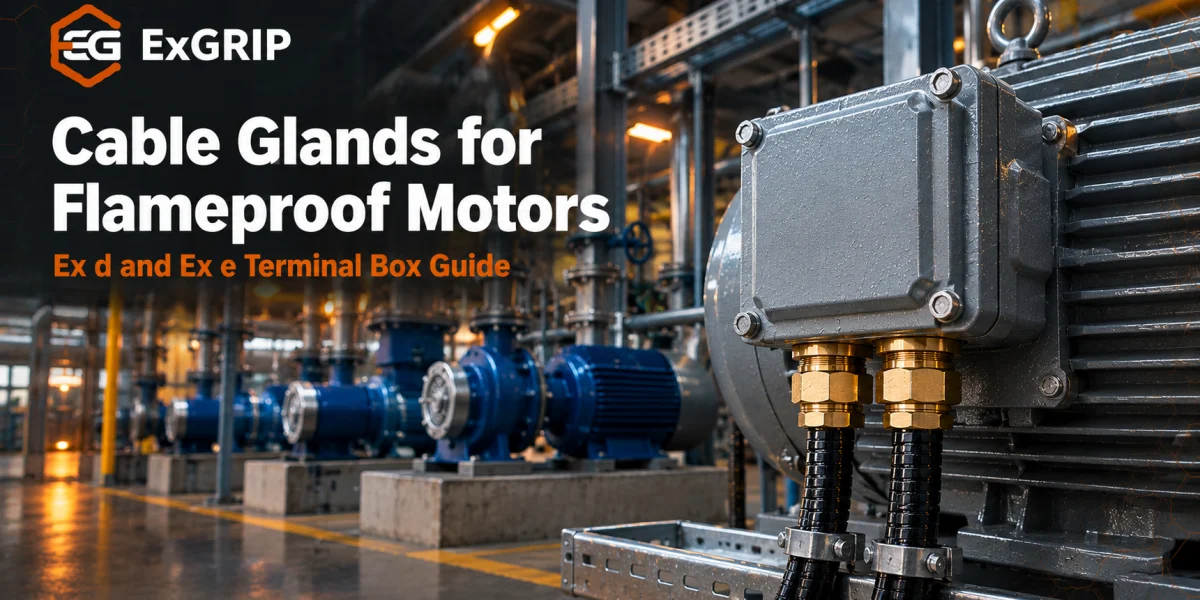
Choosing cable glands for flameproof motors starts with one detail most purchase orders miss: the gland has to match the motor’s terminal box, not the motor body. A flame proof motor can carry an Ex d terminal box, which needs a flameproof gland, or an Ex e terminal box, which needs an increased safety gland. Pick the wrong one and the motor fails inspection on a perfectly good gland.
This guide is for maintenance engineers, EPC electrical teams and buyers fitting cables to FLP pump, compressor and agitator motors. It covers how to read the motor terminal box, match the entry thread and cable, decide when a barrier gland is needed, and avoid the mistakes that come up on site. For background on the Ex d protection concept itself, see our guide to flameproof cable glands.
Does a Flameproof Motor Need a Flameproof Cable Gland?
Not always. “Flameproof” describes the motor’s main enclosure, where the windings and rotor sit. The terminal box is a separate compartment, and many flameproof motors are built with a terminal box of a different protection type. The flame proof motor classification on the nameplate tells you which one you have.
| Marking on the motor | Main enclosure | Terminal box | Cable gland required |
|---|---|---|---|
| Ex db | Flameproof | Flameproof (Ex d) | Ex d certified gland |
| Ex db eb | Flameproof | Increased safety (Ex e) | Ex e certified gland (Ex d also acceptable if certified for Ex e) |
| Ex eb | Increased safety | Increased safety (Ex e) | Ex e certified gland |
The rule behind the table is simple: a cable entry must be certified for the protection type of the enclosure it enters. In a Zone 1 area that means an Ex certified gland every time; our guide to Zone 1 and Zone 2 gland selection covers where each zone applies.
Ex d vs Ex e Motor Terminal Boxes
An electric motor terminal box looks much the same from outside whichever type it is. The difference is in how it stops ignition, and that decides what the gland must do.
Ex d Terminal Box
An Ex d box is built to contain an explosion inside it. Gas can enter, ignite on a terminal, and the box holds the pressure while its flame paths cool the escaping gas. The cable gland becomes part of that enclosure: its threads form a flame path and its inner seal must stop flame travelling out along the cable. ABB’s manual for its Ex d motors notes that only certain glands are approved for each terminal box, because the box’s free volume affects what entry is allowed.
Ex e Terminal Box
An Ex e box works the other way round. It is designed so that no spark or hot spot forms in the first place: secure terminals, set creepage and clearance distances, and a sealed enclosure, typically IP54 minimum. The gland here must hold that ingress protection and grip the cable firmly. It does not need to contain an explosion. This is why Ex db eb motors are popular: the flameproof main enclosure protects the rotating parts, while the terminal box is easier to wire.
| Point | Ex d terminal box | Ex e terminal box |
|---|---|---|
| Protection idea | Contains an internal explosion | Prevents sparks and hot spots |
| Gland’s job | Part of the flame path; seal stops flame along the cable | Keeps the IP rating; holds the cable |
| Barrier gland | Sometimes required (see below) | Not required for Ex e |
| Cover | Heavy bolted cover with machined joint | Lighter cover with gasket |
A gland that is only weatherproof fits neither box in a hazardous area. Our article on the difference between FLP and WP glands explains how to tell them apart.
What to Check on the Motor Before Ordering Glands?
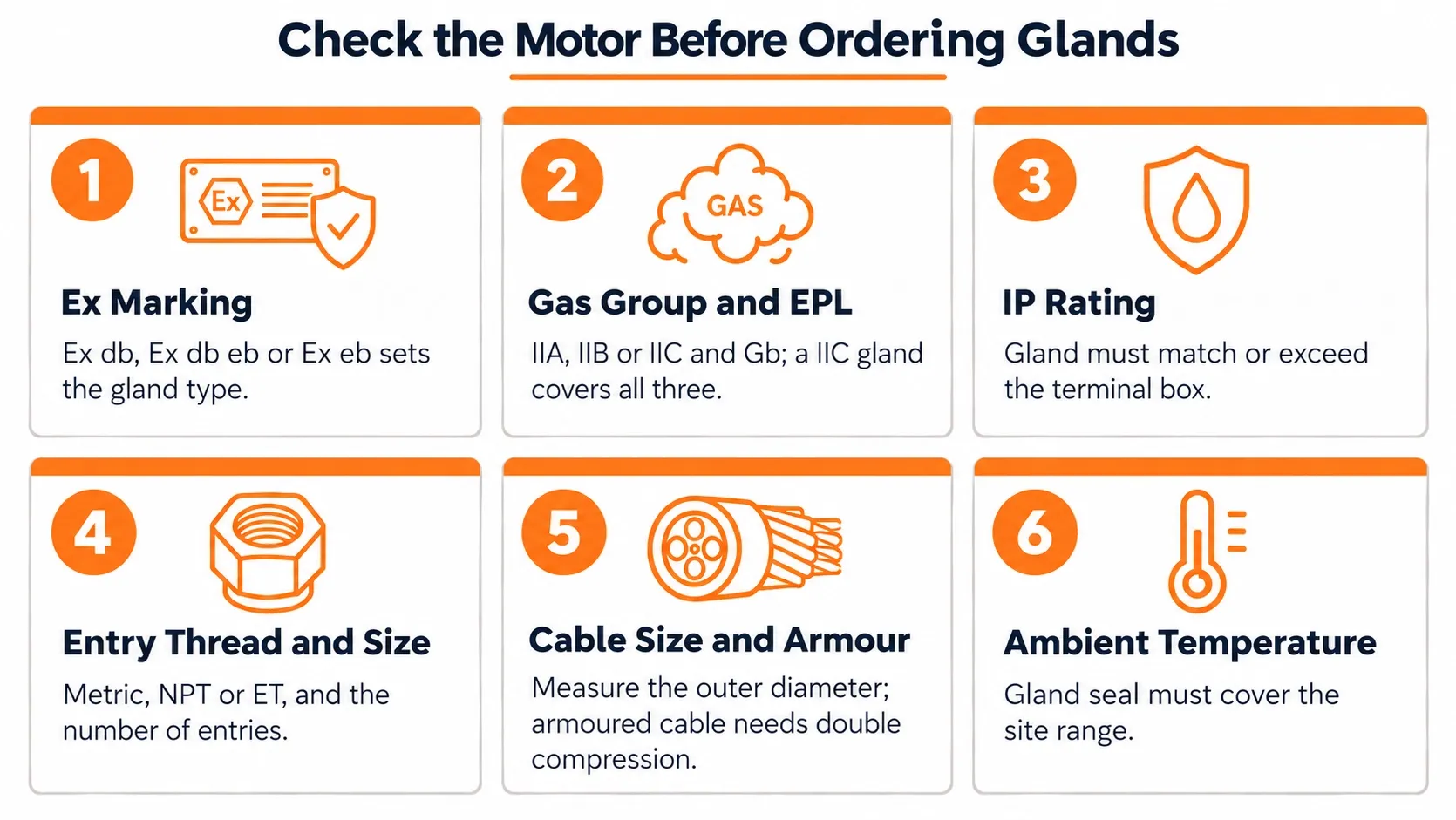
Most wrong gland orders come from ordering by cable size alone. Read these six points from the motor nameplate, terminal box and cable schedule first:
- Ex marking: Ex db, Ex db eb or Ex eb, which sets the gland’s protection type.
- Gas group and EPL: IIA, IIB or IIC, and Gb for Zone 1. The gland must be rated for the same group or higher; a IIC gland covers all three. See our note on equipment protection level (EPL).
- IP rating: flame proof motor IP ratings commonly run from IP55 to IP66. The gland must match or exceed the terminal box.
- Entry thread and size: metric (for example M25 or M32), NPT, or older ET threads, plus the number of entries.
- Cable outer diameter and armour: armoured cable needs a double compression gland; measure the cable outer diameter over the sheath, not from the catalogue.
- Ambient temperature: the gland seal must cover the site range. The motor’s temperature class is set by the motor, not the gland.
Entry Thread and Cable Size: Reducers and Adapters
Motor terminal boxes come with entry sizes chosen by the motor maker, and they do not always match the cable picked by the project. A terminal box may have an M32 entry while the cable on the schedule needs an M40 gland, or an older Indian motor may have ET threads where the site stocks metric glands.
| Situation | Fix |
|---|---|
| Gland thread larger than the entry | Certified increaser (adapter) from entry thread to gland thread |
| Gland thread smaller than the entry | Certified reducer |
| Entry thread type differs (ET, NPT, metric) | Certified thread adapter |
| Cable must come in from a tight side | Certified 90° adapter, or turn the terminal box |
On an Ex d box, the reducer or adapter is part of the flame path too. It must carry its own Ex certification, and it must screw in with at least 5 full threads or 8 mm of engagement, the figure CMP gives for flameproof entries. Our page on PESO certified reducers and stopping plugs covers the certification side, and our comparison of metric, NPT and PG threads explains how to identify the thread.
When a Motor Needs a Barrier Cable Gland?
A standard compression gland seals around the cable’s outer sheath. Gas can still travel through the gaps between the cores inside the cable. On an Ex d terminal box, a barrier gland stops that path by surrounding each core with a setting compound. IEC 60079-14 (edition 6, 2024) decides the need using three inputs: gas group, cable length and terminal box volume. A cable shorter than 3 m in IIC, or 0.5 m in other groups, needs a barrier device; for IIA and IIB, a box over 2,000 cm³ needs pressure-test evidence for the cable or a barrier gland.
Motors make this question practical, because terminal box volume grows with frame size. ABB publishes these free volumes for its Ex d motor terminal boxes:
| Frame size (ABB M2JA) | Terminal box free volume | Against the 2,000 cm³ limit |
|---|---|---|
| 80 to 132 | About 1.45 to 1.7 dm³ | Below |
| 160 to 180 | 3 dm³ | Above |
| 200 to 250 | 8.5 dm³ | Above |
| 280 to 315 | 15 dm³ | Above |
| 355 to 400 | 79 dm³ | Above |
These are one manufacturer’s figures; read your own motor’s manual or certificate. Vibration adds to the case: Cortem advises barrier glands on both ends where a vibrating machine has a cable under 3 m. For the full selection check on a specific motor, send our team the terminal box details.
Older IS 2148 Motors with Sealing Boxes
Many Indian plants still run motors built to IS 2148, often with a sealing box between the terminal box and the cable. Bharat Bijlee’s instructions for these motors call for the box to be filled with bituminous compound before connection, and make it mandatory for cables above 1 inch in Gas Groups IIA and IIB. Where there is no sealing box, the cable needs an FLP gland with statutory approval.
IP Rating, Unused Entries and Terminal Box Position
- IP rating: the gland’s IP rating must be at least the terminal box’s, says ABB’s manual. A gland rated IP66/IP68 suits any terminal box up to IP66. Our guide to IP ratings for cable glands explains the digits.
- Unused entries: close every spare entry with a stopping plug certified for the box’s protection type and IP rating. The plastic dust cap a motor ships with is not a stopping plug.
- Terminal box position: many terminal boxes turn in 90° steps so the entry faces the cable route. Bharat Bijlee warns against turning the bottom piece, which can damage the lead wires. Turn the box before deciding on a 90° adapter.
Vibration, Cable Support and Armour Earthing
A motor vibrates for its whole life, and the gland is the point where a heavy cable meets a moving machine. Clamp the cable close to the terminal box, as ABB’s manual asks, so the gland seal is not carrying the cable’s weight. On armoured cable, a double compression gland clamps the armour wires inside the gland body. That gives mechanical retention and an earth path from the armour to the motor frame. Add an earth tag where the plant’s earthing scheme needs a separate bonding conductor. Size the armour clamp from the double compression cable gland size chart, and see our page on earth tags and shrouds for the fittings.
Common Mistakes on FLP Motor Cable Entries
- A weatherproof-only gland fitted on an Ex d terminal box.
- Two adapters stacked on one entry to reach the gland size.
- PTFE tape or paint on flameproof threads.
- The motor’s plastic transit caps left in spare entries.
- Armour cut back too far, so the gland clamps only the sheath.
- Gland chosen by core size instead of measured cable outer diameter.
Exgrip Cable Glands for Flameproof Motor Terminal Boxes
Exgrip’s two main glands are certified for both terminal box types, so one gland works on Ex db and Ex db eb motors alike. The E1FW double compression cable gland suits steel and aluminium wire armoured cable, and the A2F single compression cable gland suits unarmoured cable.
- Certification: Ex db and Ex eb IIC Gb, Ex ta IIIC Da; ATEX ETL25ATEX0489X, IECEx ITS 25.0006X, PESO P675044/1 (A2F) and P675044/2 (E1FW).
- Ratings: IP66, IP67 and IP68; −60 °C to +160 °C.
- Threads and sizes: M16 to M90 and 1/2″ to 3-1/2″ NPT, with certified reducers, adapters and stopping plugs.
- Materials: brass, nickel plated brass and stainless steel. See brass or stainless steel for corrosive sites.
These glands are used on pump and compressor motors across cable glands for oil and gas refineries and cable glands for chemical plants.
Conclusion & Call-to-Action
Most motor gland problems start on the purchase order, where a line reads “FLP gland, M32” with no terminal box type, cable diameter or armour noted. Order from the terminal box marking and the measured cable, settle any thread mismatch with a single certified adapter, and check the barrier question for short cables on Ex d boxes before the motor arrives on site.
Send us the motor nameplate details, entry thread and cable schedule, and Exgrip’s team will return the gland, adapter and stopping plug for every entry, with certificate numbers for your documentation.
📩 Talk to our technical team today at Exgrip.com 📞 Or call us directly for quick assistance!Contact Us: 📞 Phone: +91 9537118899 🌐 Website: www.exgrip.com 📩 Request a Quote: Contact Page
FAQs
Can I use an Ex e cable gland on a flameproof motor?
Only if the motor’s terminal box is Ex e, as on an Ex db eb motor. An Ex d terminal box needs an Ex d certified gland. Glands certified for both, such as Exgrip’s A2F and E1FW, fit either.
What is the difference between a terminal box and a junction box?
A terminal box is part of the motor and brings the winding leads out to the supply cable. A junction box is a separate enclosure that joins or splits cables along a run. Both follow the same gland rules for their protection type.
What IP rating does a flameproof motor have?
Most Ex motors are offered from IP55 to IP66. Check the nameplate, because the gland must match or exceed the terminal box rating.
Can a motor terminal box be rotated to change the cable entry direction?
On many designs, yes, in 90° steps. Follow the motor maker’s manual and do not disturb the base section where the leads pass through.
Does a pump motor need a barrier cable gland?
It depends on the gas group, the cable length and the terminal box volume under IEC 60079-14. A short cable on a vibrating pump with an Ex d terminal box is the usual case where a barrier gland is needed.
Can I stack two adapters on one motor entry?
Most certificates do not allow it. Use one certified reducer or adapter that goes directly from the entry thread to the gland thread.