
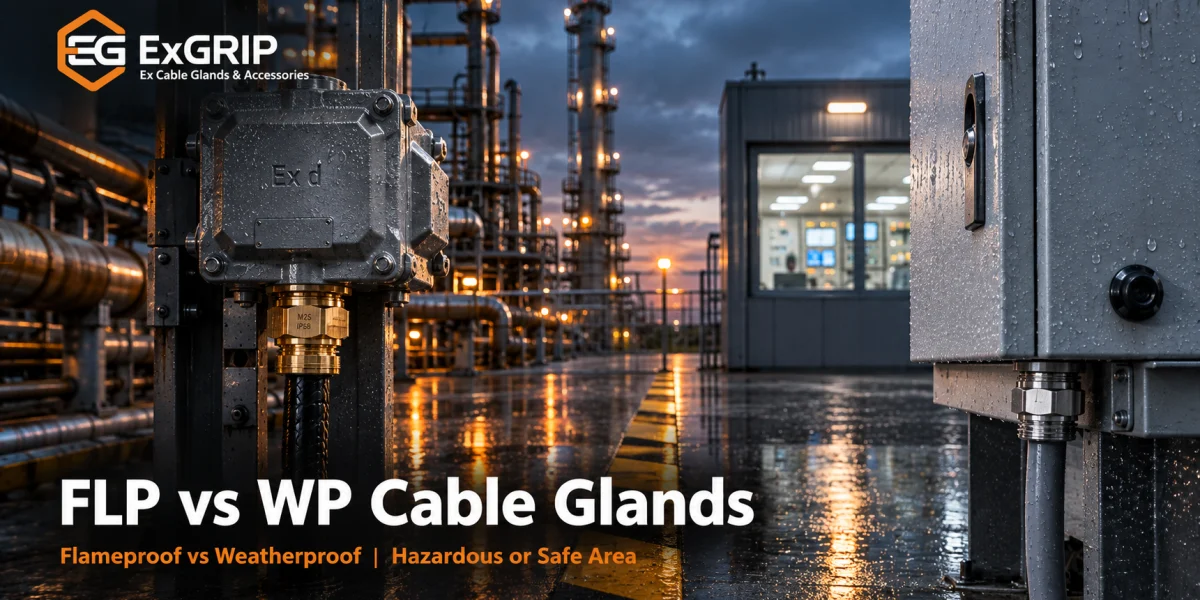
Two lines on the same BOQ: “Double compression cable gland, brass, M32, FLP” and “Double compression cable gland, brass, M32, WP”. Same size, same thread, same cable. One costs noticeably more, and on a refinery or a CBG plant the cheaper one can stop a licence inspection. This guide explains FLP vs WP cable glands: what each term means, where each is allowed, and how to tell them apart once they are out of the box.
The short version: an FLP gland is certified to keep an explosion inside the equipment it enters. A WP gland is only sealed against rain and dust. If you have been searching for the difference between FLP and WP cable glands because a supplier, consultant or inspector used both terms in the same conversation, the sections below cover the rules, the markings and a site-by-site decision table.
What FLP and WP Mean?
Both are Indian site shorthand, and both describe a type of protection rather than a product.
FLP is the short form of flameproof. Flameproof equipment, called Ex d in IEC and Indian standards (IS/IEC 60079-1), is built on the assumption that gas will get inside. If that gas ignites, the enclosure must withstand the pressure and stop the flame from escaping through its joints. A flameproof junction box, motor terminal box or lighting fitting is FLP equipment, and every cable entry on it is part of that flame-tight wall.
WP is the short form of weatherproof. A WP gland or enclosure keeps water and dust out, and its performance is stated as an IP rating under IEC 60529, such as IP66 or IP68. There is no explosion test behind a WP rating.
So FLP is not simply a “stronger” WP. The two answer different questions. WP asks whether rain can get in. FLP asks what happens when gas gets in and ignites.
FLP vs WP Cable Glands: Side-by-Side
| FLP cable gland | WP cable gland | |
|---|---|---|
| Main job | Keep an internal explosion from reaching the outside atmosphere; also seals out water and dust | Seal out water and dust |
| Governing standards | IEC 60079-0 and IEC 60079-1 (IS/IEC 60079 series in India) | IEC 60529 for the IP rating |
| Third-party certification | Required: ATEX, IECEx, and PESO approval for Indian petroleum and gas sites | None required |
| Marking on the gland | Ex marking such as “Ex db IIC Gb” plus certificate numbers | IP rating and size only |
| Body material | Metal: brass, nickel plated brass or stainless steel | Metal, or PVC, plastic and nylon |
| Where allowed | Hazardous zones and safe areas | Safe areas only |
| Armoured cable | Double compression designs clamp and earth the armour | Metal double compression designs only; plastic glands do not terminate armour |
| Paperwork | Certificate copies, Ex marking, batch test records | Datasheet with IP rating |
| Inspection | Checked under hazardous area inspection routines | Visual check for sealing |
| Can it replace the other? | Yes, in a safe area | No, never in a hazardous zone |
The last row is the one that matters on site. An FLP gland can always do a WP gland’s job, provided its IP rating suits the location. The reverse is never true. Every other row follows from that one-way rule. Note too that a metal cable gland is not automatically FLP: plenty of brass WP glands look almost identical to certified ones.
What an FLP Gland Has That a WP Gland Doesn't?
Put an FLP gland and a WP gland of the same size side by side and they can look the same. Four things separate them, and none of them is visible from a photo:
- A tested flame path. The gland’s threads and seals are designed and type tested so that a flame inside an Ex d enclosure cannot travel out along the cable entry. A WP gland’s seals are tested for water, not flame.
- An Ex marking. Exgrip’s A2F and E1FW, for example, carry “Ex db IIC Gb” and “Ex eb IIC Gb” for gas and “Ex ta IIIC Da” for dust. A WP gland has no Ex code at all.
- Certificates from a third party. ATEX and IECEx certificates come from notified or accredited bodies, and Indian petroleum and gas installations also need PESO approval. Exgrip’s PESO certified products carry all three. Certification also covers the factory: production is audited, not just a sample.
- A metal body. Flameproof glands are made of brass, nickel plated brass or stainless steel, because the body has to hold its shape and threads under explosion pressure, the same requirement that applies to an ATEX flameproof enclosure.
On many Indian BOQs, “FLP” is used loosely for any Ex certified gland, including increased safety (Ex e) types, because one certified gland is often rated for both. The difference between Ex d and Ex e cable glands is covered in our flameproof guide.
WP Cable Glands: Metal, PVC, Plastic and Nylon
Because a WP gland only has to seal, it can be made from a wider range of materials. The choice depends on the cable, the temperature and whether the gland sits in sunlight.
| Material | Typical use | Limits to know |
|---|---|---|
| Brass or nickel plated brass | Outdoor panels, substations, solar inverters, motors in safe areas | Heavier and costlier than plastic |
| Stainless steel 316 | Coastal sites, food processing, washdown areas | Highest cost of the WP options |
| Nylon (polyamide) | Control panels, machine wiring, light industrial use | Needs a UV-stabilised grade outdoors; no armour clamping |
| PVC and other plastics | Indoor panels and low-cost wiring jobs | Lower temperature and impact limits; not for armoured cable |
The armour point is the one that decides most industrial jobs. Power cables on Indian sites are usually steel wire armoured, and the armour has to be clamped and earthed at the gland. A plastic cable gland or nylon cable gland cannot do that, so armoured cable in a safe area still needs a metal gland, typically a weatherproof double compression cable gland in brass. Our page on brass cable glands covers the metal options in more detail.
Plastic WP glands also tend to use PG threads rather than metric, which matters when they go into an existing panel. Whatever the material, check the IP rating against the site: our guide to IP ratings for cable glands explains what each number means. Where glands sit in direct sun or salt spray, a PVC cable gland shroud over a metal gland adds a further layer of protection.
Can You Use One in Place of the Other?
FLP in a Safe Area: Allowed
No rule stops you fitting an FLP gland where a WP gland would do. It seals just as well, as long as its IP rating matches the location. Exgrip’s FLP glands are rated IP66, IP67 and IP68. The only cost is the price difference. On mixed sites, some contractors fit FLP glands everywhere to keep one part number in stock and remove any risk of the wrong gland going into a hazardous zone.
WP in a Hazardous Area: Never
In Zone 1 and Zone 2, IEC 60079-14 requires cable glands to be certified for the type of protection of the equipment they enter. A WP gland has no Ex certificate, so it fails that requirement in every hazardous zone, including Zone 2.
The flameproof junction box is the clearest case. Each threaded entry on the box is part of its flame path. Fit a WP gland in one entry and the box’s own certificate no longer describes what is installed, so the whole assembly is non-compliant, not just the gland. The same applies to reducers and stopping plugs in those entries.
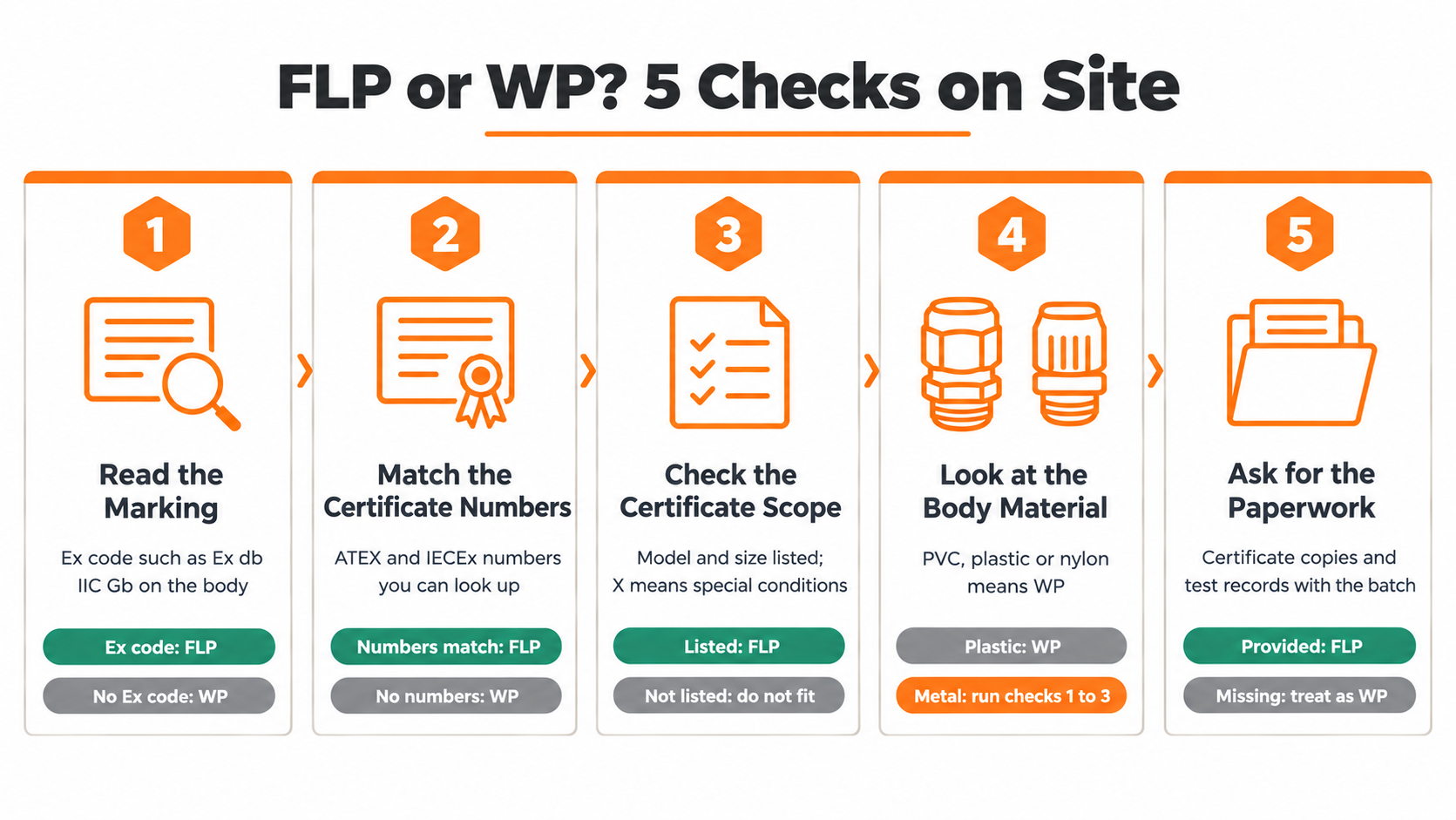
How to Tell FLP and WP Glands Apart on Site?
Why FLP Cable Glands Cost More?
The cable gland price gap between FLP and WP comes from work a WP gland never needs:
- Type testing by a certification body for each design and size range
- Ongoing factory audits under the ATEX and IECEx quality schemes, plus PESO approval for India
- Tighter machining on threads and sealing surfaces that form part of the flame path
- A metal body in every size, where WP can use plastic
- Batch traceability and certificate documentation supplied with each order
On a single gland the difference can look large. Against the cost of a failed PESO inspection or a re-glanded junction box, it is small.
Which One Does Your Site Need?
Decide by location, not by habit or by what was on the last BOQ.
| Where the gland goes | Gland you need | Notes |
|---|---|---|
| Zone 1 or Zone 2 gas areas: refineries, CBG and gas plants, chemical units, paint shops, LPG bottling | FLP (Ex certified, gas group to match) | PESO approval on Indian petroleum and gas sites |
| Zone 21 or Zone 22 dust areas: grain, flour, pharma powders | Ex certified for dust (IIIC) | A WP gland is not enough even if it is IP6X dust tight |
| Outdoor safe areas: solar plants, substations, water treatment, metro | WP, metal double compression for armoured cable | IP66 minimum outdoors, IP68 if water can pool |
| Indoor panels and control rooms, unarmoured cable | WP, plastic or nylon acceptable | Check temperature inside the panel |
| Coastal sites | FLP or WP in stainless steel 316 | Choose FLP vs WP by zone, material by salt exposure |
| Mixed sites with both zones | FLP throughout is often simplest | One part number, no mix-ups |
If the area classification drawing is not ready yet, our guide to Zone 1 or Zone 2 selection explains what to ask for. For industry examples, see cable glands for oil and gas refineries on the FLP side, cable glands for solar power plants on the WP side, and marine and offshore cable glands for coastal work.
One Gland for Both: Exgrip's FLP + WP Rated Range
Exgrip’s two main glands are certified for hazardous areas and rated for weather at the same time, so one part meets both requirements.
| E1FW | A2F | |
|---|---|---|
| Cable | Steel or aluminium wire armoured | Unarmoured |
| FLP rating | Ex db, Ex eb IIC Gb; Ex ta IIIC Da | Ex db, Ex eb IIC Gb; Ex ta IIIC Da |
| WP rating | IP66, IP67, IP68 | IP66, IP67, IP68 |
| Certificates | PESO P675044/2; ETL25ATEX0489X; IECEx ITS 25.0006X | PESO P675044/1; ETL25ATEX0489X; IECEx ITS 25.0006X |
| Sizes | M16 to M90; 1/2″ to 3-1/2″ NPT | M16 to M90; 1/2″ to 3-1/2″ NPT |
| Materials | Brass, nickel plated brass, SS 304, 316L, 316 | Brass, nickel plated brass, SS 304, 316L, 316 |
For a contractor with refinery units and outdoor safe areas on the same job, that means one metal cable gland per size instead of two parallel stocks.
Conclusion & Call-to-Action
Most FLP and WP mix-ups start on the BOQ, where the two lines sit next to each other and the cheaper one looks like a saving. Specify by location instead: mark every hazardous zone entry FLP, mark safe-area entries WP by material and IP rating, and record the Ex certificate numbers for every FLP line. On mixed sites, one dual-rated gland removes the risk of the wrong part reaching a hazardous zone.
Send us your cable schedule and area classification, and Exgrip’s team will mark which entries need FLP and which can stay WP, with the certificate numbers for your documentation.
📩 Talk to our technical team today at Exgrip.com
📞 Or call us directly for quick assistance!
Contact Us:
📞 Phone: +91 9537118899
🌐 Website: www.exgrip.com
📩 Request a Quote: Contact Page
FAQs
What is a cable gland and what is it used for?
FLP stands for flameproof and WP for weatherproof. FLP equipment is certified to contain an explosion inside it. WP equipment is only sealed against water and dust, as stated by its IP rating.
Can an FLP cable gland be used in a non-hazardous area?
Yes. It seals as well as a WP gland, provided its IP rating suits the location. The only drawback is the higher cost.
Can a WP cable gland be used in a Zone 2 area?
No. Zone 2 is still a hazardous area, and glands there must be certified for the type of protection of the equipment they enter. A WP gland has an IP rating but no Ex certificate.
Is a PVC or nylon cable gland flameproof?
No. Flameproof (Ex d) glands are made of metal. Some plastic glands are certified for increased safety (Ex e) enclosures, but a standard PVC or nylon WP gland carries no Ex certification at all.
Does a flameproof junction box need FLP cable glands?
Yes. Each entry on the box is part of its flame path, so it needs a gland certified for flameproof use. One WP gland makes the whole box non-compliant.
Why does an FLP cable gland cost more than a WP gland?
Type testing, factory audits under ATEX, IECEx and PESO, tighter machining of the flame path and a metal body all add cost. A WP gland needs none of these.