
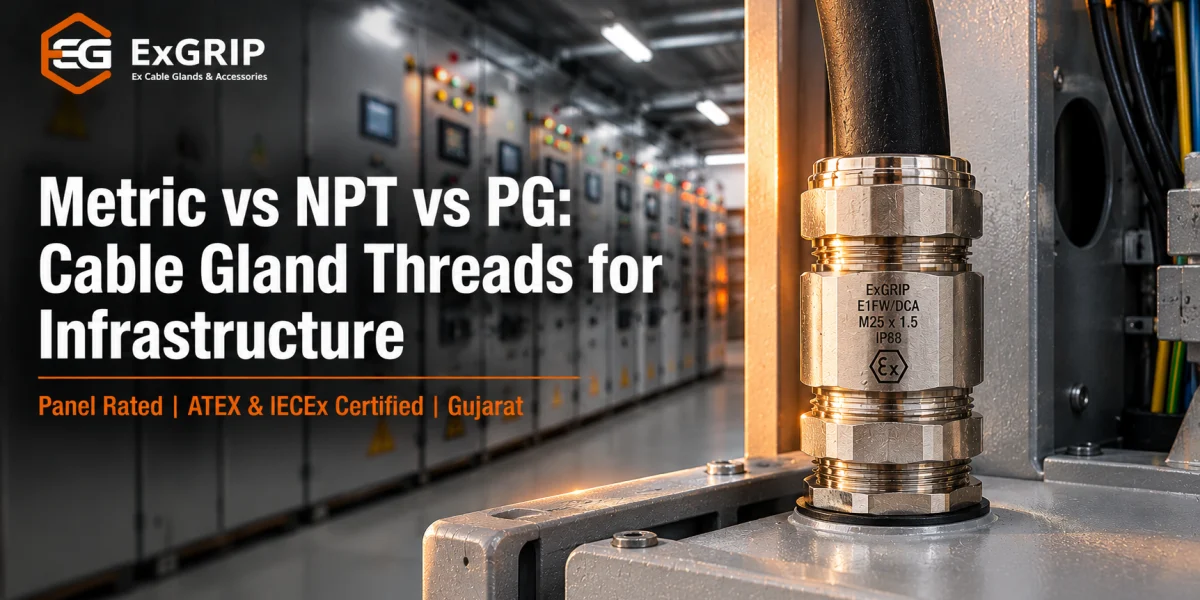
A panel specification calls out “cable gland, IP66, brass” and stops there. The panel arrives on site with knockouts cut for one thread standard, the glands procured against the spec are threaded for another, and an installer is now trying to force a tapered NPT gland into a parallel metric knockout with tape and patience. The gland’s material, IP rating, and certification were all correct. Nobody specified the thread.
Infrastructure projects draw equipment from multiple sources, imported switchgear, locally built distribution boards, motor control centres sourced from different vendors, and each tradition defaults to a different thread standard. This guide breaks down what actually differs between Metric, NPT, and PG threads, why mixing them causes real installation failures rather than minor inconvenience, and which standard typically shows up on which panel type in an infrastructure project.
Metric vs NPT vs PG: What Actually Differs Between These Three Thread Standards?
The three standards aren’t interchangeable variants of the same idea. They differ in thread geometry, how they seal, and which region’s equipment tradition specifies them by default.
Metric Threads : Parallel Threads, Sealed by Gasket
Metric threads (designated M, such as M20 or M25) run parallel along their full length, meaning the thread diameter stays constant from the first turn to the last. The seal against the enclosure wall comes from a compression washer or O-ring at the gland’s shoulder, not from the thread engagement itself. Metric is the dominant standard on Indian-built and most internationally specified industrial panels today, and it’s the standard Exgrip’s ranges are built around by default.
NPT Threads : Tapered Threads, Sealed by Thread Engagement
NPT (National Pipe Taper) threads narrow progressively along their length, so the fit tightens as the gland is threaded further in. The seal comes from that interference fit between the tapered male and female threads, typically assisted by thread sealant, rather than a separate gasket. NPT is the American standard, and shows up on US-specified switchgear and equipment sourced through EPC contractors working to American engineering standards.
PG Threads : Legacy DIN Standard, Where It Still Shows Up
PG threads (Panzergewinde, a legacy German DIN standard) predate the widespread adoption of metric threading in industrial equipment and have largely been superseded by M-series metric threads on new panel builds. PG threads still turn up on older imported European switchgear and on distribution boards being retrofitted or extended rather than replaced, where matching the existing knockout size matters more than matching the newer standard.
| Thread Standard | Origin | Thread Profile | Sealing Mechanism | Typically Specified On |
|---|---|---|---|---|
| Metric (M) | ISO / international | Parallel | Compression washer / O-ring at shoulder | Indian-built panels, most current international builds |
| NPT | United States (ANSI) | Tapered | Thread interference, often with sealant | US-specified switchgear, American-standard EPC projects |
| PG | Germany (legacy DIN) | Parallel, non-metric pitch | Compression washer at shoulder | Older imported European panels, retrofit and extension projects |
Why Mixing Thread Standards Causes Real Installation Failures
A thread mismatch doesn’t just look wrong, it produces specific, predictable problems on site:
- A tapered NPT gland forced into a parallel metric knockout seats at an angle rather than squarely, since the two thread geometries were never designed to mate
- A parallel metric gland threaded into an NPT-cut hole never reaches full engagement, leaving the compression washer unable to seal properly against the enclosure wall
- Nominally similar sizes across standards aren’t identical diameters, a PG13.5 knockout and an M20 knockout are close enough to tempt a force-fit but not close enough to actually seal correctly
- A cross-threaded entry that does get forced into place often strips the enclosure’s knockout thread, turning a gland mismatch into a panel repair
Nominal Size Doesn't Mean Identical Diameter
Thread standards that sound like they should match at a given nominal size rarely share an identical outer diameter, which is exactly what makes a force-fit tempting and wrong. The table below shows how three commonly confused “same size” entries actually compare:
| Designation | Standard | Approximate Outer Diameter |
|---|---|---|
| M20 | Metric | ~20.0 mm |
| PG13.5 | PG (legacy DIN) | ~20.4 mm |
| NPT 1/2″ | NPT | ~21.3 mm |
A millimetre or so of difference doesn’t sound like much until it’s the difference between a gasket that compresses evenly against the enclosure wall and one that sits proud on one side, which is where a “close enough” substitution turns into a leak path months after installation rather than an obvious failure on day one.
A Retrofit Mismatch in Practice
An infrastructure project extends an existing distribution board that was originally built with PG-threaded knockouts, common on equipment installed a decade or more ago. The extension’s cable glands are procured against a modern spec sheet that defaults to metric sizing, because that’s what current catalogues list first. On site, the new glands don’t seat correctly in the existing PG knockouts, and the installer either forces a compromised fit or waits on a re-order, both of which cost time that a five-minute thread check at the specification stage would have avoided.
Which Thread Standard Fits Which Infrastructure Panel?
Thread standard tends to track equipment origin and build era more than panel function, but a few patterns hold across most infrastructure projects:
Switchgear Panels
Modern Indian-built and internationally specified switchgear defaults to metric knockouts. US-origin or US-standard switchgear specified through American EPC contractors is the main case where NPT shows up instead.
MCC Panels
Motor control centres built for current Indian infrastructure projects are predominantly metric. Imported MCC panels sourced from US-standard vendors carry NPT entries, and this is worth confirming at procurement rather than assuming based on the panel’s general specification.
Distribution Boards
Distribution boards show the widest mix of the three, new builds are metric, but boards being extended or retrofitted may carry legacy PG entries from their original installation, and imported boards on older infrastructure projects can carry either PG or NPT depending on their country of origin.
| Panel Type | Commonly Specified Thread | Typical Exception |
|---|---|---|
| Switchgear panels | Metric | NPT on US-standard EPC projects |
| MCC panels | Metric | NPT on imported US-vendor panels |
| Distribution boards | Metric (new builds) | PG on retrofit and extension of older boards |
A2F vs DCA: Matching Exgrip's Panel Ranges to Thread and Cable Type
Once thread standard is confirmed, the second decision is armour handling, which determines whether A2F or DCA is the right range for a given cable entry.
A2F : Unarmoured, Single Compression
A2F is Exgrip’s unarmoured single compression range, suited to control and instrumentation cabling entering a panel where only the outer sheath needs sealing. Available across Metric, NPT, and PG thread options.
DCA : Armoured, Double Compression
DCA is Exgrip’s armoured double compression range, built for steel wire armoured feeder cable entering a panel from outside, where the armour itself needs to be clamped and earthed at the gland in addition to sealing the outer sheath. Available across Metric, NPT, and PG thread options.
| Range | Armour | Compression Type | Thread Options | Typical Panel Use |
|---|---|---|---|---|
| A2F | Unarmoured | Single compression | Metric, NPT, PG | Control and instrumentation cabling within the panel |
| DCA | Armoured (SWA) | Double compression | Metric, NPT, PG | Armoured feeder cable entering from outside the panel |
For a full product listing, specifications, and dimensional drawings, visit
our Products page.
Certification and Ingress Rating Are Independent of Thread Standard
Thread standard is a mechanical fit decision, separate from hazardous area certification and ingress protection rating. A gland can be specified in Metric, NPT, or PG thread and still carry ATEX, IECEx, and PESO certification alongside IP66 or IP68 ingress protection, since these certify different things entirely. For infrastructure panels installed in a classified hazardous area rather than a standard electrical room, confirm hazardous area certification separately from thread standard, the same way material and ingress rating are separate decisions from each other on any Exgrip range.
Ingress rating still tracks panel environment independently of all of this. An indoor switchgear room with controlled humidity rarely needs more than IP66, while an outdoor distribution board or an MCC panel exposed to monsoon conditions typically justifies IP68 regardless of which thread standard its knockouts happen to use. Specifying thread, material, ingress rating, and hazardous area certification as four separate decisions, rather than assuming one implies another, is what keeps a panel’s cable gland specification accurate across every field it actually needs to cover.
How to Confirm Thread Standard Before Ordering Glands?
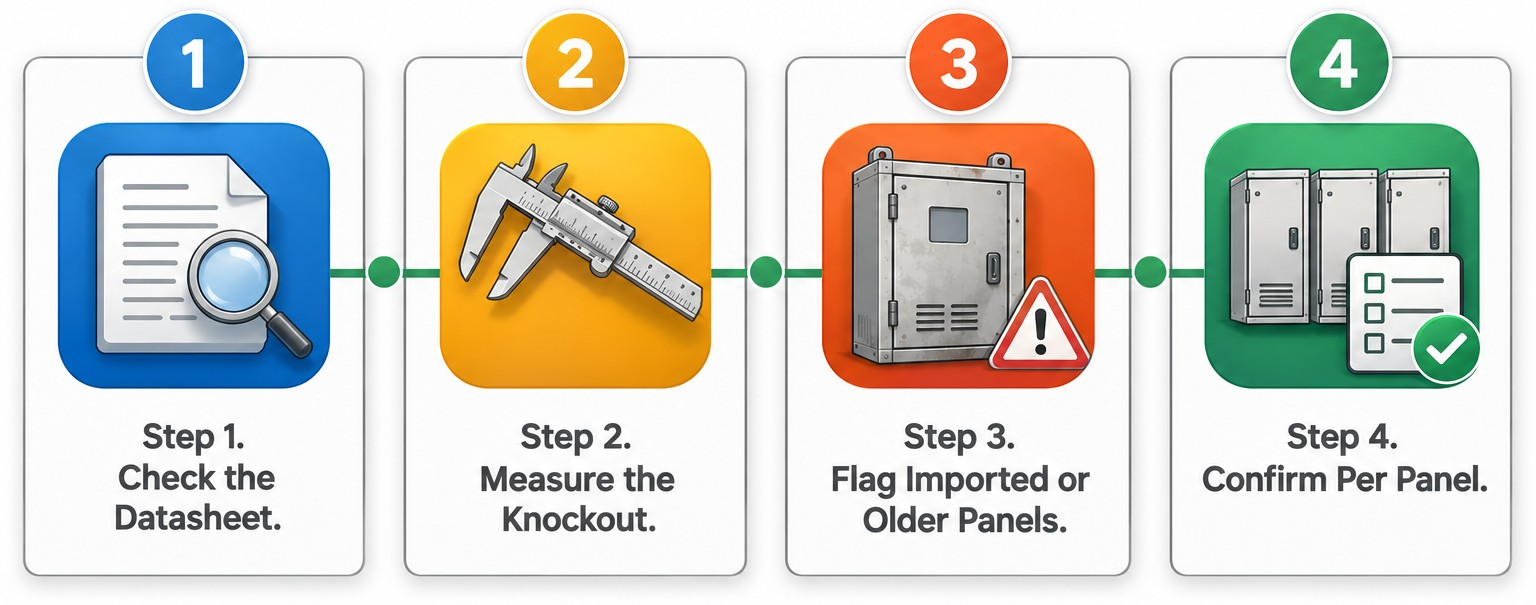
Confirming thread standard is a five-minute check against documentation or the panel itself, and it’s cheaper every time than discovering a mismatch after glands arrive on site:
- Check the panel manufacturer’s datasheet or enclosure drawing for the knockout thread callout directly, rather than assuming from the panel’s general specification
- Where documentation isn’t available, measure the knockout’s outer diameter and thread pitch physically and compare against known Metric, NPT, and PG values rather than guessing from a visual match
- Treat imported or older equipment as a candidate for PG or NPT threading by default, and confirm rather than assume metric, since these are exactly the cases where the mismatch shows up
- On multi-vendor infrastructure projects, confirm thread standard per panel rather than per project, since different vendors on the same job frequently default to different traditions
Why Exgrip for Infrastructure Panel Installations?
Exgrip manufactures its A2F and DCA ranges from the Jamnagar facility across Metric, NPT, and PG thread options, in brass and nickel-plated brass, with IP66 and IP68 variants and ATEX, IECEx, and PESO certification carried across the same product lines. An infrastructure project sourcing panels from multiple vendors with different thread traditions can specify the correct thread against each panel’s actual knockouts from one certified manufacturer, rather than discovering a mismatch on site.
For the full certified range built for infrastructure and panel applications, see Exgrip’s Infrastructure Industry page, which covers panel compatibility, certification, and material selection across switchgear, MCC panels, and distribution boards.
Conclusion & Call-to-Action
Metric, NPT, and PG threads answer the same basic question, how does the gland seal against the enclosure, in three genuinely different ways, and a panel specification that names material and IP rating without naming thread standard is leaving the one detail that determines whether the gland fits at all. The fix isn’t picking one standard as a default across every project, it’s confirming the actual knockout thread against each panel before glands are ordered, especially on projects sourcing equipment from more than one vendor tradition.
Exgrip’s technical team can help infrastructure project engineers confirm thread standard against panel documentation as part of standard project support, alongside material and certification review.
📩 Talk to our technical team today at Exgrip.com
📞 Or call us directly for quick assistance!
Contact Us:
📞 Phone: +91 9537118899
🌐 Website: www.exgrip.com
📩 Request a Quote: Contact Page
FAQs
What's the main difference between Metric, NPT, and PG cable gland threads?
Metric threads are parallel and seal via a compression washer at the gland’s shoulder. NPT threads are tapered and seal through thread interference as they’re tightened. PG is a legacy German standard, parallel like metric but with a different pitch, found mostly on older or retrofitted panels.
Can an NPT cable gland be fitted into a metric knockout?
Not correctly. The tapered NPT thread and the parallel metric thread aren’t designed to mate, and forcing the fit typically produces an angled seat, incomplete engagement, or a stripped knockout. Confirm the actual thread standard before ordering rather than substituting one for another.
Why does PG thread still show up on infrastructure projects?
PG threads persist on older imported European switchgear and on distribution boards being extended or retrofitted rather than replaced, where matching the existing knockout matters more than switching to a newer standard.
Which thread standard is most common on Indian infrastructure projects?
Metric is the default on most current Indian-built panels. NPT and PG both show up as exceptions, NPT on US-standard imported or EPC-specified equipment, PG on older or retrofitted boards.
What's the difference between Exgrip's A2F and DCA ranges?
A2F is the unarmoured single compression range, suited to control and instrumentation cabling within a panel. DCA is the armoured double compression range, built for armoured feeder cable entering a panel from outside, where the armour needs clamping and earthing at the gland.
Can a single infrastructure project mix Metric, NPT, and PG glands across different panels?
Yes, and on multi-vendor projects it’s common rather than exceptional. The key is specifying thread standard per panel based on that panel’s actual knockouts, not assuming one thread standard applies uniformly across every panel sourced for the project.