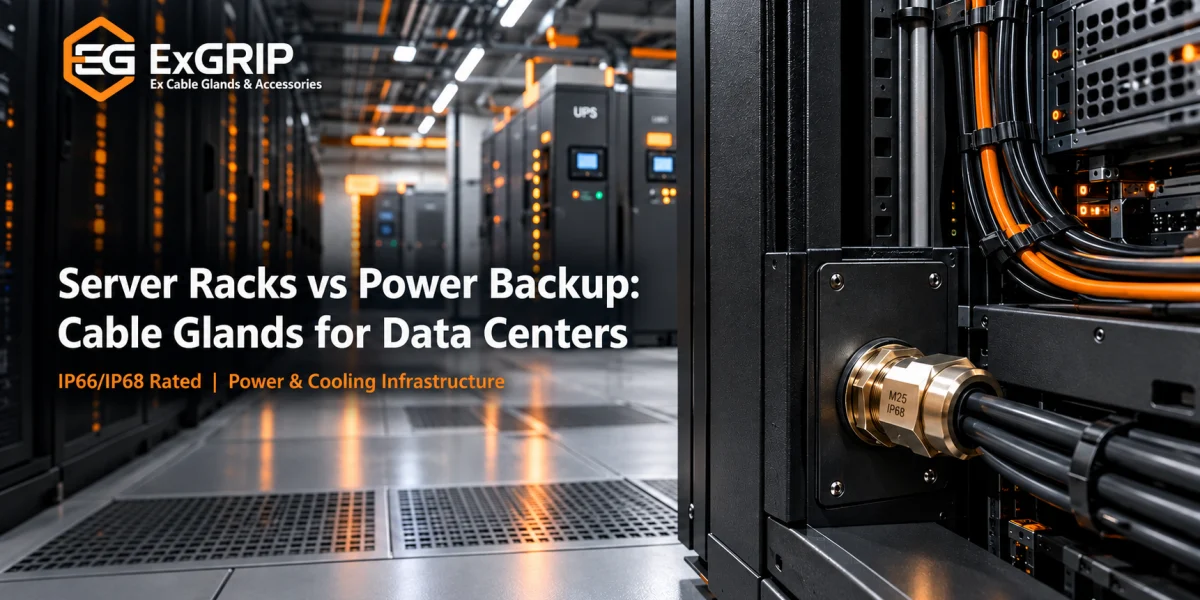
A data center cable gland spec often reads as a single line: IP66, brass, done. That line gets applied to a server rack’s low-voltage data cabling and to a UPS room’s armoured power feed alike, as if the two locations present the same problem. They don’t. A rack cabinet carries unarmoured signal and low-voltage power cable in a controlled environment. A UPS, PDU, or generator backup room carries armoured feeder cable under real fault current, sometimes with a diesel fuel store attached.
AI data centers in particular run both environments side by side, high-density rack rows a few metres from the power infrastructure keeping them running. This guide breaks down why server racks and power backup systems call for different cable gland ranges, how Exgrip’s A2F and E1FW ranges map to each, the material choice between brass, stainless steel, and nylon, and where hazardous area certification genuinely applies on a data center site.
Server Racks and Network Cabinets: Why A2F Fits?
Server racks and network cabinets carry a specific kind of cable load, and the cable gland handling it doesn’t need to solve problems that don’t exist at that location.
Cable Types and Entry Requirements in Rack Environments
Rack and cabinet cable entries are overwhelmingly unarmoured, structured, low-voltage data and signal cable, alongside some low-voltage power feeds to individual rack units. The volume is high, dozens of entries per cabinet on a dense AI compute row, but the mechanical stress on any single entry is low compared to a power room feeder cable. What matters here is clean entry, strain relief, and enough entries per cabinet without oversizing the gland for a load it will never see.
Why Unarmoured, Single Compression Makes Sense Here
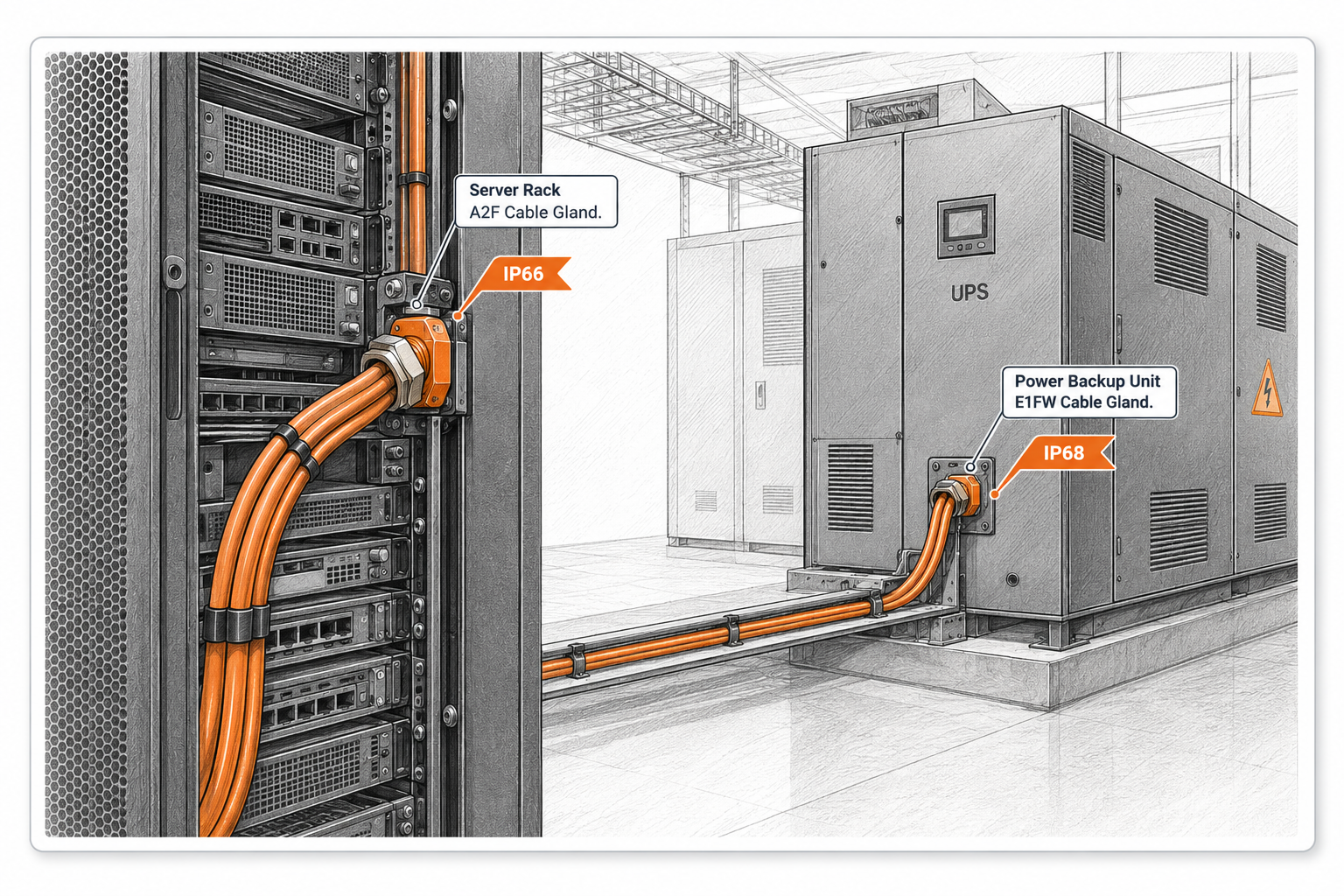
A2F, Exgrip’s unarmoured single compression range, is built for exactly this profile, sealing the outer cable sheath without the added bulk and cost of an armour clamp that a rack cable was never going to need. Specifying double compression armoured glands across every rack entry on a high-density row adds unnecessary cost and installation time for a mechanical retention capability the cable itself doesn’t require.
UPS, PDU, and Generator Backup: Why E1FW Fits?
Power backup infrastructure presents a different profile entirely, one where the cable gland’s mechanical role matters as much as its seal.
Armoured Cable and Fault Current Considerations
UPS systems, power distribution units, and generator backup feeds typically run steel wire armoured cable, carrying higher current and needing the armour itself to provide a fault current return path back to earth. A gland that only seals the outer sheath, without clamping and earthing the armour, leaves that fault path unaddressed, a real safety gap rather than a minor spec shortfall.
Double Compression for Earthing and Mechanical Retention
E1FW, Exgrip’s double compression range, clamps and earths the cable armour as a dedicated function separate from sealing the outer sheath, which is exactly what a UPS or generator feed needs. The double compression design also gives the cable stronger mechanical retention at the entry point, relevant on power infrastructure where cable movement or vibration from generator operation is a real installation consideration that a rack cabinet doesn’t face.
A Mismatched Spec in Practice
A data center project standardises on A2F across the entire site to simplify procurement, one range, one order, one vendor conversation. It works fine on the rack floor. In the generator room, the armoured feeder cable arrives, and the A2F glands seal the outer sheath correctly but have no mechanism to clamp or earth the armour, since that was never part of their design. The armour ends up earthed by whatever ad hoc bonding the installation crew improvises on site, rather than through the gland itself, which is a workable fix but not the reliable, repeatable fault path a properly specified E1FW gland would have provided by design.
| Application | Typical Cable | Key Requirement | Fits |
|---|---|---|---|
| Server racks and network cabinets | Unarmoured, low-voltage signal and power | Clean entry, strain relief, high entry count | A2F |
| UPS, PDU, generator backup | Steel wire armoured, higher fault current | Armour clamping, earthing, mechanical retention | E1FW |
A2F vs E1FW: Side by Side
Once application zone is confirmed, the product choice follows directly from it rather than requiring a separate decision.
| Range | Armour | Compression Type | IP Rating | Typical Zone Fit |
|---|---|---|---|---|
| A2F | Unarmoured | Single compression | IP66 / IP68 | Server racks, network cabinets |
| E1FW | Armoured (SWA) | Double compression | IP66 / IP68 | UPS systems, PDUs, generator backup |
Cooling and HVAC Infrastructure: A Third Application Zone
AI data centers run cooling infrastructure hard enough that it deserves its own place in this comparison rather than being folded into either the rack or the power backup side by default. CRAC and CRAH unit motors, pumps, and chiller feeds typically draw enough current that their cabling is armoured, similar in profile to the power backup side, which makes E1FW the usual fit for cooling plant cable entries. Control and sensor cabling within the same cooling system, monitoring temperature and airflow rather than driving motor load, is closer to the rack profile and suits A2F instead. The decision follows the same logic used for racks and power backup, match the gland to what the specific cable actually is, rather than assuming cooling infrastructure is uniformly one type or the other.
Material Options for Data Center Cable Glands: Brass, Stainless, and Nylon
Material choice on a data center project answers a different question than armour type, it’s about the electrical and environmental context of each location rather than the mechanical cable load.
- Brass is the standard choice across most data center cable entries, cost-effective and reliable in a controlled indoor environment
- 316 stainless steel is worth specifying where a data center sits in a coastal or high-humidity location, the same chloride-resistance logic covered in Exgrip’s marine and offshore material guide
- Nylon is a genuinely different option for low-voltage rack cabinets specifically, non-conductive and electromagnetically neutral, which matters in dense signal cabinet environments where a metallic gland body isn’t adding any earthing function the rack doesn’t already provide elsewhere
| Material | Conductivity | Typical Data Center Use |
|---|---|---|
| Brass | Conductive | Standard choice across most rack and power room entries |
| 316 Stainless Steel | Conductive | Coastal or high-humidity site locations |
| Nylon | Non-conductive | Low-voltage signal cabinets where a non-conductive, EMI-neutral entry is preferred |
Nylon isn’t a substitute for brass or stainless on power-side infrastructure, where armour earthing and mechanical retention rule it out entirely, it’s a genuinely separate option specific to the rack side of the site.
Certification for Data Center Power Infrastructure
Most of an AI data center site, server halls, network cabinets, and standard power rooms, isn’t a classified hazardous area, so hazardous area certification isn’t the default requirement it would be on an oil and gas or chemical plant project. The genuine exception is diesel generator backup, where an on-site fuel storage or day tank area can fall under hazardous area classification depending on tank size and layout, and that’s where certification becomes a real specification question rather than a formality.
ATEX
ATEX certification, issued by an EU Notified Body such as SIRA, TÜV Rheinland, Intertek, or Bureau Veritas, applies where a data center project’s generator fuel area is classified and the FEED specification originates from a European framework.
IECEx
IECEx is the international mutual-recognition scheme, relevant on multi-country data center builds where a single certification needs to be accepted across the project’s different site locations without re-testing per jurisdiction.
PESO
PESO approval applies where an Indian data center’s diesel generator fuel storage falls under Petroleum and Explosives Safety Organisation jurisdiction, the same statutory requirement that applies to any classified fuel storage installation in India regardless of the facility type around it.
IS 2148
IS 2148 is the Bureau of Indian Standards flameproof enclosure specification, aligned with IEC 60079-1, worth confirming against project vendor qualification requirements on data center builds sourcing equipment for classified generator fuel areas from Indian PSU-adjacent supply chains.
| Certification | Issuing Body | Required For | Applicable Standard |
|---|---|---|---|
| ATEX | EU Notified Body (SIRA, TÜV Rheinland, Intertek, Bureau Veritas) | Classified generator fuel areas on European-origin FEED projects | IEC 60079-1, ATEX Directive 2014/34/EU |
| IECEx | IECEx-accredited body | Multi-country data center projects | IEC 60079 series |
| PESO | PESO India | Classified diesel fuel storage areas in India | Petroleum Act 1934, Petroleum Rules 2002 |
| IS 2148 | BIS / recognised test house | Indian vendor qualification for classified equipment | IS 2148, aligned with IEC 60079-1 |
Server racks, network cabinets, and standard UPS or PDU rooms don’t need this certification tier, it applies specifically where a generator’s fuel storage introduces a classified area onto an otherwise unclassified site.
Why Exgrip for AI Data Center Installations
Exgrip manufactures its A2F and E1FW ranges from the Jamnagar facility in brass, nickel-plated brass, 316 stainless steel, and nylon, with IP66 and IP68 variants and ATEX, IECEx, and PESO certification available where a project’s generator fuel area requires it. An AI data center project can specify rack-side and power-side cable entries, plus the rare classified fuel storage area, from one certified manufacturer rather than sourcing across separate vendors for each zone type.
Across a single AI data center site, that typically means:
- A2F for server rack and network cabinet entries, and for cooling system control and sensor cabling
- E1FW for UPS, PDU, and generator backup entries, and for cooling plant motor and chiller feed cabling
- Nylon variants for low-voltage signal cabinets where a non-conductive entry avoids unplanned grounding paths
- ATEX, IECEx, or PESO certified glands specifically where a generator fuel area introduces a classified zone
For the full certified range built for AI data center conditions, see Exgrip’s AI Data Centers Industry page, which covers server rack, UPS, PDU, and generator backup applications with material and certification detail for each.
Conclusion & Call-to-Action
Server racks and power backup infrastructure sit metres apart on an AI data center floor and call for genuinely different cable glands, unarmoured for the rack side, armoured and earthed for the power side, with material and certification decisions layered on top of that split rather than replacing it. A single generic gland spec across the whole site either over-specifies the rack cabling or under-specifies the power infrastructure, and neither is a small mistake once the project is at data center scale.
Exgrip’s technical team can help data center project engineers map application zones to the right range as part of standard project support, including confirming whether a generator fuel area needs hazardous area certification.
📩 Talk to our technical team today at Exgrip.com
📞 Or call us directly for quick assistance!
Contact Us:
📞 Phone: +91 9537118899
🌐 Website: www.exgrip.com
📩 Request a Quote: Contact Page
FAQs
What's the main difference between A2F and E1FW cable glands?
A2F is unarmoured single compression, built for the low-voltage signal and power cabling in server racks and network cabinets. E1FW is armoured double compression, built for the armoured feeder cable in UPS, PDU, and generator backup systems, where the armour needs clamping and earthing.
Do server racks need armoured cable glands?
Usually not. Rack and cabinet cabling is typically unarmoured, so A2F’s single compression design is the correct fit without the added cost and bulk of an armour clamp the cable doesn’t need.
When does a data center need hazardous area certification?
Most server halls, network cabinets, and standard power rooms aren’t classified hazardous areas. The exception is diesel generator fuel storage, where a classified area can exist depending on tank size and layout, and that’s where ATEX, IECEx, or PESO certification becomes genuinely relevant.
What IP rating do data center cable glands typically need?
IP66 or IP68 covers most data center server hall and power room environments. Higher washdown-grade ratings like IP69K, relevant on offshore platforms, aren’t typically a data center requirement.
Are Exgrip's A2F and E1FW ranges certified for data center use?
Yes. Both ranges carry IP66/IP68 ingress protection, and ATEX, IECEx, and PESO certification is available on the same ranges for the classified generator fuel area cases where it’s needed.