
India reached 20 percent ethanol blending in petrol (E20) in the 2025-26 supply year, and national ethanol capacity now stands at about 2,000 crore litres a year. Behind those numbers is a wave of new distilleries, and every ethanol plant in India built for fuel supply handles a flammable liquid at scale. Choosing cable glands for ethanol plants looks simple until you notice that a grain-based plant has two different explosion hazards on one site: ethanol vapour around the column and tanks, and combustible grain dust around the silos and dryer.
This guide walks through an ethanol manufacturing plant area by area. It covers which zones to expect, what gas group and dust group apply, which gland fits each area, and how PESO licensing affects the tank farm. Product details refer to Exgrip’s PESO, ATEX and IECEx certified range, made in Jamnagar.
Grain-Based vs Molasses-Based Ethanol Plants
Indian fuel ethanol comes from two main routes, and the route decides how many hazards the electrical design has to cover.
| Grain-based plant | Molasses-based distillery | |
|---|---|---|
| Feedstock | Maize, broken rice, damaged food grain | Cane molasses or cane juice, usually at a sugar mill |
| How feed arrives | Dry grain by truck, stored in silos | Liquid, pumped from tanks |
| Grain dust hazard | Yes: receipt, elevators, milling, DDGS dryer | Usually none |
| Ethanol vapour hazard | Yes: distillation, dehydration, tank farm, loading | Yes: the same areas |
| By-product | DDGS (distillers’ dried grains with solubles), sold as cattle feed | Spent wash, treated or used as fuel |
A growing number of sugar mills run dual-feed distilleries that switch to grain outside the cane season, so a plant built as molasses-only can gain dust areas later. A third route, second-generation (2G) ethanol, uses agricultural residue such as rice straw. IOCL’s Panipat refinery hosts India’s best-known 2G ethanol plant. Its biomass handling end behaves more like a grain plant than a molasses one.
For anyone pricing the electrical package of a new ethanol factory in India, the feedstock line in the project report is the first thing to check. A molasses distillery needs Ex equipment for vapour areas only. A grain plant of the same capacity adds silos, elevators, hammer mills and a DDGS dryer, each with motors, sensors and junction boxes in dust zones. That can add dozens of dust-rated cable entries to the schedule, and they are the entries most often missed when a molasses-plant template is reused.
Hazardous Areas in an Ethanol Plant, Area by Area
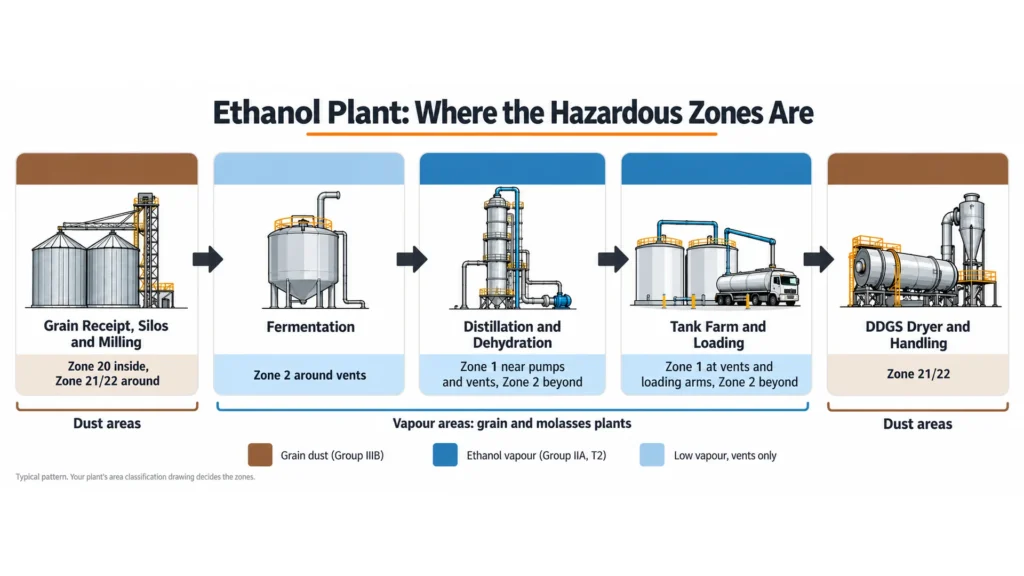
Zones are set by each plant’s area classification drawing, prepared under IS/IEC 60079-10-1 for vapour and IS/IEC 60079-10-2 for dust. The pattern below is what most plants follow. If you need a refresher on how gas and dust zones differ, our chemical plants guide covers the basics; this section stays on what is specific to ethanol.
Grain Receipt, Silos and Milling
Grain dust is the hazard most new plant teams underestimate. Inside silos, bins and elevator casings the dust cloud is present during normal operation, and the areas around elevator heads, conveyor transfer points and hammer mills are typically classified Zone 21 or Zone 22. Bucket elevators are the most common starting point for primary grain dust explosions, with filter collectors and dryers close behind. Motors, level switches and junction boxes on these items all need dust-certified glands.
Fermentation
Fermenters release large volumes of CO₂ carrying some ethanol vapour. Vapour levels in the fermentation hall are low compared with distillation, and many plants classify only the zones around vents and scrubbers. The bigger electrical concern here is humidity and washdown, which matters for gland material and sealing.
Distillation and Dehydration
This is the main vapour area. Distillation columns, condensers, reflux pumps and the molecular sieve dehydration unit handle hot ethanol, and pump seals, flanges and sample points are release sources. Areas around them are typically Zone 1 close in and Zone 2 further out. Most of the plant’s Ex motors and instruments sit here.
Tank Farm and Tanker Loading
Finished ethanol is stored in fixed-roof or floating-roof tanks and dispatched by road tanker to oil marketing company depots. Tank vents and loading arms create Zone 1 areas, with Zone 2 around them. Whether a particular pump bay counts as Zone 1 or Zone 2 depends on ventilation and release frequency. The layout looks much like a refinery product tank farm, and the same gland practice applies as for cable glands for oil and gas refineries.
DDGS Dryer and Handling
At the end of a grain plant, wet cake from the decanters is dried into DDGS. The dryer and its cyclones and conveyors bring dust back into the picture, along with heat. Glands close to dryer casings and hot-air ducts also see higher ambient temperatures than the rest of the plant, so check the gland’s rated range; Exgrip’s A2F and E1FW are rated for −60 °C to +160 °C ambient. A grain plant therefore has dust areas at both ends of the process and vapour areas in the middle.
| Area | Hazard | Typical classification | Grain plant | Molasses plant |
|---|---|---|---|---|
| Grain receipt, silos, milling | Grain dust | Zone 20 inside, Zone 21/22 around | Yes | No |
| Fermentation | CO₂ with ethanol vapour | Zone 2 around vents, often no zone elsewhere | Yes | Yes |
| Distillation and dehydration | Ethanol vapour | Zone 1 near pumps and vents, Zone 2 beyond | Yes | Yes |
| Tank farm and loading | Ethanol vapour | Zone 1 at vents and loading arms, Zone 2 beyond | Yes | Yes |
| DDGS dryer and handling | Grain dust, heat | Zone 21/22 | Yes | No |
Ethanol Vapour and Grain Dust: Groups and Temperature Class
| Hazard | Group | Temperature class / ignition | What it means for the gland |
|---|---|---|---|
| Ethanol vapour | IIA | T2; auto-ignition about 363 °C | Any IIA, IIB or IIC certified gland qualifies |
| Grain dust (maize, rice) | IIIB (non-conductive dust) | Set by dust cloud and layer ignition tests | Any IIIB or IIIC certified gland qualifies |
Ethanol is one of the easier gases to protect against: it sits in the lowest gas group, and its ignition temperature is high. The dust side needs more care, because a dust layer on hot equipment ignites at a lower temperature than a dust cloud. That limit applies to motors and dryers more than to the glands, but it is why dust-area equipment carries its own surface temperature rating. Our temperature class guide explains how to read those ratings. Specifying IIC for gas and IIIC for dust covers every case with one rating.
Choosing Cable Glands for Each Area
Most power cables in an ethanol plant are steel wire armoured, so the default is a double compression armoured cable gland that seals the inner sheath, clamps the armour and seals the outer sheath. Instrument and lighting cables are often unarmoured and take a single compression gland.
| Area | Protection needed | Armoured cable | Unarmoured cable | Material |
|---|---|---|---|---|
| Grain receipt, silos, milling | Ex t, dust certified | E1FW | A2F | Brass |
| Fermentation (classified parts) | Ex db / Ex eb (gas) | E1FW | A2F | Nickel plated brass for humidity and washdown |
| Distillation and dehydration | Ex db / Ex eb (gas) | E1FW | A2F | Brass or nickel plated brass |
| Tank farm and loading | Ex db / Ex eb (gas), PESO approved | E1FW | A2F | Brass; SS 316 on coastal sites |
| DDGS dryer and handling | Ex t, dust certified | E1FW | A2F | Brass |
| CIP and chemical dosing areas | As classified | E1FW | A2F | Stainless steel 316 where caustic or acid washdown reaches the gland |
Because Exgrip’s E1FW and A2F are certified Ex db and Ex eb IIC Gb as well as Ex ta IIIC Da, the same two part numbers cover the vapour areas and the dust areas. They are rated IP66, IP67 and IP68 for washdown, and come in brass, nickel plated brass and stainless steel 304, 316L and 316. A plain brass cable gland is the right default in most of the plant; dry ethanol is compatible with brass, so the upgrade decision depends on cleaning chemicals and coastal air. See our pages on the brass cable gland range and, for where flameproof entries need extra care, flameproof cable glands. Plants sharing a site with solvent or chemical units can follow our guide to cable glands for chemical plants.
PESO Licence and Ethanol Storage
Ethyl alcohol is listed under the Inflammable Substances Act, 1952, and products covered by that Act need a licence under the Petroleum Rules, 2002. An ethanol plant’s storage tanks and loading area therefore come under PESO, the Petroleum and Explosives Safety Organisation, and so do the inspections that go with the licence.
For the electrical side, that means the Ex equipment in the licensed area is checked against PESO requirements, including the cable glands on every motor, junction box and lighting fitting around the tanks. Our guide to PESO approval for cable glands explains what inspectors look for. Exgrip’s E1FW and A2F hold PESO approval under P675044/2 and P675044/1, and the same approval series covers our PESO certified cable glands, reducers and stopping plugs for spare entries and size changes on flameproof boxes.
Ethanol Plants in Gujarat
Gujarat has moved quickly into grain ethanol. By mid-2025, about 14 companies in the state had oil marketing company approval for ethanol units, with combined planned capacity of around 2,800 kilolitres per day (KLPD). Grainspan Nutrients runs two grain plants at Bhamsara near Ahmedabad: a 110 KLPD unit on maize and rice commissioned in 2023, and a 240 KLPD unit added in 2025. Other projects around Ahmedabad include a 300 KLPD greenfield plant by True Green Bio Energy.
Most of these are grain-based, which puts dust areas and vapour areas on the same site, exactly the case covered above. For an ethanol plant in Gujarat, Exgrip supplies from Jamnagar within the state, with the PESO, ATEX and IECEx certificate numbers your licence file needs.
Conclusion & Call-to-Action
On a grain ethanol project the gland schedule usually gets written once for the vapour areas, because that is where the column and tanks are. The silos, mills and DDGS dryer then end up with ordinary glands, or with gas-certified glands that carry no dust rating. Split the schedule by hazard at the design stage: dust areas at the front and back of the plant, vapour areas in the middle, and PESO approved glands throughout the tank farm. A cable gland certified for both IIC gas and IIIC dust removes most of that risk with one part number.
Send us your area classification drawing and cable schedule, and Exgrip’s team will mark the gland type, size, material and certificate numbers for each area of your ethanol plant.
📩 Talk to our technical team today at Exgrip.com
📞 Or call us directly for quick assistance!
Contact Us:
📞 Phone: +91 9537118899
🌐 Website: www.exgrip.com
📩 Request a Quote: Contact Page
FAQs
Is an ethanol plant a hazardous area?
Parts of it are. Distillation, dehydration, the tank farm and tanker loading are vapour areas, and in grain plants the grain handling, milling and DDGS dryer can be dust areas. Utilities and offices are usually safe areas, as shown on the plant’s classification drawing.
What gas group and temperature class is ethanol?
Ethanol is Group IIA, temperature class T2, with an auto-ignition temperature of about 363 °C. Any gland certified for IIA, IIB or IIC is suitable for its gas group.
Does a molasses-based distillery have dust zones?
Usually not from feedstock, because molasses arrives as a liquid. Boiler fuel handling, such as bagasse or coal, is assessed separately, and dual-feed plants that also run on grain will have grain dust areas.
Which cable gland is used in an ethanol storage tank area?
An Ex certified gland, Ex db or Ex eb, rated for the zone. Use a double compression gland such as the E1FW for armoured cable, and choose PESO approved glands because the tank farm is a licensed area.
Does ethanol storage need a PESO licence?
Yes. Ethyl alcohol is covered by the Inflammable Substances Act, 1952, so its storage needs a licence under the Petroleum Rules, 2002. Electrical equipment in the licensed area is checked during PESO inspections.
Can one cable gland cover both gas and dust zones?
Yes, if it is certified for both. Exgrip’s A2F and E1FW carry Ex db and Ex eb IIC Gb for gas and Ex ta IIIC Da for dust, so one gland type serves the whole plant.
What is a 2G ethanol plant?
A 2G plant makes ethanol from agricultural residue, such as rice straw, instead of grain or molasses. IOCL’s plant at its Panipat refinery is the best-known example in India. Its biomass handling areas raise dust questions similar to a grain plant’s.