
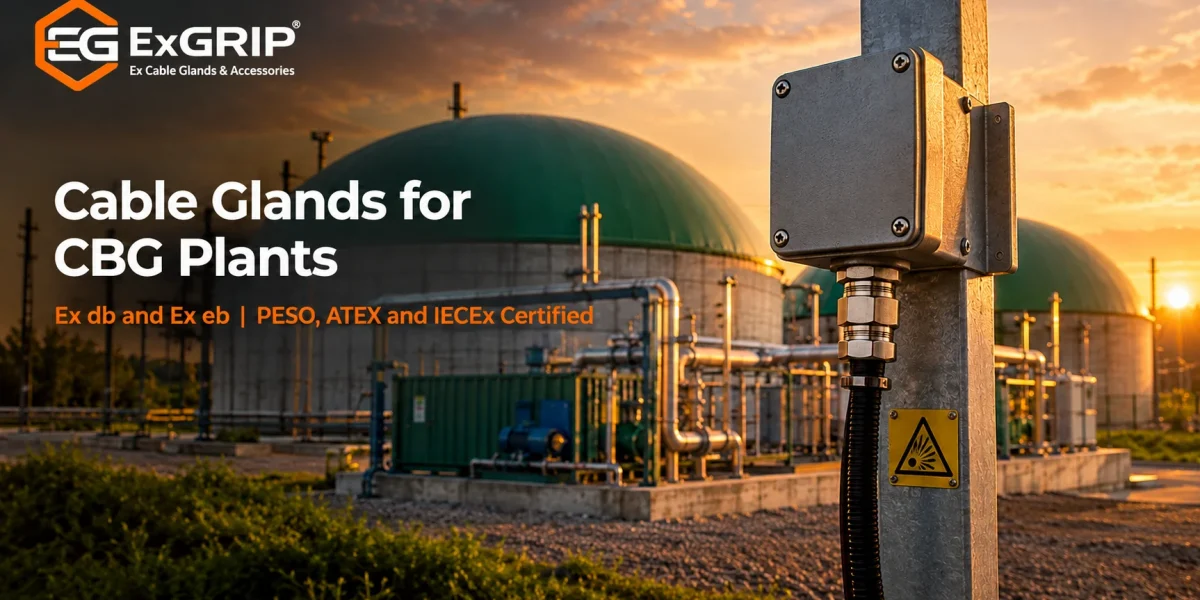
A compressed biogas plant handles the same methane as a city gas station, plus something a CNG station never sees: raw biogas carrying hydrogen sulphide. That second gas changes how cable glands for a CBG plant in India should be chosen. The gas group and zone decide the protection concept. The H2S decides the material. A gland that is correct on the first count and wrong on the second can pass commissioning and then start corroding near the digester.
This guide follows the gas through a bio CNG plant, from digester to cascade, and sets out which gland type, certification and material fits each area. It is written for EPC engineers, electrical consultants and plant owners building under the SATAT scheme. The product details refer to Exgrip’s PESO, ATEX and IECEx certified range, made in Jamnagar.
How a CBG Plant Turns Biogas into Fuel
Every CBG plant, whether it runs on cattle dung, press mud or paddy straw, follows the same chain. Knowing the chain matters because the gas changes character at each step, and so does the risk around the cable entries.
- Feedstock reception and pre-treatment. Waste is received, shredded or mixed into slurry. No biogas yet.
- Anaerobic digester and gas holder. Bacteria break the feed down into raw biogas, roughly 50 to 70 percent methane with most of the rest CO₂, plus water vapour and H2S. A double membrane dome usually stores it.
- Gas cleaning. Desulphurisation, blowers and chillers remove H2S and moisture. This is where H2S levels are highest around equipment.
- Upgrading. A water scrubber, PSA or membrane unit strips out CO₂ until methane exceeds 90 percent, the level oil marketing companies buy as CBG.
- Compression. The clean gas is compressed to a maximum of 250 bar.
- Cascade storage and dispatch. Cylinder cascades are filled for road transport, or the gas goes to an on-site dispenser or a pipeline.
Steps 2 to 6 all handle flammable gas, and each sits in a different electrical environment. The motors, junction boxes, instruments and lighting along that chain are where the cable glands go.
Why CBG Plants in India Need Certified Cable Glands
SATAT and the Blending Obligation
The Ministry of Petroleum and Natural Gas launched SATAT in October 2018 with a target of 5,000 CBG plants. Oil marketing companies sign offtake agreements with plant owners and buy the CBG they produce. In November 2023 the government added a compressed biogas blending obligation for city gas networks. It was voluntary until FY 2024-25 and is now mandatory:
| Financial year | CBG share of CNG (transport) and PNG (domestic) consumption |
|---|---|
| 2025-26 | 1% |
| 2026-27 | 3% |
| 2027-28 | 4% |
| 2028-29 onwards | 5% |
The obligation triples in one year, from 1% to 3%, and city gas companies need plants to supply it. Some owners have run a biogas plant in India before for cooking gas or captive power. A 250 bar fuel plant is a different job: it brings PESO licensing and hazardous area rules that those plants never needed.
What PESO Checks at a CBG Plant
Compressing and filling CBG brings a plant under the Gas Cylinders Rules, 2016. The plant needs PESO consent to establish and to operate, and licences for filling cylinders (Form E), storing them (Form F) or dispensing CBG as automotive fuel (Form G). For CNG and CBG compressor packages, a recent PESO circular sets a clear condition: every Ex electrical component in the package must carry approval from the Chief Controller of Explosives. Cable glands on the compressor motor, panels and junction boxes are Ex components. Our guide to PESO approval for cable glands explains how that approval is checked on site.
Hazardous Zones in a Compressed Biogas Plant
| Plant area | Gas around equipment | Typical classification | What it means for the gland |
|---|---|---|---|
| Feedstock reception and shredding | None | Usually safe area for gas; check for dust zones where dry straw is shredded | Weatherproof gland; Ex ta IIIC only if a dust zone is drawn |
| Digester roof and gas holder | Raw biogas with H2S | Zone 1 close to vents and membrane seals, Zone 2 beyond | Ex certified gland in corrosion-resistant material |
| Gas cleaning (desulphurisation, blower, chiller) | Raw biogas, highest H2S | Zone 1 or Zone 2 around flanges, seals and drains | Ex certified gland, stainless steel 316 or 316L preferred |
| Upgrading skid | Biogas in, CBG out | Zone 2 in a ventilated skid, Zone 1 near vents | Ex certified gland, nickel plated brass or stainless steel |
| Compressor house | CBG at up to 250 bar | Zone 1 or Zone 2 depending on ventilation | PESO approved Ex gland; armoured cable to motors |
| Cascade filling and dispensing | CBG | Zone 1 at filling points, Zone 2 around them | PESO approved Ex gland, IP66/IP68 for open-air bays |
Zone 1 calls for equipment protection level Gb, which covers flameproof (Ex db) and increased safety (Ex eb) equipment. Zone 2 accepts Gb or Gc. If your team is deciding between the two zones for a particular skid, our post on Zone 1 vs Zone 2 cable gland selection walks through the difference.
Gas Group and Temperature Class: Methane vs H2S
Biogas is not a single gas, and its two flammable components sit in different groups.
| Gas | Where it occurs | Gas group | Temperature class | Ignition temperature |
|---|---|---|---|---|
| Methane | Raw biogas and CBG | IIA | T1 | 600 °C |
| Hydrogen sulphide | Raw biogas, before cleaning | IIB | T3 | 260 °C |
| Hydrogen (for comparison) | Green hydrogen plants | IIC | T1 | about 560 °C |
The area classification states which group applies in each zone. For the gland, the simpler route is to specify Group IIC. A IIC certified gland is also suitable for IIA and IIB, so it covers the methane areas, any area drawn as IIB because of H2S, and the same spares fit both. The temperature class point matters more for the equipment the gland enters than for the gland itself: an H2S area needs equipment rated T3 or better. The T1 to T6 temperature class guide covers how that rating is read. Hydrogen plants are the IIC case in full, which our article on cable glands for green hydrogen plants covers separately.
H2S Corrosion: Cable Glands for an H2S Environment
H2S gas is the reason a CBG plant cannot simply copy the gland schedule of a CNG station. In dairy manure biogas, H2S typically runs from about 600 ppm to over 7,000 ppm. It causes rapid corrosion of non-ferrous metals such as copper, brass and aluminium. Cleaned and upgraded CBG, by contrast, has to meet the sulphur limit in IS 16087:2016, so H2S exposure drops sharply after the gas cleaning stage.
That split gives a practical material rule across the plant:
| Area | H2S exposure | Recommended gland material |
|---|---|---|
| Gas cleaning and desulphurisation | Continuous, highest | Stainless steel 316 or 316L |
| Digester roof, gas holder, raw gas pipework | Frequent, from vents and seals | Stainless steel 316/316L, or nickel plated brass as a minimum |
| Upgrading skid | Raw gas at the inlet only | Nickel plated brass; stainless steel at the raw gas inlet |
| Compressor, cascade, dispensing | Low (cleaned gas) | Brass or nickel plated brass |
| Coastal plants (Saurashtra, Kutch) | Salt air on top of the above | Stainless steel 316/316L throughout the outdoor areas |
A nickel plated brass cable gland protects the brass body with a plated layer. That works well where exposure is occasional. Where H2S is present all the time, plating damaged during installation at the threads or spanner flats leaves bare brass exposed, which is why stainless steel is the safer pick around desulphurisation units. The full comparison of a brass cable gland against stainless steel is in our oil and gas buyer’s guide. Biogas plants share the same sour gas problem. For other corrosive process sites, see our page on cable glands for chemical plants.
Which Cable Gland Goes Where in a CBG Plant
Armoured Cables to Motors and Skids
Power cables to the compressor motor, blowers, scrubber pumps and agitators are almost always steel wire armoured. They need a double compression gland that seals on the inner sheath, clamps the armour and seals again on the outer sheath. Exgrip’s E1FW double compression cable gland does this for steel and aluminium wire armoured cable. To match the gland to the cable’s armour and outer diameter, our armoured cable gland selection guide covers the sizing.
Unarmoured Instrument and Lighting Cables
Gas analysers, pressure transmitters, gas detectors and lighting along the gas train often use unarmoured cable. The A2F single compression cable gland carries the same certification as the E1FW, so one approval set covers both cable types on the vendor document list.
| Specification | E1FW | A2F |
|---|---|---|
| Cable | Steel or aluminium wire armoured | Unarmoured |
| Protection | Ex db, Ex eb IIC Gb; Ex ta IIIC Da | Ex db, Ex eb IIC Gb; Ex ta IIIC Da |
| PESO | P675044/2 | P675044/1 |
| ATEX / IECEx | ETL25ATEX0489X / IECEx ITS 25.0006X | ETL25ATEX0489X / IECEx ITS 25.0006X |
| Ingress protection | IP66, IP67, IP68 | IP66, IP67, IP68 |
| Ambient temperature | −60 °C to +160 °C | −60 °C to +160 °C |
| Sizes | M16–M90, 1/2″ to 3-1/2″ NPT | M16–M90, 1/2″ to 3-1/2″ NPT |
| Materials | Brass, nickel plated brass, SS 304, 316L, 316 | Brass, nickel plated brass, SS 304, 316L, 316 |
Flameproof Entries, Barrier Glands and Spare Entries
Compressor packages and panels in Zone 1 often use flameproof (Ex db) enclosures. IEC 60079-14 decides whether the cable entry into a flameproof enclosure needs a barrier gland, based on the cable type and the enclosure. Our post on SCUB barrier cable glands explains when that applies. The same enclosures also need certified reducers where the entry size does not match the gland, and certified stopping plugs in every spare entry. Exgrip’s PESO certified reducers and stopping plugs belong to the same P675044 approval series as the glands.
Biogas and CBG Plants in Gujarat
Gujarat’s dairy cooperatives are among the most active CBG builders in the country. Banas Dairy, with NDDB and Suzuki, has commissioned a 100 tonnes per day dung-based CBG plant at Vinchhiwadi in Banaskantha district, its third biogas plant. NDDB and Suzuki plan five more at milk unions across the state. The H2S range quoted above comes from dairy manure biogas, so the material table applies to these plants directly.
For a biogas plant in Gujarat, Exgrip manufactures in Jamnagar, inside the state. Gland schedule changes tend to arrive late on first-of-a-kind plants, and in-state supply keeps the turnaround on those changes short. Plants near the Kutch or Saurashtra coast should also follow the stainless steel row in the material table.
Conclusion & Call-to-Action
On most CBG projects the gland schedule gets copied from a CNG station or a general plant template. That covers the methane and misses the H2S. The fix costs little at the design stage: specify IIC Ex glands throughout, split the schedule into raw gas and clean gas areas, and put stainless steel or nickel plated brass on the raw gas side. Then confirm every gland on the compressor package carries a PESO certificate before the licence inspection.
Send us your area classification drawing and cable schedule, and Exgrip’s team will mark up the gland type, size, material and certificate number for each entry across the compressed biogas plant.
📩 Talk to our technical team today at Exgrip.com
📞 Or call us directly for quick assistance!
Contact Us:
📞 Phone: +91 9537118899
🌐 Website: www.exgrip.com
📩 Request a Quote: Contact Page
FAQs
Is a compressed biogas plant a hazardous area?
Yes, in part. The digester roof, gas holder, gas cleaning, upgrading, compressor and filling areas handle flammable gas and are classified as Zone 1 or Zone 2 on the plant’s area classification drawing. Feedstock and office areas are usually safe areas.
What is the difference between CBG and CNG?
The source. CNG is fossil natural gas, while CBG is biogas that has been cleaned and upgraded to more than 90 percent methane. Both are compressed to about 250 bar, and a CNG vehicle can run on CBG without modification.
Is bio-CNG the same as CBG?
Yes. Bio-CNG and compressed biogas are two names for the same upgraded fuel. A bio CNG plant in India selling under SATAT supplies it to oil marketing companies as CBG.
Which cable gland is used in a biogas plant?
An Ex certified gland rated for the zone, usually Ex db or Ex eb IIC Gb. Use a double compression gland such as the E1FW for armoured cable and a single compression gland such as the A2F for unarmoured cable. Choose stainless steel or nickel plated brass on the raw gas side.
Does H2S corrode brass cable glands?
Yes. H₂S corrodes copper alloys, including brass, quickly. Plain brass is acceptable on the clean CBG side of the plant, but around the digester and gas cleaning units use nickel plated brass or stainless steel 316/316L.
What gas group is methane?
Methane is Group IIA, temperature class T1, for surface industry. In underground mining the same gas falls under Group I. Hydrogen sulphide in raw biogas is IIB, T3, so a IIC rated gland covers both.
Do CBG compressor packages need PESO approved components?
Yes. PESO requires every Ex electrical component in a CNG or CBG compressor package to be approved by the Chief Controller of Explosives. That includes the cable glands. Exgrip’s E1FW and A2F are PESO certified under P675044/2 and P675044/1.