
Hydrogen has the widest flammability range and the lowest ignition energy of any industrial gas in common use, which is why electrical equipment in a green hydrogen plant is held to a stricter standard than equipment in a conventional oil and gas facility. A cable gland rated for Gas Group IIB, the group that covers most petroleum and chemical applications, is not automatically suitable for hydrogen service. Hydrogen requires Gas Group IIC certification, the most demanding classification under IEC 60079, and specifying the wrong gland at an electrolyzer or compression skid is a certification failure that surfaces at commissioning, not a detail that can be corrected later.
This guide covers what green hydrogen is and how it is produced, the scale of green hydrogen development in India under the National Green Hydrogen Mission, the hazardous area classification that applies to electrolyzer and compression areas, and the Ex d IIC double compression cable glands required for Zone 1 installations at Indian green hydrogen plants.
What Is Green Hydrogen?
Green hydrogen is hydrogen gas produced by splitting water into hydrogen and oxygen using an electrolyzer powered entirely by renewable electricity solar, wind, or hydropower. The distinction from “grey hydrogen” (produced from natural gas via steam methane reforming) or “blue hydrogen” (grey hydrogen with carbon capture) is the energy source, not the gas itself. The hydrogen molecule is identical regardless of production method; what changes is the carbon footprint of getting there.
India’s interest in green hydrogen is driven by two factors working together: the country’s rapidly expanding solar and wind capacity provides the renewable electricity input at falling cost, and green hydrogen offers a decarbonisation pathway for sectors that are difficult to electrify directly steel manufacturing, fertiliser production, refining, and heavy transport.
How Green Hydrogen Is Produced: From Electrolysis to Storage
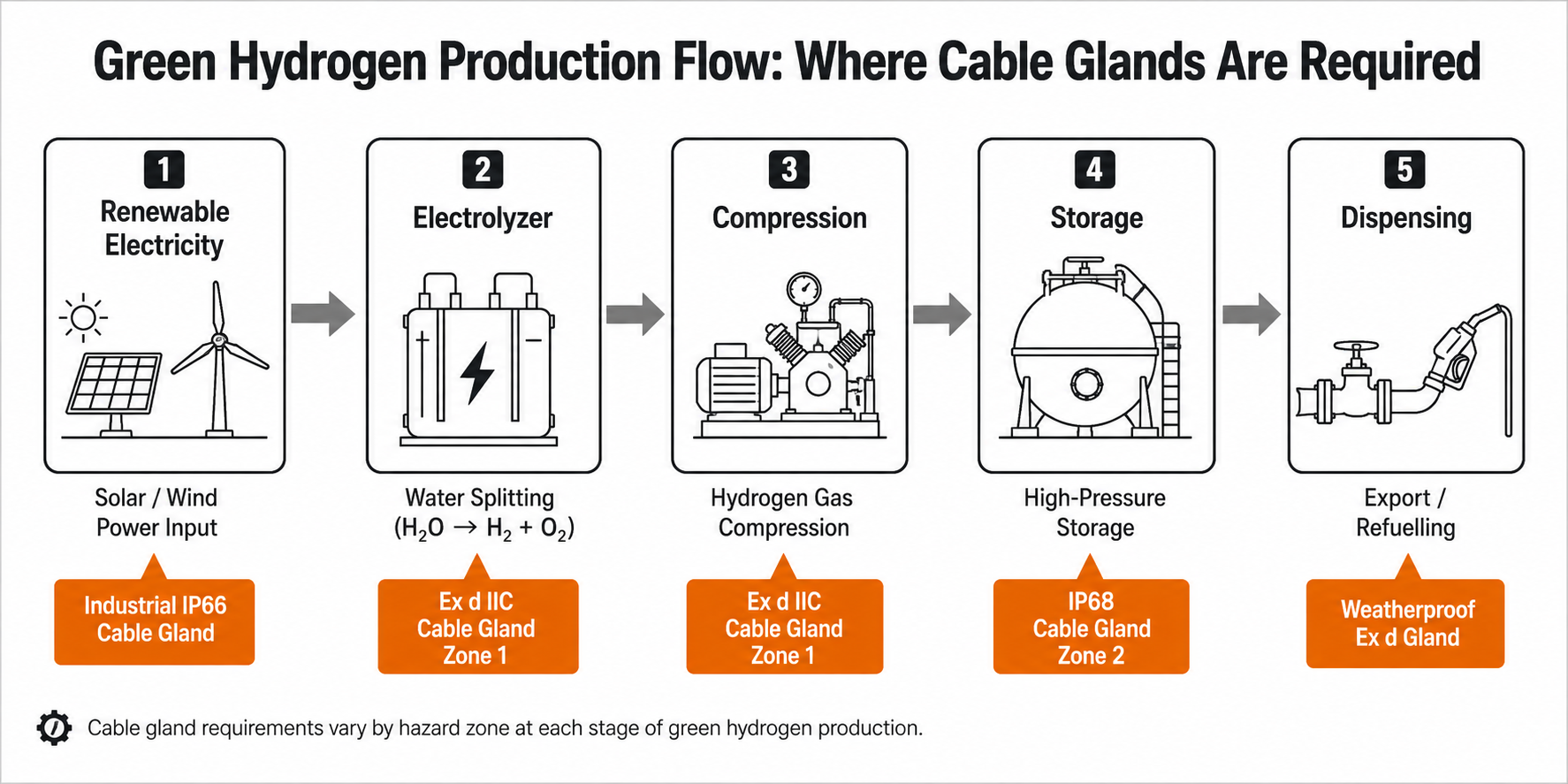
Water electrolysis splits H2O into hydrogen and oxygen using direct current electricity. In an alkaline or PEM (proton exchange membrane) electrolyzer, this reaction happens continuously as long as power is supplied, producing hydrogen gas at the cathode and oxygen at the anode. The hydrogen output is then compressed, dried, and either stored in high-pressure vessels or routed directly to downstream use such as ammonia synthesis or refinery hydrogenation.
Each stage of this process has a distinct cable gland requirement, driven by the equipment and hazard classification at that point in the plant.
Cable Gland Application Points Across the Production Flow
| Production Stage | Equipment | Hazard Context | Cable Gland Requirement |
|---|---|---|---|
| Renewable power input | Solar/wind feeder cables to rectifier | Non-hazardous, outdoor | IP66/IP68 weatherproof gland |
| Electrolyzer stack | DC power feed, control and monitoring cabling | Zone 1 hydrogen present at electrode | Ex d IIC double compression |
| Hydrogen compression | Compressor motor, control panel | Zone 1 highest hydrogen concentration point | Ex d IIC double compression |
| Storage vessels | Pressure and level instrumentation | Zone 2 surrounding storage area | Ex d or Ex e, IP68 |
| Dispensing / pipeline export | Flow metering, valve actuators | Zone 1 or 2 depending on layout | Ex d IIC, weatherproof rated |
Green Hydrogen Plants in India: The National Green Hydrogen Mission
The Government of India launched the National Green Hydrogen Mission in January 2023 with an outlay of nearly ₹19,700 crore, targeting 5 million metric tonnes of annual green hydrogen production capacity by 2030. The mission is structured around production-linked incentives for electrolyzer manufacturing and green hydrogen production, alongside pilot projects across steel, mobility, and shipping.
Several large Indian industrial groups have announced green hydrogen production capacity as part of this mission. NTPC has commissioned pilot green hydrogen projects at its existing thermal power sites, using surplus renewable capacity to power electrolyzers. Reliance Industries has announced large-scale green hydrogen manufacturing ecosystem plans at its Jamnagar complex, the same industrial belt where Exgrip manufactures its certified cable gland range. Adani New Industries and SAIL have separately announced green hydrogen and green ammonia capacity tied to steel decarbonisation. Each of these projects requires the same underlying electrical infrastructure: Zone 1 classified electrolyzer and compression areas, and cable entries that carry Ex d IIC certification specific to hydrogen service.
Hazardous Area Classification in Green Hydrogen Plants: Why Gas Group IIC Matters
IEC 60079 divides Group II gases into three sub-groups based on how easily they ignite and how much pressure their ignition generates inside a flameproof enclosure. Group IIA covers gases like propane and methane. Group IIB covers ethylene and most petrochemical process gases this is the classification referenced throughout Exgrip’s flameproof cable gland guide for oil refinery and chemical plant applications. Group IIC covers hydrogen and acetylene, the two gases with the widest flammability range and lowest ignition energy of any industrial gas group.
A cable gland certified Ex d IIB is not automatically suitable for hydrogen service. The flame path tolerances required to contain an internal ignition safely are tighter for Group IIC than for IIB, because hydrogen’s smaller molecule size and lower ignition energy make flame propagation easier to achieve and harder to contain. Any cable gland specified for an electrolyzer, compressor, or storage area handling hydrogen must carry an explicit IIC rating on its certification a IIB-rated gland from an oil and gas project does not transfer to a green hydrogen application.
Zone classification within a green hydrogen plant follows the same logic covered in Exgrip’s guide to flameproof cable glands for hazardous areas in India: Zone 1 applies where hydrogen is likely to be present under normal operating conditions inside the electrolyzer stack enclosure and immediately around compression equipment. Zone 2 extends to the surrounding storage and dispensing area, where hydrogen presence is possible only under abnormal conditions.
ATEX, IECEx, and PESO Certification for Hydrogen Plant Cable Glands
Certification requirements for green hydrogen plant cable glands follow the same statutory structure as any other Indian hazardous area installation, with the added technical requirement of Gas Group IIC rating. ATEX and IECEx certification confirm the gland’s design has been tested against IEC 60079-1 for the relevant gas group for hydrogen service, this means the certificate must specifically reference IIC, not a general Ex d marking.
PESO approval remains a separate, mandatory layer for any facility in India handling compressed flammable gas, which includes green hydrogen production, storage, and dispensing infrastructure. As covered in Exgrip’s PESO approved cable glands compliance guide, ATEX or IECEx certification alone does not satisfy Indian statutory requirements a PESO approval certificate specific to the gland model and its IIC rating is required for installation in a PESO-regulated Indian facility. Given that green hydrogen is a relatively new regulatory category in India, project teams should confirm directly with their certifying body whether a specific green hydrogen facility falls under existing PESO petroleum/explosives rules or an updated framework, since this is an area still being clarified as the sector scales.
Double Compression vs Single Compression Cable Glands for Hydrogen Installations
Single compression cable glands are not suitable for Zone 1 areas in any hazardous gas application, and this holds without exception for hydrogen service. IEC 60079-1 requires independent sealing of the cable outer sheath and independent clamping of the armour wire at any Zone 1 cable entry a requirement only double compression glands satisfy. Given hydrogen’s narrow safety margin for flame containment, using anything less than a double compression Ex d IIC gland at an electrolyzer or compressor cable entry is not a cost-saving option available to project teams; it falls outside the certification scope entirely.
| Feature | Single Compression | Double Compression (Ex d IIC) |
|---|---|---|
| Zone 1 hydrogen service | Not permitted | Required |
| Armour wire clamp | Combined with sheath grip | Independent backnut/locknut clamp |
| Gas group rating available | Not applicable for Zone 1 | IIC (hydrogen, acetylene) |
| IP rating achievable | IP54 typical | IP66 / IP68 |
Cable Gland Sizing and Types for Green Hydrogen Plant Cabling
Cable gland size for green hydrogen plant cabling is determined by the same principle as any other armoured cable installation: measure the actual cable outer diameter from the drum label, not from a standard cross-section chart. Electrolyzer DC power feeders are typically larger-format SWA cable given the high current demand, running from M40 through M75 sizes, while control and instrumentation cabling around compression and storage areas typically falls in the M20 to M32 range. Exgrip’s cable gland selection tool covers the full size range with armour grip tolerances, and the cable gland selection chart is available as a downloadable PDF reference for site engineers building a material take-off.
Cable gland type selection for a green hydrogen plant follows the classification already established for other hazardous area work: double compression for all armoured Zone 1 and Zone 2 cable entries, Ex d IIC for electrolyzer, compression, and dispensing areas, and standard IP66/IP68 glands for non-hazardous renewable power feed cabling that never enters the classified zone. Brass is the standard body material; nickel-plated brass or 316 stainless steel is recommended for hydrogen facilities located near coastal sites, since several announced Indian green hydrogen projects including port-adjacent ammonia export facilities sit in exactly this environment.
Conclusion & Call-to-Action
India’s green hydrogen sector is moving from pilot projects to committed industrial capacity faster than its supporting infrastructure standards have fully matured, which puts pressure on EPC contractors and procurement teams to specify components correctly the first time. Gas Group IIC certification is the detail most likely to be missed by teams accustomed to IIB-rated equipment from conventional oil and gas work, and getting it wrong is not discovered until commissioning inspection, when replacement lead time becomes the project’s problem.
Exgrip manufactures Ex d IIC double compression cable glands in Jamnagar, Gujarat the same industrial belt hosting some of India’s largest announced green hydrogen manufacturing plans. The range carries ATEX, IECEx, and PESO certification, with documentation confirming the IIC gas group rating supplied at the time of order.
📩 Talk to our technical team today at Exgrip.com
📞 Or call us directly for quick assistance!
Contact Us:
📞 Phone: +91 9537118899
🌐 Website: www.exgrip.com
📩 Request a Quote: Contact Page
FAQs
What is the difference between green hydrogen and grey hydrogen?
Green hydrogen is produced by electrolysis powered entirely by renewable electricity. Grey hydrogen is produced from natural gas through steam methane reforming, a process that releases carbon dioxide. The hydrogen molecule itself is identical; the difference is the production method and its carbon footprint.
What is the National Green Hydrogen Mission?
It is the Indian government’s policy framework, launched in January 2023 with an outlay of nearly ₹19,700 crore, targeting 5 million metric tonnes of annual green hydrogen production capacity by 2030 through production-linked incentives for electrolyzer manufacturing and hydrogen production.
Why does hydrogen require Gas Group IIC cable glands instead of IIB?
Hydrogen has a smaller molecule size and lower ignition energy than gases in Group IIB, such as ethylene. This makes flame propagation easier to achieve inside a flameproof enclosure, so Group IIC certification requires tighter flame path tolerances that IIB-rated equipment does not meet.
Which areas of a green hydrogen plant are classified Zone 1?
The electrolyzer stack enclosure and the immediate area around hydrogen compression equipment are typically classified Zone 1, since hydrogen is likely to be present under normal operating conditions at these points. Surrounding storage and dispensing areas are generally classified Zone 2.
Can single compression cable glands be used anywhere in a green hydrogen plant?
Only on non-hazardous, unarmoured cabling outside the classified zone, such as renewable power feed cabling to the rectifier before it enters the electrolyzer building. Any armoured cable entry into a Zone 1 or Zone 2 area requires a double compression gland.
Does Exgrip supply Ex d IIC certified cable glands for hydrogen applications?
Yes. Exgrip’s double compression cable gland range, manufactured in Jamnagar, is available with Ex d IIC certification alongside ATEX, IECEx, and PESO approval, with gas group documentation confirmed at the time of order.