
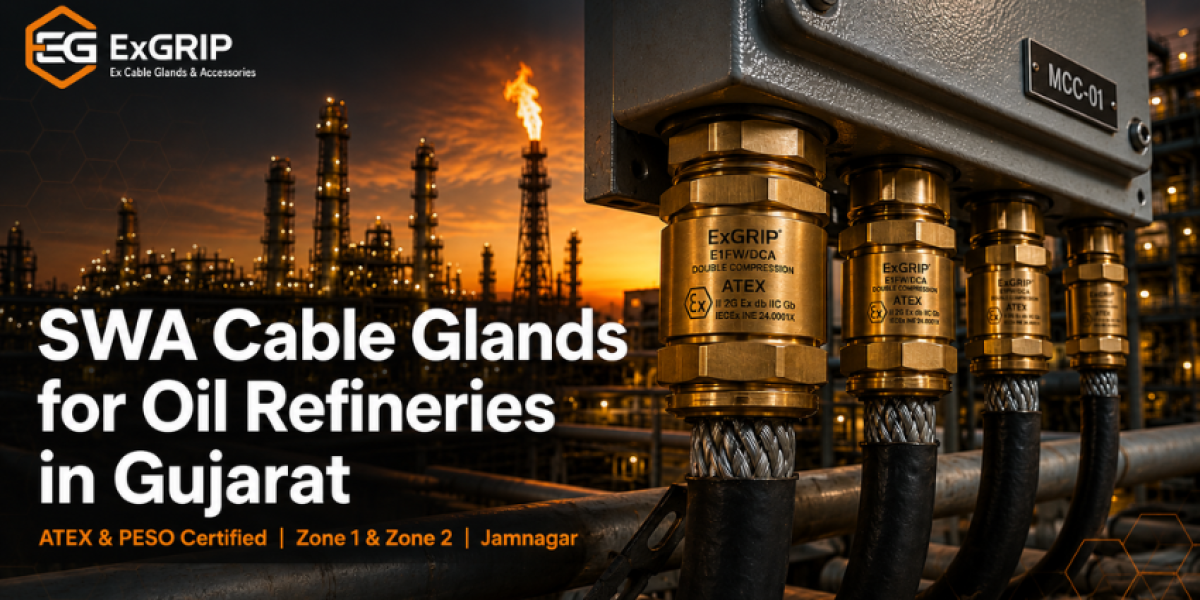
Gujarat is home to India’s densest concentration of oil refinery capacity. Reliance Industries’ Jamnagar complex 1.4 million barrels per day, the world’s largest refining site at a single location along with IOCL’s Vadodara refinery and the Shell-ONGC Hazira complex near Surat, collectively represent hundreds of kilometres of SWA armoured cable running through Zone 1 and Zone 2 classified process areas. Every termination on every SWA cable in those zones requires a double compression cable gland that is ATEX certified and PESO approved. A gland that carries only one of those qualifications, or neither, fails third-party inspection and in a PESO-regulated facility, that means a stop-work notice, not a snag list.
This guide covers the mandatory gland type for SWA cable in Gujarat oil refinery hazardous areas, the certifications that apply under Indian petroleum regulations, cable gland sizing for armoured cable, and the Exgrip double compression range certified for Zone 1 and Zone 2 refinery installations.
What Is SWA Cable and Why Gujarat Oil Refineries Use It?
SWA stands for Steel Wire Armoured. The armour layer galvanised steel wires wound over the cable’s inner cores serves two functions that make SWA cable the standard specification for hazardous area electrical installations in Gujarat refineries: it resists mechanical damage from impact, crushing, and cable tray abrasion; and when correctly terminated at both ends by a double compression gland, the armour wire provides a continuous supplementary earth path along the full cable run.
In a Gujarat oil refinery, SWA armoured cable appears across four main application types:
- 3-phase armoured cable motor feeders: From the Motor Control Centre (MCC) to pumps, compressors, and agitators in Zone 1 and Zone 2 classified process units
- Multicore SWA instrumentation cable: Carrying 4–20mA and HART signals between field instruments and the DCS/PLC control room across long process plant cable routes
- Underground power distribution: LV and MV SWA cable in direct-burial or ducted runs between substations and process area switchgear
- Control and safety system wiring: Fire and gas detection, ESD (Emergency Shutdown) cabling where armour provides both mechanical protection and screening
SWA and Armoured Cable Types in Gujarat Refinery Projects
| Cable Type | Armoured Wire | Common Sizes | Gujarat Refinery Application |
|---|---|---|---|
| SWA 3-phase (3 or 4-core) | Galvanised steel wire armour | 2.5mm² to 300mm² | Motor feeders, power distribution in process areas |
| SWA Multicore (7 to 37-core) | Galvanised steel wire armour | 0.75mm² to 2.5mm² per core | Instrumentation, control, and ESD cable runs |
| AWA (Aluminium Wire Armoured) | Aluminium wire armour | 16mm² to 400mm² | Larger LV/MV feeders; avoided near Jamnagar coast due to galvanic corrosion |
| XLPE/SWA Medium Voltage | Steel wire armour over XLPE | 50mm² to 630mm² | 6.6kV / 11kV substation feeders at Jamnagar and Vadodara |
Cable Gland Requirements for SWA Cable in Refinery Hazardous Areas
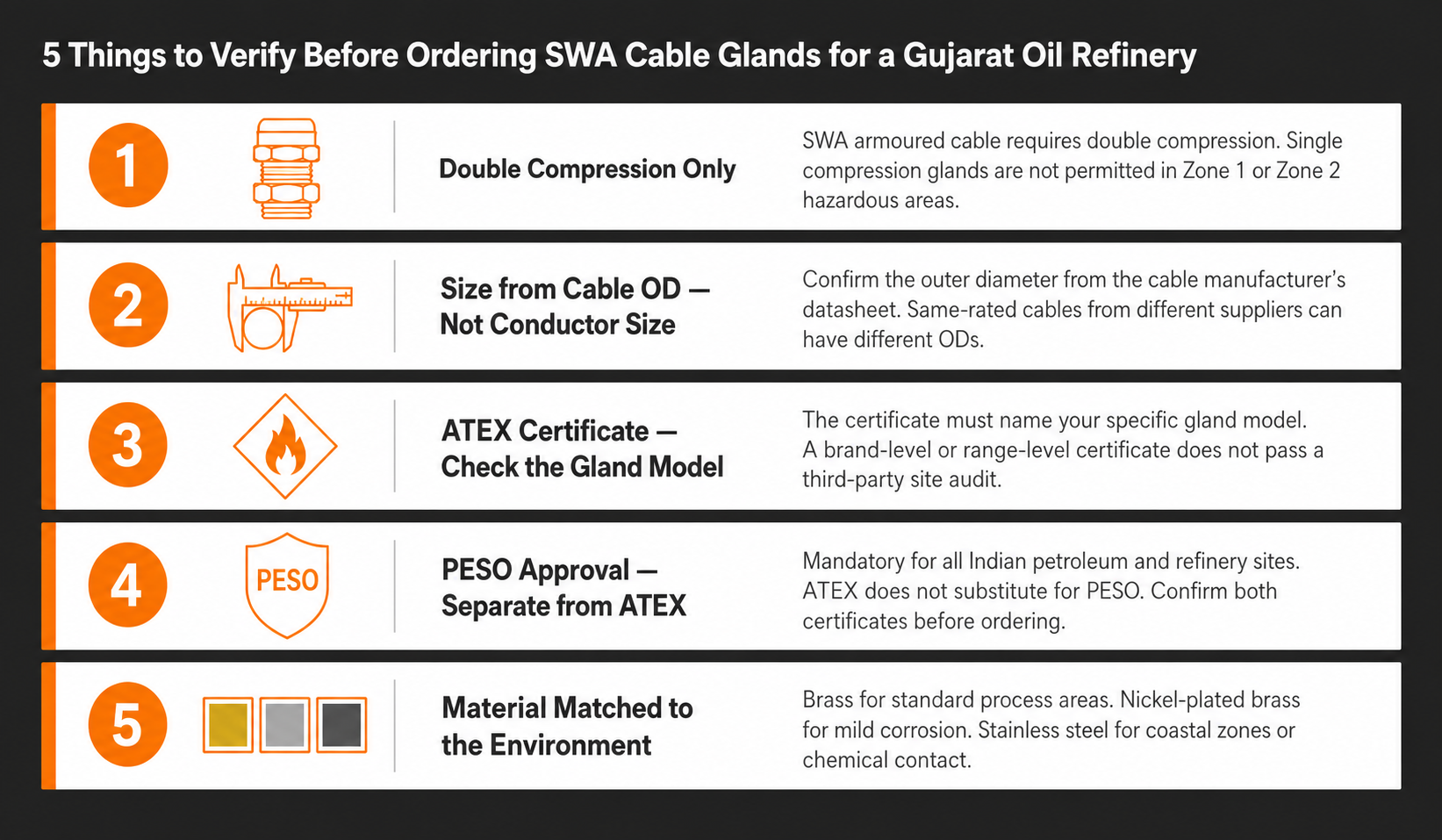
Every SWA cable termination in a Gujarat refinery Zone 1 or Zone 2 area requires a double compression cable gland. This is a requirement under IEC 60079-14, the standard governing electrical installation in explosive gas atmospheres. Single compression glands do not terminate the armour wire and are not permitted in any classified hazardous area regardless of the IP rating printed on the box.
The double compression design works in two stages: the first compression cone closes onto the steel wire armour, gripping the wires mechanically and making electrical contact for earth continuity; the second sealing ring compresses against the cable outer PVC sheath, achieving the IP rating. Both are needed. A single compression gland delivers only the second.
Single vs Double Compression Refinery Hazardous Area Comparison
| Specification | Single Compression | Double Compression |
|---|---|---|
| Suitable for SWA armoured cable | No | Yes |
| Armour wire termination | None armour left floating | First cone clamps steel wire armour |
| Earth continuity path | Cable earth conductor only | Armour wire + cable earth conductor |
| IP rating | IP66 / IP67 | IP66 / IP67 / IP68 |
| Zone 1 / Zone 2 permitted | No | Yes requires ATEX certification |
| Exgrip models | A2F, SCU, SCA (unarmoured cable only) | E1FW, DCA, DCU, DCAB, DCUB |
ATEX and PESO Certifications for Gujarat Oil Refinery Cable Glands
Two separate certification frameworks govern cable glands in Gujarat oil refineries. Both must appear on the gland certificate before any installation in a PESO-regulated facility.
- ATEX (Ex db / Ex eb / Ex ta): Required for Zone 1 and Zone 2 hazardous areas under IEC 60079. The certificate must name the specific gland model not the range or brand. Exgrip holds ATEX certification across Ex db (flameproof), Ex eb (increased safety), and Ex ta (dust ignition protection)
- IECEx: International equivalent of ATEX, required when the project specification calls for IECEx marking. Exgrip’s double compression range carries both ATEX and IECEx certification
- PESO: Petroleum and Explosives Safety Organisation approval is mandatory under Indian petroleum legislation for all cable glands in petroleum storage and refinery facilities including Reliance Jamnagar, IOCL Vadodara, and Shell-ONGC Hazira. PESO approval appears separately on the certificate from ATEX and cannot be substituted by it
- IP rating: IP66 minimum for enclosed process area cable entries; IP67 for outdoor process areas and exposed junction boxes; IP68 for direct-burial terminations
Sizing SWA Cable Glands for Gujarat Refinery Installations
Cable gland size is set by the cable outer diameter (OD) across the outer PVC sheath not by conductor cross-section or cable rating. On a Gujarat refinery project sourcing cables from multiple manufacturers (KEI, Polycab, LAPP, Havells), the OD of a 35mm² 4-core SWA cable differs between suppliers by up to 4mm. A gland schedule built on conductor size rather than OD produces sizing errors that only surface when the cable is being pulled.
- Get cable OD from the cable manufacturer’s technical datasheet the specification sheet, not the drum label
- Record armour wire diameter separately this determines the depth of the first compression cone engagement
- Confirm entry thread type on MCC, junction box, or field enclosure: Metric (M) for most Indian-spec equipment; NPT for US-spec equipment common on Reliance and HPCL projects
- Build the gland schedule from the OD column of the project cable schedule using Exgrip’s cable gland size chart it covers the full double compression range across all thread types and cable OD ranges
For individual cable queries, the Exgrip cable gland selection tool returns the correct model and size from cable OD and entry thread inputs directly.
Exgrip ATEX and PESO Certified SWA Cable Gland Manufacturer in Gujarat
Exgrip manufactures its double compression range at Udhyognagar, Jamnagar less than 15 kilometres from the Reliance refinery complex. For Gujarat refinery EPC and maintenance projects, this means no import clearance delays, no third-party certification sourcing, and direct manufacturer access for PESO documentation. All glands in the range are manufactured in Jamnagar’s brass engineering district, where alloy quality and machining tolerances are verifiable from the source.
| Model | Type | Material | ATEX | PESO | Max IP | Hazardous Area |
|---|---|---|---|---|---|---|
| E1FW | Double compression | Brass | Yes | Yes | IP68 | Zone 1, Zone 2 |
| DCA | Double compression | Brass | Yes | Yes | IP68 | Zone 1, Zone 2 |
| DCU | Double compression | Brass | Yes | Yes | IP68 | Zone 1, Zone 2 |
| DCAB | Double compression barrier | Brass | Yes | Yes | IP68 | Zone 1, Zone 2 |
| DCUB | Double compression barrier | Brass | Yes | Yes | IP68 | Zone 1, Zone 2 |
Thread sizes cover Metric (M), PG, and NPT. Full certifications, datasheets, and cable OD compatibility ranges are on the Exgrip oil and gas industry page.
Conclusion & Call-to-Action
SWA cable gland specification for Gujarat oil refineries is four decisions made at procurement: gland type (double compression, without exception, for all armoured cable in hazardous areas), gland size (from cable OD on the manufacturer’s datasheet, not from conductor cross-section), certifications (ATEX protection concept and PESO approval both confirmed on the specific gland certificate), and material (brass for standard process areas, nickel-plated brass for mild corrosion exposure, stainless steel for coastal zones near the Jamnagar port and Hazira marine environment).
Exgrip manufactures the certified double compression range in Jamnagar with supply to refinery projects across Gujarat. Browse the certified product range on the products page, or use the cable gland selection tool to confirm the correct gland for your cable before the purchase order is raised.
📩 Talk to our technical team today at Exgrip.com
📞 Or call us directly for quick assistance!
Contact Us:
📞 Phone: +91 9537118899
🌐 Website: www.exgrip.com
📩 Request a Quote: Contact Page
FAQs
What cable gland is required for SWA cable in a Zone 1 oil refinery area?
A double compression cable gland with ATEX certification for Zone 1 is required. The gland must carry an Ex db, Ex eb, or Ex ta marking (depending on the protection concept specified in the area classification drawing) plus a PESO approval certificate for installations in Indian petroleum facilities. Single compression glands are not permitted in Zone 1 or Zone 2 classified areas, regardless of their IP rating. Exgrip’s E1FW, DCA, and DCU models cover Zone 1 and Zone 2 with full ATEX, IECEx, and PESO certification.
Do cable glands for Gujarat oil refineries need PESO approval?
Yes. PESO (Petroleum and Explosives Safety Organisation) approval is a mandatory Indian regulatory requirement for cable glands installed in petroleum storage and refinery facilities. This applies to all major Gujarat refinery sites including Reliance Jamnagar, IOCL Vadodara, and Shell-ONGC Hazira. PESO approval must appear on the gland certificate independently from ATEX or IECEx it is a separate Indian national requirement, not covered by international certifications. Exgrip holds PESO approval across the full double compression range.
What is the difference between single and double compression cable glands?
A single compression gland seals only against the cable outer sheath. It has no mechanism to clamp the armour wire on SWA cable, which means the armour is left unterminated no earth continuity, no mechanical retention of the armour at the entry point. A double compression gland adds a first compression cone that grips the steel wire armour, providing earth continuity and mechanical retention. For SWA cable in any application, single compression glands are the wrong specification. In a Zone 1 refinery area, using one is an ATEX non-conformance.
Are barrier cable glands required for any Gujarat refinery SWA cable installations?
Yes, in specific applications. Barrier cable glands (Exgrip DCAB and DCUB) are required where the cable entry into an enclosure must be gas-tight preventing flammable gas from migrating through the cable cores from the hazardous area into the enclosure. This applies to cables entering pressurised (Ex p) enclosures or where the area classification drawing specifies a gas-tight cable entry. For standard Zone 1 and Zone 2 SWA cable terminations into flameproof (Ex d) or increased safety (Ex e) enclosures, standard double compression glands (E1FW, DCA, DCU) are the correct specification.
How do I select the correct cable gland size for SWA cable at a Gujarat refinery?
From the cable outer diameter (OD) on the cable manufacturer’s technical datasheet not the conductor cross-section. On Gujarat refinery projects with cables from multiple manufacturers, the OD of identical-rated SWA cables can vary by several millimetres. Exgrip’s cable gland size chart is indexed by cable OD across the full double compression range, which is the correct basis for building a gland schedule from the project cable schedule.