Choosing cable gland seal materials requires more than matching a rubber name to a site condition. The seal must stay in contact with the cable or enclosure interface while exposed to the actual temperature, moisture, chemicals and mechanical loading at that point. For engineers specifying cable glands for projects in Jamnagar, Gujarat, and elsewhere in India, the useful question is not which compound is best in general, but which compound is documented for the service conditions.
Neoprene, Silicone and EPDM each have useful characteristics, but they are not interchangeable. This guide compares their typical material behaviour, explains the difference between a cable-sealing insert and an enclosure sealing washer, and gives engineers and procurement teams a practical way to specify the right elastomer without assuming a product option or a temperature limit that has not been verified for the chosen gland.
Start by identifying which seal you are specifying
Before comparing the materials, identify where each seal sits. A gland can contain multiple elastomers, and each seals a different interface.
Cable-sealing insert or grommet
The insert compresses around the cable sheath. Its job is to create contact around the cable’s outside diameter while the gland is assembled as intended. Cable diameter, sheath condition, insert geometry and the specified compression range all affect the result. An insert that is chemically compatible but too large, too small or damaged can still fail to seal properly.
Enclosure sealing washer or O-ring
Where the gland design uses a washer or O-ring at the enclosure entry, this component seals the interface between the gland body and the enclosure face. It experiences a different contact surface and compression condition from the cable insert. Confirm whether the selected gland uses an entry washer, an O-ring or another specified sealing arrangement before ordering replacement seals.
When a supplier lists a sealing material, ask which component the material applies to. Do not assume the insert and washer use the same compound unless the product documentation says so. If a drawing calls it a washer rubber seal, confirm the exact component and gland model before choosing the compound.
EPDM: a strong option for water and outdoor exposure
EPDM stands for ethylene propylene diene monomer. EPDM material properties relevant to cable glands include resistance to water, weathering, ozone and ageing. For an enclosure exposed to rain, sunlight or regular washdown, those properties may make EPDM a suitable candidate, provided the exact compound and gland configuration are rated for the operating conditions. National Rubber Corporation’s EPDM material guide also identifies weathering and water resistance as common strengths, while cautioning against petroleum oils and fuels.
EPDM rubber properties vary by compound. Suitability for hot water, steam or cleaning chemicals must be checked against the specific seal data; formulation, hardness, cure system, compression and exposure time all affect performance. Use the manufacturer’s data for the specific seal rather than borrowing a generic temperature range from a general-purpose rubber guide.
The main limitation is compatibility with petroleum oils, greases, fuels and many hydrocarbon-based fluids. EPDM can swell or soften when exposed to incompatible media, which can reduce contact pressure around the cable or enclosure entry.
For an EPDM seal or EPDM washer, record every medium that can reach the entry, including oil mist or cleaning chemicals from nearby equipment.
Neoprene: a general-purpose compound with defined trade-offs
Neoprene rubber, also called chloroprene rubber and abbreviated CR, is used in industrial sealing where a balance of weathering resistance, physical properties and moderate oil resistance is needed. It can suit some general-purpose cable-gland sealing applications, but the compound must be checked against the conditions at the entry.
Compared with EPDM, Neoprene may be a better candidate for some environments where limited contact with oil or grease is possible. That is not the same as saying it is suitable for all petroleum products. Chemical composition, concentration, temperature and duration of contact can change compatibility. If a gland is exposed to hydraulic oil, cleaning solvent or process chemical, obtain a compatibility statement for the named medium and the exact compound.
Neoprene can provide useful weathering and ozone resistance, but performance depends on formulation and mechanical demands. Do not select it solely because a replacement has the correct dimensions: dimensional fit does not establish chemical suitability or approval for the gland assembly.
In purchasing documents, include the Neoprene material name and supplier’s compound or part reference where available; “Neoprene washer” alone may not identify the correct grade.
Silicone: useful when temperature flexibility is a priority
A silicone cable gland seal, commonly identified as VMQ, may be selected where the compound must remain flexible across a broad temperature range. It also has good resistance to ozone and weathering. These characteristics make silicone a candidate for some hot or cold environments where other elastomers may become too stiff or exceed their documented service limits. Seal-material reference data for Silicone likewise warns that temperature figures are approximate and depend on the application.
Silicone is not automatically the strongest choice. Some compounds have lower tear and abrasion resistance, so a sharp sheath edge, damaged insert or incorrect assembly can harm the sealing lip. Silicone also has limitations with many oils and fuels.
Consider installation as well as operating conditions. A compound suitable for the temperature may still fail if it is nicked during fitting or exposed to repeated movement. Cable support, sheath condition, insert design and the manufacturer’s procedure remain part of the specification.
Do not copy a temperature range from a different silicone gasket or O-ring into a cable-gland datasheet. A supplier’s stated range applies to a defined product or compound and its test conditions, not to all silicone seals.
Neoprene vs Silicone vs EPDM: comparison table
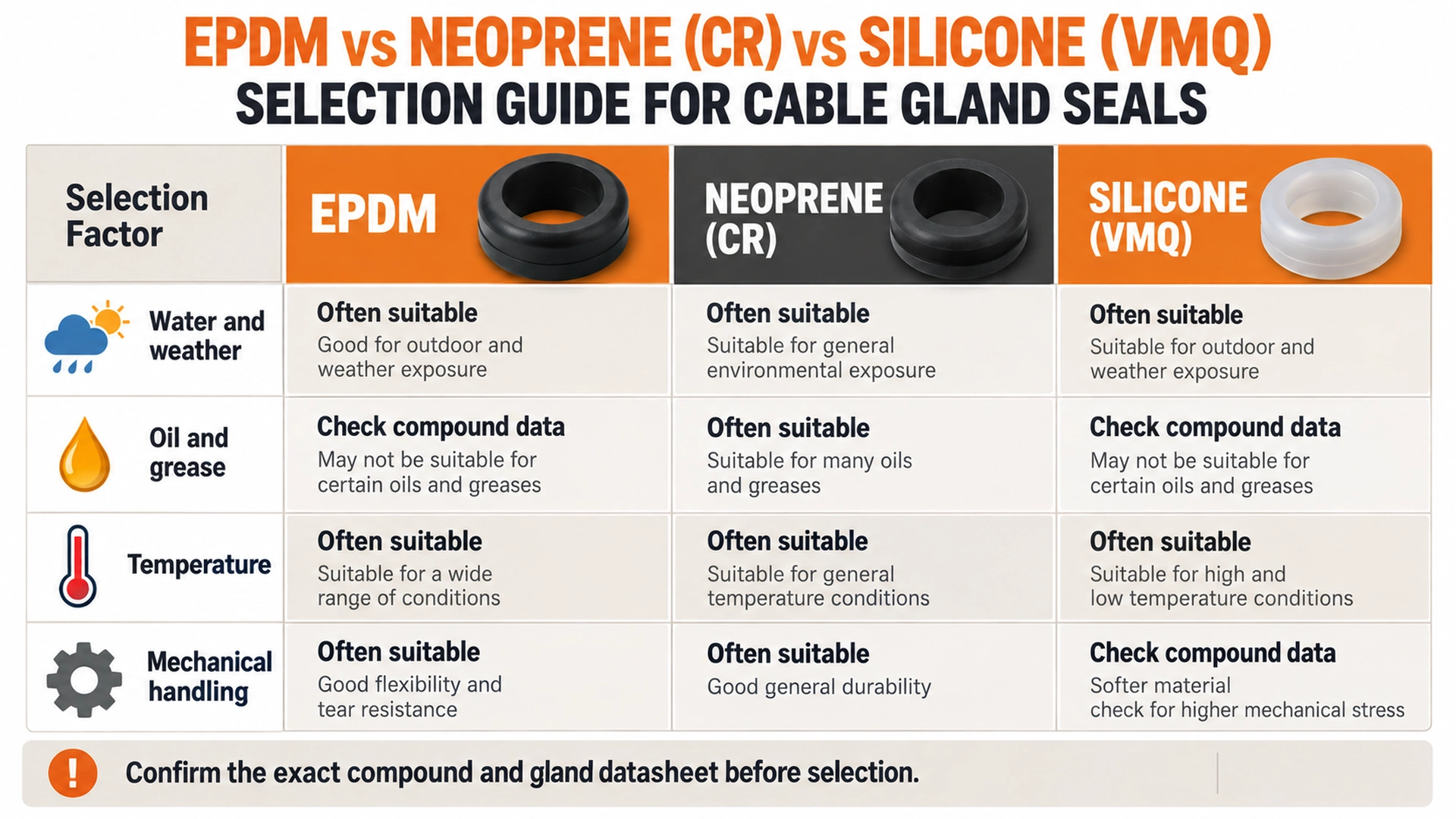
The table below is a screening comparison for early specification work. It describes common material tendencies, not guaranteed performance limits for every commercial compound. For final selection, use the manufacturer’s technical data for the actual seal component and the expected service conditions.
| Selection factor | EPDM | Neoprene (CR) | Silicone (VMQ) |
|---|---|---|---|
| Water and washdown | Often a strong candidate | May be suitable, subject to compound data | May be suitable, subject to compound data |
| Weather, ozone and UV | Generally very good | Generally good | Generally very good |
| Petroleum oil and grease | Generally a poor choice | Compatibility must be checked for the specific medium | Often limited; verify the exact compound |
| Broad temperature exposure | Compound-specific limits apply | Compound-specific limits apply | Often selected for wide temperature flexibility |
| Tear and abrasion concerns | Check compound and seal geometry | Check compound and seal geometry | Pay close attention to tear and handling risk |
| Best selection basis | Water, weather, ozone and the exact chemical environment | Balanced properties with verified media compatibility | Temperature demands balanced against mechanical and chemical exposure |
Use this as screening guidance only: compatibility ratings vary with compound, concentration, temperature, strain and exposure duration. Trelleborg’s chemical compatibility guide likewise says reference limits must be assessed against actual service conditions.
Choose the seal against the environment at the gland entry
Rain, sunlight and routine washdown
Where the gland is outdoors or exposed to water and ozone, EPDM is often a sensible candidate. Confirm that the seal compound is suitable for any detergents or sanitising agents used at the site. If oil or fuel can also reach the entry, do not choose EPDM based on weather resistance alone. The exposure at the gland is what matters.
Oil mist, grease or hydraulic equipment nearby
Do not default to EPDM where petroleum oil or grease may contact the seal. Consider Neoprene only if the supplier confirms compatibility with the fluid and conditions. For aggressive media, request a written recommendation rather than relying on a generic chart.
High or low temperatures
Silicone may be a candidate when the entry experiences temperature extremes, but the maximum and minimum values must come from the actual gland and seal documentation. Check whether the stated limit is continuous or intermittent, and consider temperature cycling, compression and the enclosure interface. A high rating for a seal material does not raise the limit of the complete cable gland assembly.
Cleaning chemicals or process fluids
List chemicals that may reach the gland, including cleaning products and maintenance fluids. Record the name, concentration, temperature and contact duration. “Chemical resistant” is not enough to approve a seal for a specific process.
The seal is only one part of cable-gland suitability
Material selection cannot replace checking the gland itself. Cable outside diameter, cable construction, entry thread, enclosure thickness, environmental protection and the gland’s intended application must all match the installation. Exgrip’s Cable Gland Selection Chart can help with the broader gland selection process, but the specific seal compound still needs confirmation from the applicable product documentation.
The gland body and the elastomer also face different exposures. Brass, nickel-plated brass and stainless steel glands have different material characteristics, but a corrosion-resistant body does not make an incompatible seal suitable for the same environment. Conversely, choosing a suitable elastomer does not establish that the body, thread or complete assembly is fit for the application.
For equipment in a classified hazardous area, do not substitute an insert, washer or other component solely because its dimensions appear to match. Confirm that any replacement is permitted by the manufacturer’s documentation and remains within the approved ATEX cable gland configuration. The approval applies to the documented assembly, not to an isolated material name.
What to specify when requesting a cable gland
A useful enquiry gives the supplier the operating facts needed to recommend a seal, rather than requesting a material by name alone. Include the following information where it is relevant to the installation:
- Seal location: Identify whether the requirement is for the cable compression insert, enclosure washer, O-ring or another component.
- Cable details: Provide cable construction, sheath material and measured outside diameter, along with the required gland type and entry thread.
- Environmental exposure: State indoor or outdoor location, direct sunlight, water, washdown, ozone and expected contamination.
- Chemical contact: Name the process fluids, oils, greases and cleaning chemicals, with concentration and temperature where known.
- Temperature profile: Give normal operating temperature, minimum ambient, peak temperature and whether peaks are continuous or intermittent.
- Approval and records: Identify any project specification, hazardous-area requirement, certificate reference or approved parts list that governs substitutions.
Ask the supplier to confirm the seal compound, component part number and applicable service limits in writing. If the supplier cannot identify the compound or its compatibility basis, the selection is not complete. Keep the confirmed information with the equipment or cable-gland schedule so maintenance teams can identify the correct replacement later.
Conclusion & Call-to-Action
EPDM, Neoprene and Silicone solve different sealing problems. EPDM is often attractive for water and weather exposure, Neoprene can provide a useful balance of properties when the exact medium is compatible, and Silicone is often considered when temperature flexibility is a priority. None is the automatic winner for every cable gland.
The decision should start with the sealing location and the environment at that point, then be checked against the actual compound and gland documentation. Before specifying a replacement or approving a new gland, confirm the seal component, cable dimensions, entry interface and required product approvals. Exgrip’s cable gland product range and technical reference provide the next points to review when checking a suitable gland configuration.
📩 Talk to our technical team today at Exgrip.com
📞 Or call us directly for quick assistance!
Contact Us:
📞 Phone: +91 9537118899
🌐 Website: www.exgrip.com
📩 Request a Quote: Contact Page
FAQs
Is EPDM better than Neoprene for cable gland seals?
Not in every application. EPDM is generally strong in water, weather and ozone exposure, while Neoprene may be considered for some service environments requiring a different balance of properties. Confirm the exact fluid, temperature and compound before selecting either material.
When should Silicone be considered for a cable gland seal?
Silicone may be suitable where wide temperature flexibility and weathering resistance are priorities. Check the particular compound’s chemical compatibility and mechanical properties, especially tear resistance during installation and exposure to oils or fuels.
Can the cable-sealing insert and enclosure washer use different materials?
They can differ in some product designs, because they seal separate interfaces and may experience different conditions. Do not assume that they are the same compound; check the product-specific parts list or supplier documentation.
Does EPDM resist oil and fuel?
EPDM is generally a poor choice for petroleum oils, greases and many fuels because the material can swell or soften. If oil exposure is possible, obtain a documented compatibility recommendation for the exact fluid and seal compound.
Can I use a generic temperature range for every seal material?
No. The cable gland seal temperature range depends on the compound, gland design, compression and service conditions. Use the documented limits for the specific configuration and check whether they apply continuously or intermittently.
Does a stainless steel cable gland always need a Silicone seal?
No. The gland body and the sealing compound are selected against different requirements. Stainless steel may be chosen for body corrosion resistance, while the elastomer must be selected for cable contact, temperature and chemical compatibility.
Can I replace an EPDM seal with Neoprene if the size is the same?
Matching dimensions alone are not enough. Confirm compatibility with the operating environment and verify that the replacement is permitted for the specific gland model, especially where product approvals or hazardous-area certification apply.
What information should I send a supplier to select a seal material?
Provide the seal location, cable data, expected temperature range, chemicals that may contact the entry, outdoor or washdown exposure, and relevant project or approval requirements. Ask for the proposed compound and its documented suitability in writing.