
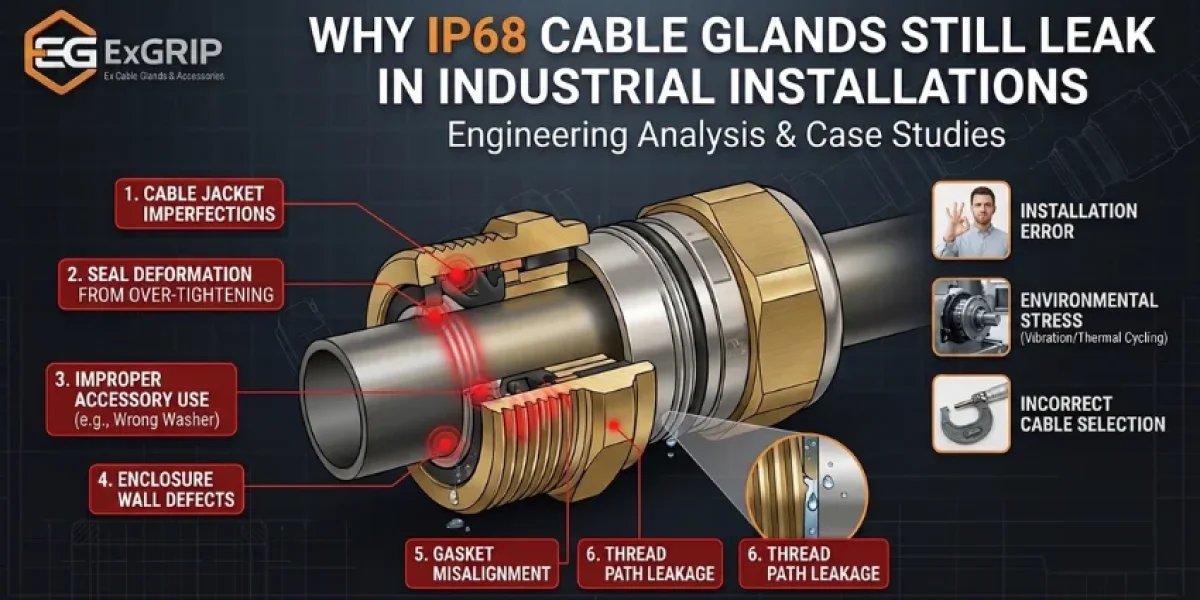
Industrial engineers often assume that installing an IP68 cable gland automatically guarantees complete waterproof protection. However, many industrial failures still happen because of water ingress, dust entry, incorrect gland sizing, or poor installation practices.
In real industrial environments like oil & gas plants, chemical factories, marine systems, solar projects, and outdoor electrical panels, even a certified IP68 cable gland can leak if the installation is not properly engineered.
At ExGrip, industrial cable gland systems are designed for harsh environments with IP66, IP67, and IP68 protection, including double compression cable glands, flameproof cable glands, reducers, adapters, stopping plugs, and hazardous-area accessories.
This guide explains the real reasons behind leakage problems, how to select the correct gland size, common installation mistakes, and how industrial users can achieve long-term sealing reliability.
What Is an IP68 Cable Gland?
An IP68 cable gland is a cable entry device designed to provide:
- Protection against dust ingress
- Protection against continuous water immersion
- Mechanical cable retention
- Strain relief
- Environmental sealing
- Armour grounding continuity (for armoured cables)
The “IP68” rating means:
| Rating | Meaning |
|---|---|
| IP6X | Complete dust protection |
| IPX8 | Protection against long-duration water immersion |
Why Do IP68 Cable Glands Still Leak?
Wrong Cable Gland Size Selection
One of the biggest causes of leakage is incorrect cable gland sizing.
Many installers choose glands based only on conductor size instead of:
- Outer cable diameter
- Armour thickness
- Inner bedding diameter
- Cable construction type
For example:
- A 300 sq mm cable gland size
- A 4 core cable gland size chart
- A 3.5 core 300 sq mm cable gland size
- A 120 sq mm cable gland size
all require different sealing ranges depending on the cable manufacturer.
Even if the conductor size is identical, the outer sheath diameter may vary significantly.
Common ResultIf the cable diameter is smaller than the sealing range:
- The sealing ring cannot compress properly
- Water enters through the gap
- IP68 protection fails
This is why engineers always refer to:
- Cable gland size chart
- Cable gland selection chart
- Cable and gland size chart
- Double compression cable gland size chart PDF
- Electrical cable gland size chart PDF
before installation.
Improper Tightening Torque
Over-tightening and under-tightening both create sealing problems.
Under-tightening Causes- Loose sealing ring
- Water ingress
- Cable movement
- Dust penetration
- Damaged sealing insert
- Cracked sealing material
- Cable sheath deformation
- Reduced gland life
Industrial sites often use adjustable spanners instead of calibrated torque tools, leading to inconsistent sealing.
Incorrect Cable Type for the Gland
Not every gland works with every cable.
Using an armoured cable gland on an unarmoured cable or vice versa creates sealing gaps.
Typical Mismatches
| Cable Type | Incorrect Gland Result |
|---|---|
| SWA Cable | Improper armour clamping |
| XLPE Cable | Poor bedding seal |
| Flexible Cable | Cable pull-out |
| Braided Cable | Uneven compression |
This is why manufacturers provide:
- Cable gland types and sizes
- Electrical cable gland type and size
- Cable gland sizing chart
- Armoured cable gland size chart
Poor Installation of Double Compression Cable Glands
A double compression cable gland seals at two locations:
- Inner sheath
- Outer sheath
If either compression stage is improperly assembled:
- Water tracks through the cable
- Moisture reaches the enclosure
- IP68 sealing fails
Many installers tighten only the outer compression nut and ignore the inner seal.
This is especially dangerous in:
- Hazardous areas
- Outdoor panels
- Marine installations
- Underground cable systems
ExGrip’s DCA, DCAB, and E1FW double compression cable glands are designed specifically to provide dual sealing for industrial reliability.
Missing Accessories and Sealing Components
An IP68 gland system is incomplete without proper accessories.
Common Missing Components
- O-rings
- IP washers
- Shrouds
- Locknuts
- Earth tags
- Entry thread sealant
- Reducers and adapters
Without these components, water can enter through:
- Thread interfaces
- Panel gaps
- Uneven surfaces
At ExGrip Products, cable gland kits include multiple sealing accessories for industrial-grade installation.
Parts of an IP68 Cable Gland
Main Components
| Component | Function |
|---|---|
| Entry Thread | Connects gland to enclosure |
| Compression Nut | Compresses sealing system |
| Seal Ring | Creates waterproof seal |
| Armour Clamp | Secures cable armour |
| Locknut | Locks gland to panel |
| Washer | Improves sealing |
| Shroud | External environmental protection |
Types of Cable Glands Used in Industrial Installations
Single Compression Cable Gland
Suitable for:
- Indoor use
- Light industrial applications
- Unarmoured cables
- Lower cost
- Easier installation
- Compact design
Less effective in high-moisture environments.
Double Compression Cable Gland
Used for:
- Outdoor systems
- Hazardous areas
- Armoured cables
- Marine applications
Advantages
- Dual sealing
- Better strain relief
- Higher environmental protection
- Improved vibration resistance
These glands are commonly referenced in:
- Double compression gland size chart
- Compression gland size chart
- DC gland size chart
Flameproof Cable Glands
Designed for:
- ATEX areas
- IECEx environments
- Oil & gas plants
- Chemical industries
ExGrip manufactures certified flameproof glands with:
- Ex db
- Ex eb
- Ex ta
- IP66/IP67/IP68 protection
How to Select the Correct IP68 Cable Gland
Identify Cable Type
Determine whether the cable is:
- Armoured
- Unarmoured
- Braided
- Flexible
- SWA
- XLPE
Measure Cable Diameter
Never select based only on conductor size.
Measure:
- Outer sheath diameter
- Inner bedding diameter
- Armour diameter
Use a Cable Gland Size Chart
Always refer to:
- Cable gland size chart
- Cable gland chart
- Gland size chart
- Cable gland sizes chart
- Gland size chart with cable
- Cable size and gland size chart
before ordering.
Practical Cable Gland Size Reference Table
Common Industrial Cable Gland Sizing Examples
| Cable Type | Typical Cable Size | Approx. Gland Size |
|---|---|---|
| 3.5 Core Cable | 70 sq mm | M50 |
| 4 Core Cable | 120 sq mm | M63 |
| 3.5 Core Cable | 300 sq mm | M90 |
| 4 Core Cable | 300 sq mm | M100 |
| Armoured XLPE Cable | 240 sq mm | M80 |
| Control Cable | 16 sq mm | M25 |
Actual gland size depends on outer cable diameter and manufacturer specifications.
This is why industrial buyers often search:
- 300 sq mm cable gland size
- 300 cable gland size
- 300sqmm cable gland size
- 4 core 300 sq mm cable gland size
- 3.5 core 70 sq mm cable gland size
during procurement.
Industrial Applications Where Leakage Is Common
High-Risk Environments
- Oil & gas plants
- Offshore platforms
- Wastewater treatment plants
- Marine systems
- Solar power projects
- Underground cable installations
- Chemical industries
These environments require:
- Double compression armoured cable glands
- Corrosion-resistant materials
- Stainless steel glands
- Certified hazardous-area accessories
Recommended Accessories for Better IP68 Protection
| Accessory | Purpose |
|---|---|
| PVC Shroud | Additional weather protection |
| Earth Tag | Earthing continuity |
| Serrated Washer | Improves bonding |
| Locknut | Mechanical locking |
| Reducer | Thread conversion |
| Adapter | Thread compatibility |
| Stopping Plug | Unused entry sealing |
ExGrip also manufactures:
- Reducers
- Adapters
- Stopping plugs
- Y adapters
- 90° adapters
for complete industrial cable entry systems.
Why Engineers Prefer Double Compression IP68 Cable Glands
Industrial engineers prefer double compression cable glands because they provide:
- Better environmental sealing
- Improved cable retention
- Stronger armour clamping
- Higher vibration resistance
- Longer operational life
This is especially important in:
- Heavy industries
- Outdoor installations
- Hazardous zones
- Marine environments
Downloadable Resources Engineers Commonly Use
Engineers and procurement teams frequently use:
- Cable gland size chart PDF
- Electrical cable gland size chart PDF
- Armoured cable gland size chart PDF
- Double compression cable gland size chart PDF
These resources help ensure correct gland selection before installation.
You can also create internal links to:
- Double compression cable gland pages
- Flameproof cable gland guides
- Cable gland accessories
- Hazardous area installation guides
- Cable gland selection charts
Conclusion & Call-to-Action
Selecting the right cable gland, whether it’s a waterproof cable gland, brass cable gland, or using the correct cable gland accessories, is vital for industrial safety and system reliability.
At Exgrip, we provide a full range of cable glands, connectors, and accessories, certified with ATEX, IECEx, IP, RoHS, and REACH, suitable for any industrial or hazardous application.
📩 Talk to our technical team today atExgrip.com
📞 Or call us directly for quick assistance!
Contact Us:
📞 Phone: +91 9537118899
🌐 Website: www.exgrip.com
📩 Request a Quote: Contact Page
FAQs
What is the most common reason for IP68 cable gland leakage?
The most common reason is incorrect cable gland sizing. If the cable outer diameter does not match the gland sealing range, water ingress becomes possible even with an IP68-rated gland.
Are double compression cable glands better than single compression glands?
Yes. Double compression cable glands provide sealing at both the inner and outer sheath, offering better protection against moisture, vibration, and cable pull-out.
How do I select the correct cable gland size?
Measure the cable’s outer diameter and refer to a cable gland size chart or cable gland selection chart provided by the manufacturer.
Can I use the same gland for all cable types?
No. Different cable constructions require different gland designs. Armoured, unarmoured, braided, and flexible cables all need compatible glands.
Why are armoured cable glands important in industrial installations?
They provide:
- Armour grounding continuity
- Mechanical cable retention
- Improved environmental sealing
- Better protection in hazardous areas
What is the difference between IP67 and IP68 cable glands?
IP67 protects against temporary immersion, while IP68 is designed for longer-duration immersion under manufacturer-defined conditions.
Why do outdoor cable glands fail faster?
Outdoor installations face:
- UV exposure
- Rain
- Dust
- Vibration
- Temperature changes
- Corrosion
which increase sealing stress.
Which material is best for industrial cable glands?
Nickel-plated brass and stainless steel are widely preferred because of their corrosion resistance and mechanical strength.