
SS 304 vs 316 is one of the most searched material questions in Indian engineering, and for cable glands the answer is short. Use SS 304 indoors and in dry inland plants. Use SS 316 wherever salt, chlorides or regular chemical washdown reach the gland. Specify SS 316L when the project specification or the enclosure material calls for low-carbon stainless steel.
The rest of this guide explains why. It covers what SS 304, SS 316 and SS 316L are, how they differ, which differences matter on a threaded cable gland, and which grade suits which site. Exgrip makes stainless steel cable glands in all three grades, so the last section shows how to order the right one.
What Is SS 304?
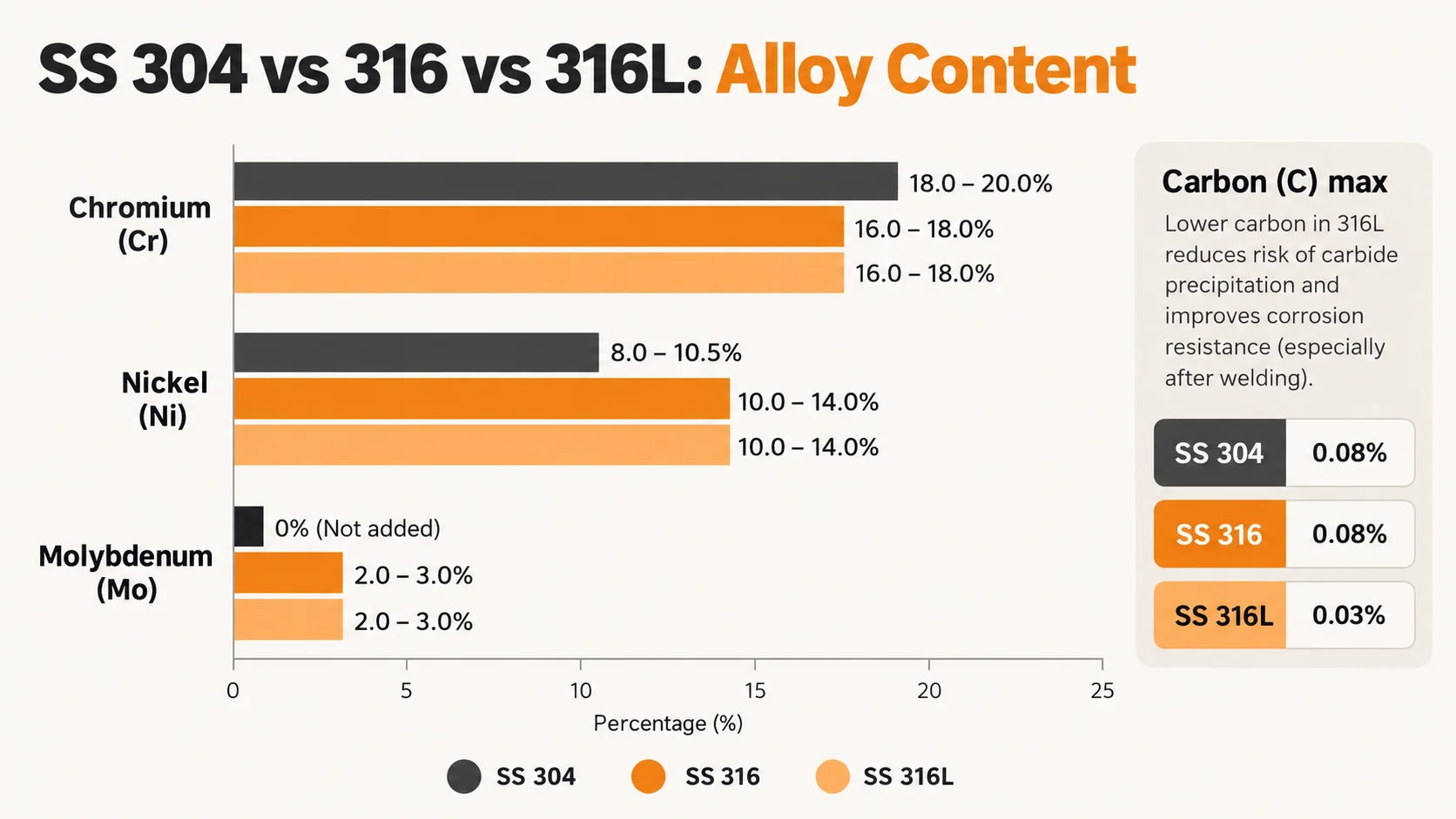
SS 304 is the most widely used stainless steel in the world. It is an austenitic grade with 18 to 20 percent chromium and 8 to 10.5 percent nickel, which is why it is often called 18/8 stainless. The chromium forms a thin oxide film on the surface that heals itself when scratched. That film is what makes stainless steel “stainless”.
SS 304 resists rust in normal air, fresh water and most mild chemicals. It is non-magnetic in the annealed condition, easy to machine compared with harder grades, and costs less than SS 316. Its weak point is chlorides. Salt air, seawater spray, chlorinated cleaning water and many process chemicals can break through the oxide film in small spots, and once that starts SS 304 pits. Above roughly 50 to 60 °C in a chloride environment, pitting and crevice attack on SS 304 become likely.
What Is SS 316?
SS 316, often written as 316 SS on drawings, is SS 304’s corrosion-resistant sibling. It has 16 to 18 percent chromium, 10 to 14 percent nickel and, the important part, 2 to 3 percent molybdenum. Molybdenum strengthens the oxide film against chloride attack.
The usual way to compare pitting resistance is the PREN number (Pitting Resistance Equivalent Number). SS 304 scores about 18 to 20. SS 316 scores about 24 to 28. That gap is why SS 316 grade stainless steel is the default near the sea and in chemical plants, and why it is often called marine grade. It costs more than SS 304, mainly because of the molybdenum and the higher nickel content.
What Is SS 316L, and How Is It Different from 316?
SS 316L is SS 316 with less carbon. The “L” stands for low carbon: a maximum of 0.03 percent, against 0.08 percent for standard 316. Chromium, nickel and molybdenum stay in the same ranges, so 316L stainless steel has essentially the same resistance to pitting as 316.
The difference shows up after heating. When ordinary 316 is welded or held at high temperature, carbon can combine with chromium at the grain boundaries. That leaves chromium-poor zones that corrode faster, a problem called sensitisation or intergranular corrosion. Keeping carbon low prevents it, which is why 316L SS is the standard choice for welded pipework, tanks and enclosures.
So the difference between SS 316 and 316L comes down to one question: will the part be welded or heated? We come back to what that means for a cable gland below.
SS 304 vs 316 vs 316L: Side-by-Side
Drawings and datasheets phrase it in different ways, SS 304 vs SS 316 or stainless steel type 304 vs 316, but the comparison comes down to the same few properties:
| SS 304 | SS 316 | SS 316L | |
|---|---|---|---|
| Chromium | 18–20% | 16–18% | 16–18% |
| Nickel | 8–10.5% | 10–14% | 10–14% |
| Molybdenum | None | 2–3% | 2–3% |
| Maximum carbon | 0.08% | 0.08% | 0.03% |
| Pitting resistance (PREN) | About 18–20 | About 24–28 | About the same as 316 |
| Chloride and salt resistance | Moderate | High | High |
| Resistance after welding | Can sensitise | Can sensitise | Resists sensitisation |
| Relative cost | Lowest | Higher | Similar to 316 |
| Typical gland use | Indoor and inland industrial | Coastal, chemical, washdown, offshore | Where specs or enclosures call for 316L |
Read the table as two decisions. First, 304 or the 316 family, decided by chlorides. Second, within the 316 family, 316 or 316L, decided by the specification and by whether anything around the gland is welded.
Difference Between SS304 and SS316 on a Cable Gland
Most 304 vs 316 stainless steel comparisons are written for sheet, pipe and tanks. A cable gland is a small threaded assembly with seals, and three things about that shape make the grade choice matter more than the gland’s size suggests.
- Crevices under the seals. The gap where a seal meets the metal body stays damp and starved of oxygen. That is exactly where chlorides concentrate and where SS 304 starts crevice corrosion first. SS 316’s molybdenum resists that attack.
- Thread galling. Stainless steel threads tightened against stainless steel can cold-weld and seize, which is called galling. It affects 304 and 316 alike, so the fix is the same for both: clean threads, the correct torque and a suitable anti-seize where the installation instructions allow it. Grade choice does not remove the need for care at installation.
- Mixed metals. An SS 316 gland in an SS 304 enclosure is fine. An SS gland in an aluminium or painted mild steel enclosure in salty air can set up galvanic corrosion on the enclosure side, so match or isolate where the site is coastal.
The practical rule: if salt, chlorides or chemical washdown can reach the gland, SS 304 is the wrong saving. For the wider choice between brass and stainless steel, see our guide to choosing a stainless steel cable gland over brass.
Does 316L Matter for a Cable Gland?
This is the question almost every 316 vs 316L article skips. A cable gland body is machined from bar, not welded. The main advantage of 316L, resistance to sensitisation during welding, does not apply to the gland itself.
316L still earns its place in three situations:
- The specification says 316L. Offshore, pharma and many chemical projects write “SS 316L” across all wetted and exposed parts. The gland has to match the material schedule to pass document review, whatever the metallurgy argument.
- The enclosure is welded 316L. Using the same grade for the gland and the enclosure keeps one material on the vendor document list and removes any question about mixed grades.
- High-temperature service. Where glands sit near hot equipment for long periods, low carbon gives extra margin against intergranular corrosion.
Outside those cases, SS 316 and SS 316L glands perform the same, and either is a correct choice for chloride environments.
Which Stainless Steel Grade for Which Site
| Where the gland is installed | Recommended grade | Why |
|---|---|---|
| Indoor panels, control rooms, dry inland plants | SS 304 | No chlorides; lowest cost |
| Outdoor inland sites with normal rain | SS 304, or 316 if close to cooling towers or chemical vents | Rainwater is low in chlorides; cooling tower drift is not |
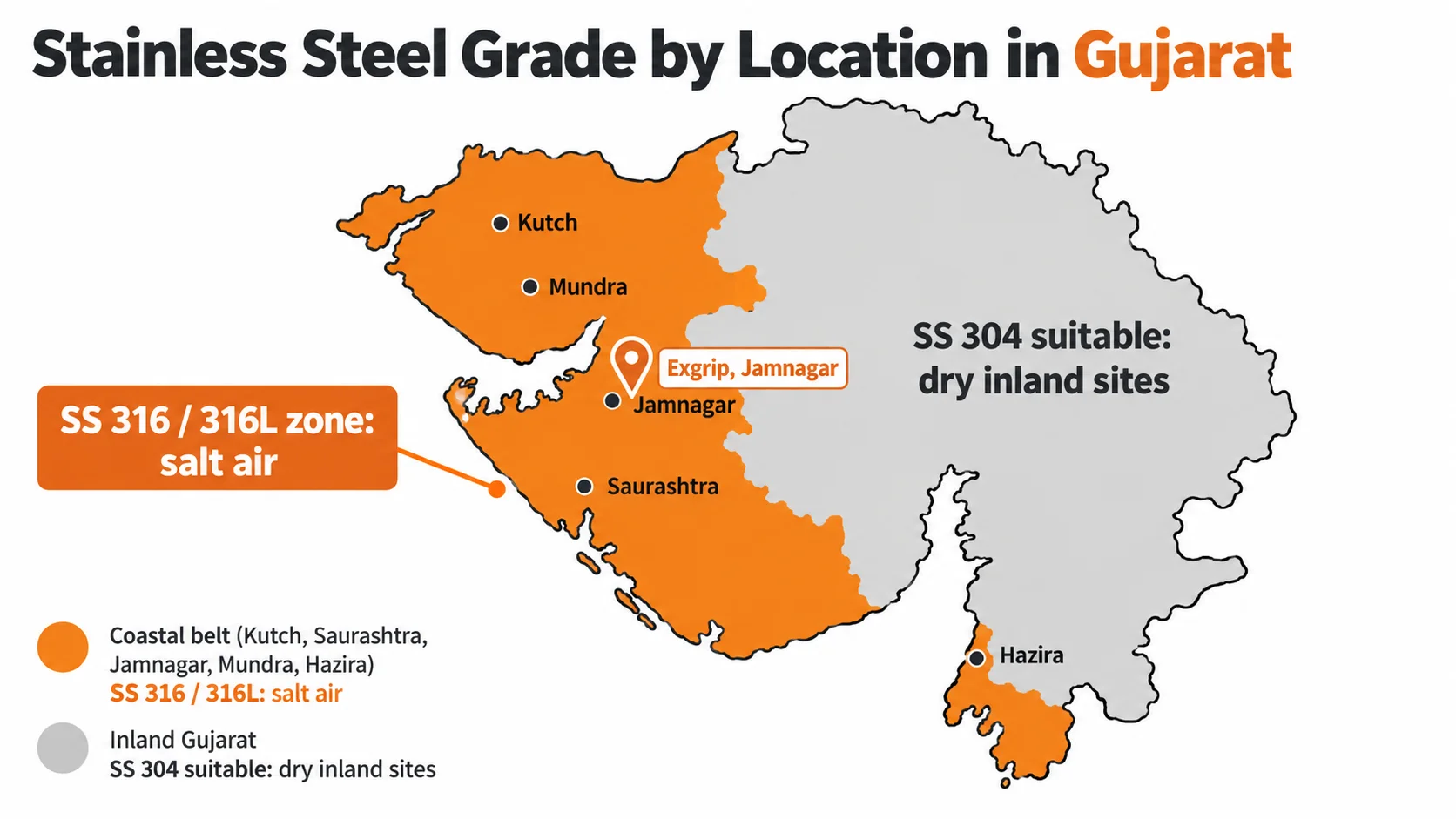
| Coastal sites (Saurashtra, Kutch, Jamnagar, Mundra) | SS 316 or 316L | Salt air can pit SS 304 within a few years |
| Offshore platforms and jetties | SS 316 or 316L | Continuous salt spray |
| Chemical and fertiliser plants | SS 316 or 316L | Chloride and acid vapours; washdown |
| Food, dairy and pharma washdown areas | SS 316 or 316L | Chlorinated cleaning water and hot washdown |
| Projects specifying 316L throughout | SS 316L | Material schedule compliance |
Material and hazardous area certification are separate decisions. A stainless steel gland is not flameproof because it is stainless; it is flameproof only if it carries Ex certification. Exgrip’s stainless steel glands carry the same ATEX, IECEx and PESO certification as the brass versions. For coastal work in detail, see our guide on stainless steel cable glands for marine applications and our page on marine and offshore cable glands. Chemical sites are covered on our cable glands for chemical plants page, and gas plants with H₂S in our guide to cable glands for compressed biogas plants.
Why SS 316 Costs More Than SS 304
Buyers comparing SS 304 price and SS 316 price per kg see a clear gap, and it comes from the alloy. SS 316 adds 2 to 3 percent molybdenum and needs more nickel, and both are expensive alloying metals whose prices move with global markets. That is why SS 304 rates and SS 316 rates change week to week, and why stainless steel gland price lists are revised more often than brass ones.
On a cable gland, the material is only part of the price. Size, compression type, certification and quantity all add to it. Even so, choosing SS 304 to save money on a coastal site usually costs more later, because a pitted gland loses its seal and has to be replaced along with the cable termination.
Exgrip Stainless Steel Cable Glands: 304, 316L and 316
Exgrip’s main glands are made in all three stainless steel grades, with the material shown by a code in the part number.
| Material code | Grade | Typical use |
|---|---|---|
| X1 | SS 304 | Indoor and inland industrial sites |
| X2 | SS 316L | Projects specifying 316L; welded 316L enclosures |
| X3 | SS 316 | Coastal, chemical, washdown and offshore sites |
The E1FW double compression cable gland for armoured cable and the A2F single compression cable gland for unarmoured cable are both available as SS 304 cable glands and as SS 316 and 316L cable glands. Every grade keeps the same certification: Ex db and Ex eb IIC Gb, Ex ta IIIC Da, ATEX, IECEx and PESO, IP66, IP67 and IP68, and an ambient range of −60 °C to +160 °C. Sizes run from M16 to M90 and 1/2″ to 3-1/2″ NPT. To compare ingress ratings in more detail, see our guide to IP ratings for cable glands.
Conclusion & Call-to-Action
Most stainless steel gland failures are not caused by a bad gland. They come from the wrong grade on the wrong site: SS 304 on a coastal jetty, or near a chemical vent, chosen because it was cheaper or because it was the grade on the last order. Decide by chlorides first, then by the specification. SS 304 for dry inland work, SS 316 wherever salt or chemicals reach the gland, and SS 316L when the material schedule asks for it.
Send us your site location, cable schedule and material specification, and Exgrip’s team will confirm the right grade for each gland, along with the certificate numbers for your documentation.
📩 Talk to our technical team today at Exgrip.com
📞 Or call us directly for quick assistance!
Contact Us:
📞 Phone: +91 9537118899
🌐 Website: www.exgrip.com
📩 Request a Quote: Contact Page
FAQs
Is 316 better than 304?
For corrosion resistance, yes. SS 316’s 2 to 3 percent molybdenum gives it much better resistance to chlorides and salt. For a dry indoor site, though, SS 304 performs just as well and costs less.
What is the difference between SS304 and SS316?
SS 316 contains 2 to 3 percent molybdenum and more nickel, while SS 304 has none. That raises its pitting resistance (PREN) from about 18-20 to about 24-28, which matters wherever salt or chlorides are present.
What is the difference between SS 316 and 316L?
Only carbon: 316L has a maximum of 0.03 percent against 0.08 percent for 316. Lower carbon protects against corrosion after welding. Corrosion resistance in normal service is essentially the same.
Can SS 304 cable glands rust?
Yes, in salty or chloride-rich air. SS 304 pits and shows rust spots near the sea, around chemical vents and where chlorinated water is used for cleaning. Use SS 316 or 316L in those places.
Why are cable glands not made from SS 303?
SS 303 has added sulphur to make it easier to machine, but the sulphur lowers its corrosion resistance compared with SS 304. For a part that must seal outdoors for years, SS 304 or 316 is the better choice.
Are stainless steel cable glands flameproof?
Only if they carry Ex certification. The material does not make a gland flameproof. Exgrip’s SS 304, 316 and 316L glands carry the same ATEX, IECEx and PESO certification as the brass range.
Which stainless steel grade is best for coastal Gujarat?
SS 316 or 316L. Salt air along the Saurashtra and Kutch coast can pit SS 304 within a few years. Choose 316L if the project’s material schedule specifies it.