
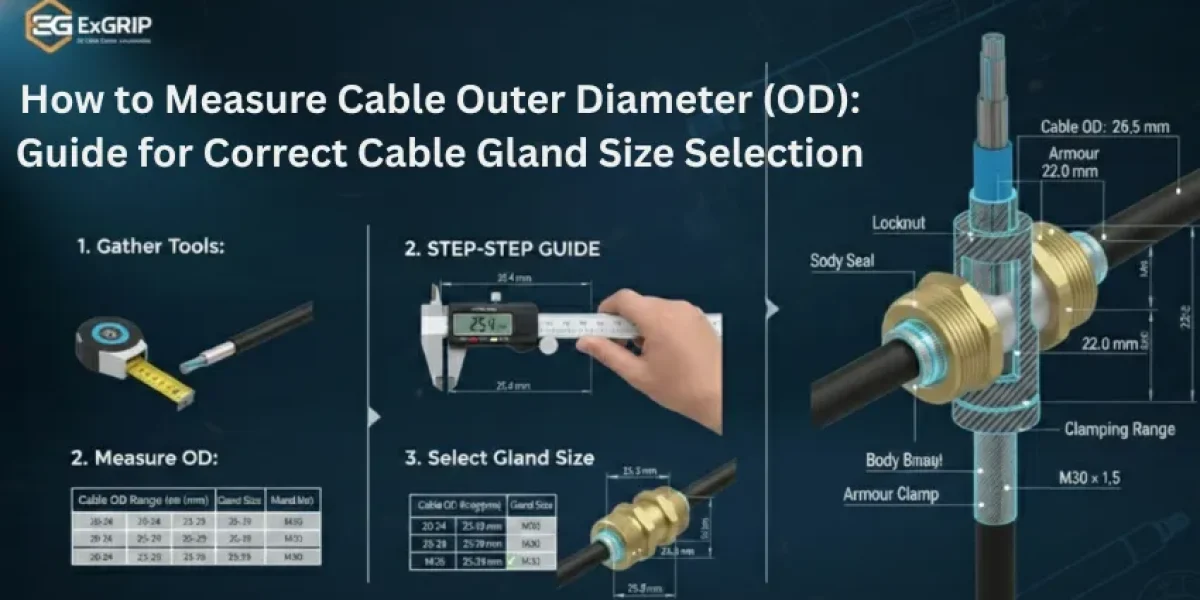
Selecting the correct cable gland starts with one critical step measuring the cable’s outer diameter (OD) accurately. A small mistake in measurement can lead to sealing failure, loose connections, or even hazardous installations.
In this guide, ExGrip explains how to measure cable OD properly and how to use a cable gland size chart to select the right gland for safe and reliable installation.
Cable gland introduction
Every industrial installation whether oil & gas, power plant, marine, or manufacturing depends on proper cable termination. Choosing the wrong cable gland size can cause:
-
Poor sealing
-
Reduced IP protection
-
Mechanical stress on cable
-
Risk of cable pull-out
-
Water or dust ingress
That is why accurate OD measurement is the foundation of correct gland selection.
What is Cable Outer Diameter (OD)?
The Cable Outer Diameter (OD) is the total external diameter of a cable including:
-
Conductor insulation
-
Inner sheath (if applicable)
-
Armouring (if armored cable)
-
Outer sheath
It is usually measured in millimeters (mm).
Correct OD measurement helps match the cable with the right cable gland types, whether it is a single compression cable gland or double compression cable gland.
Why Correct Cable OD Measurement is Important
Choosing the wrong gland size can result in:
-
Improper compression
-
Failed sealing rings
-
Reduced mechanical retention
-
Compromised explosion-proof integrity
Using a proper cable gland chart ensures:
✔ Tight sealing
✔ Proper clamping
✔ Long service life
✔ Compliance with safety standards
Tools Required to Measure Cable OD
To measure accurately, use:
Digital Vernier Caliper (Recommended)
Micrometer (for high precision)
Measuring tape (not preferred for accuracy)
For industrial installations, always use a calibrated digital caliper.
Step-by-Step Guide: How to Measure Cable Outer Diameter
Step 1: Clean the Cable Surface
Remove dirt, grease, or dust from the cable sheath. This ensures accurate measurement.
Step 2: Use a Digital Vernier Caliper
Place the cable between the jaws of the caliper.
Ensure jaws are perpendicular to the cable.
Do not apply excessive pressure.
Note the measurement in mm.
Step 3: Take Multiple Readings
Rotate the cable slightly and measure again.
Take at least 3 readings and calculate the average value.
This is important because cable OD may slightly vary.
Step 4: Compare with Cable Gland Size Chart
Now match the measured OD with the appropriate cable gland size chart in mm.
Each gland supports a specific clamping range.
Cable Gland Size Chart (Example)
Below is a general reference cable gland size chart. Always verify with manufacturer data.
| Gland Size | Cable OD Range (mm) |
|---|---|
| M16 | 5 – 10 mm |
| M20 | 6 – 12 mm |
| M25 | 11 – 17 mm |
| M32 | 15 – 22 mm |
| M40 | 19 – 28 mm |
| M50 | 27 – 35 mm |
| M63 | 34 – 44 mm |
For detailed selection, download our electrical cable gland size chart PDF or cable gland size chart pdf from the ExGrip resources section.
Understanding Cable Gland Types
Before final selection, you must understand different cable gland types.
Single Compression Cable Gland
A single compression cable gland compresses only the outer sheath.
Used in:
-
Indoor applications
-
Light-duty installations
-
Non-hazardous areas
Double Compression Cable Gland
A double compression cable gland provides:
Dual sealing
Armour clamping
Enhanced IP protection
Used in:
Hazardous areas
Outdoor installations
Heavy industrial environments
For armored cables, always use double compression glands.
Material Selection: Why Brass Cable Gland is Popular
A brass cable gland is widely used due to:
-
High mechanical strength
-
Corrosion resistance
-
Excellent conductivity
-
Long life
Nickel-plated brass is recommended for harsh environments.
How to Select the Correct Cable Gland Size
Follow this practical selection guide:
Use digital caliper.
-
Armored or unarmored?
-
Hazardous or non-hazardous area?
Match OD with gland clamping range.
-
Metric
-
PG
-
NPT
If unsure, consult ExGrip technical support or refer to our cable gland size chart pdf.
Accessories Required with Cable Glands
Proper installation may require:
Locknut
Earth tag
PVC shroud
Sealing washer
Reducer / Adaptor
These accessories ensure complete protection and sealing.
Quick Reference Table: Selection Summary
| Parameter | What to Check |
|---|---|
| Cable OD | Measure in mm using caliper |
| Cable Type | Armored / Unarmored |
| Environment | Indoor / Outdoor / Hazardous |
| Material | Brass cable gland recommended |
| Type | Single compression cable gland / Double compression cable gland |
| Size | Match using cable gland size chart in mm |
Downloadable Resources
For field engineers and procurement teams, ExGrip provides:
Installation manual for cable gland
Selection guide for various cable gland types
Contact us to download the latest technical PDF guide.
Conclusion & Call-to-Action
Correct measurement of cable OD is the first and most important step in selecting the right cable gland size. Using a proper cable gland chart, understanding cable gland types, and selecting quality materials like brass cable gland ensures safe, durable, and compliant installations.
For armored cables and harsh environments, always prefer a double compression cable gland for superior sealing and protection.
When in doubt, measure twice and verify using the official cable gland size chart pdf.
📩 Talk to our technical team today at Exgrip.com
📞 Or call us directly for quick assistance!
Contact Us:
📞 Phone: +91 9537118899
🌐 Website: www.exgrip.com
📩 Request a Quote: Contact Page
FAQs
How do I measure cable outer diameter accurately?
Use a digital Vernier caliper and take multiple readings around the cable to get the average OD.
Can I use a measuring tape to select cable gland size?
No. Measuring tape is not accurate enough for selecting the correct cable gland size.
What happens if I select a wrong cable gland size?
It may cause improper sealing, reduced IP protection, and cable pull-out.
Where can I get a cable gland size chart in mm?
You can download the cable gland size chart pdf or electrical cable gland size chart pdf from ExGrip.
When should I use a double compression cable gland?
Use double compression cable gland for armored cables, outdoor installations, and hazardous areas.
Is brass cable gland suitable for outdoor use?
Yes. A brass cable gland, especially nickel-plated, is ideal for outdoor and industrial environments.
What are the main cable gland types?
The main cable gland types are single compression and double compression glands.