
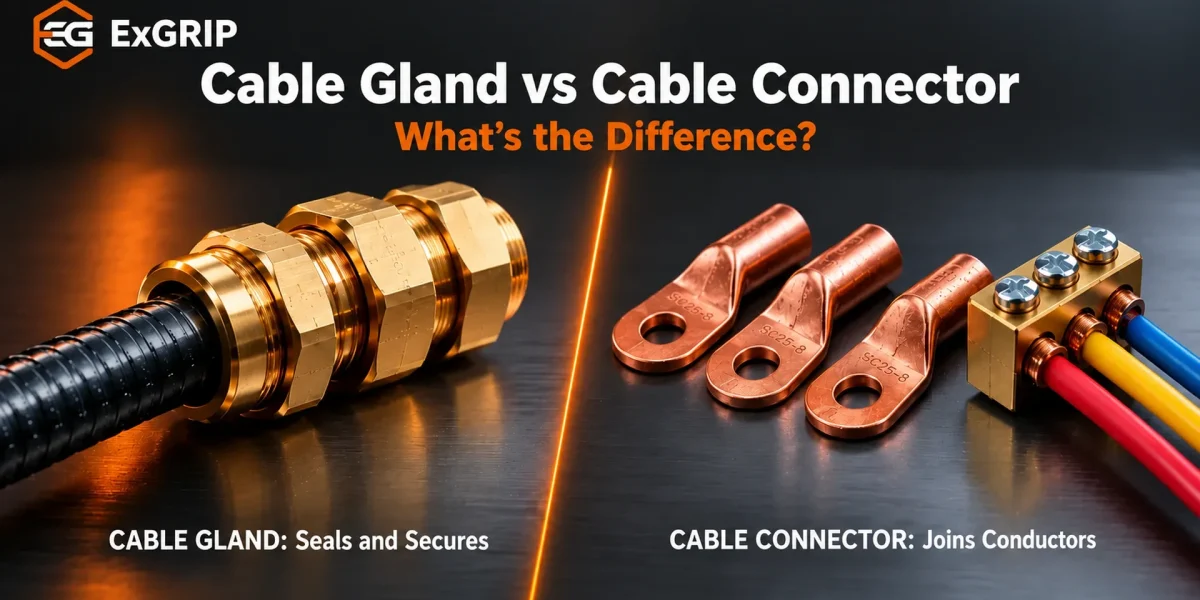
A cable gland and a cable connector both sit at the end of a cable, and both get listed under “cable accessories” on a purchase order, so they are easy to confuse. The difference is simple. A cable gland is where the cable passes through the wall of an enclosure: it seals the entry, holds the cable and, on armoured cable, earths the armour. A cable connector is where the conductors are joined: it carries current or signal from one cable to another, or from a cable to a device.
So the cable gland vs cable connector question is not “which one”, but “which job”. Most industrial terminations need both: a gland at the enclosure wall and a connector, terminal or lug inside. This guide explains what each does, where each is used, and how to tell which part a drawing or BOQ line is really asking for.
What Is a Cable Gland?
A cable gland is a threaded fitting that screws into an enclosure entry and grips the cable passing through it. Inside the gland, an elastomer seal compresses around the cable’s outer sheath. The result is a sealed, strain-relieved entry that keeps water and dust out (IP66, IP67 or IP68) and stops a pull on the cable from reaching the terminals.
Glands come in two main forms. A single compression gland seals on one sheath and suits unarmoured cable. A double compression gland seals the inner sheath, clamps the armour wires and seals the outer sheath, which also earths the armour through the gland body. In hazardous areas the gland is also part of the explosion protection of the enclosure, so it must carry Ex certification. Our guide to what a cable gland is covers the basics in more depth.
What Is a Cable Connector?
A cable connector is any device that makes an electrical connection between conductors. That covers a wide family of parts, and the word means different things in different trades.
| Connector type | What it joins | Where you see it |
|---|---|---|
| Plug and socket (male female) connectors | A cable to a device, detachable | Portable equipment, machine wiring, instruments |
| Terminal connectors and terminal blocks | A conductor to a terminal rail or device | Inside panels and junction boxes |
| Cable lugs | A conductor to a busbar or stud | Power terminations in LT panels and motors |
| Cable joint (jointer) connectors | Two cables end to end | Straight-through cable joints, cable repairs |
| Signal and data connectors | Data or RF signal lines | Networking, instrumentation, telecom |
What all of these share is conduction. A connector’s job is to keep a low-resistance path between metal parts. None of them is designed to seal a hole in an enclosure wall.
Cable Gland vs Cable Connector: Side-by-Side
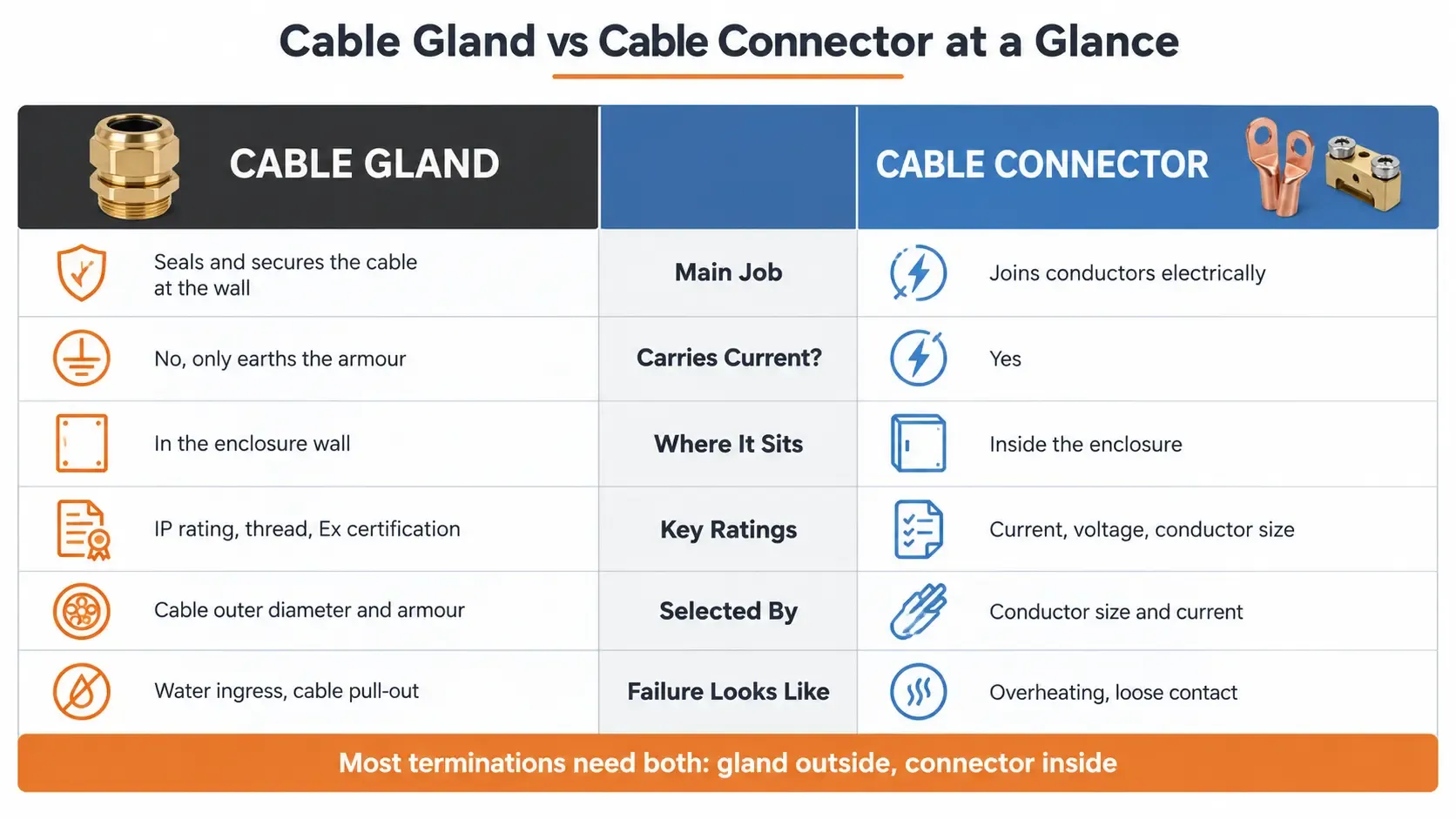
| Cable gland | Cable connector | |
|---|---|---|
| Main job | Seal and secure the cable at an enclosure entry | Join conductors electrically |
| Carries current? | No (only earth continuity for the armour) | Yes |
| Where it sits | In the enclosure wall, outside the terminals | Inside the enclosure, or between two cables |
| Key ratings | IP rating, cable diameter range, thread size, Ex certification | Current and voltage rating, conductor size, contact resistance |
| Typical materials | Brass, nickel plated brass, stainless steel, nylon | Copper, tinned copper, aluminium, brass contacts |
| Selected by | Cable outer diameter, armour type, entry thread | Conductor cross-section and current |
| Failure looks like | Water ingress, cable pulled out, armour not earthed | Overheating, loose contact, voltage drop |
The selection data shows the real split. You size a gland from the cable’s outer diameter and the enclosure’s entry thread. You size a connector or lug from the conductor’s cross-section and current. A 4 core 95 sq mm cable needs a gland sized to its outer sheath and four lugs sized to its 95 sq mm conductors, two completely different calculations.
Why You Usually Need Both
Follow one power cable from a cable tray into a motor terminal box and you meet both parts within a few centimetres:
- The cable enters through a double compression cable gland screwed into the terminal box entry. The gland seals the outer sheath, clamps and earths the armour, and seals the inner sheath.
- Inside the box, each conductor is crimped into a cable lug.
- The lugs are bolted onto the motor’s terminal studs, which complete the electrical connection.
This is why “cable glands and lugs” usually appear together on the same BOQ line, and why they are ordered as a pair. Leave out the gland and the box is open to water and dust. Leave out the lug and there is no reliable connection. To match the gland to the cable’s armour and outer diameter, our armoured cable gland selection guide walks through the sizing.
When a Connector Seems to Replace a Gland
There are two situations where people ask whether a connector can do a gland’s job.
Plug and Socket Connectors on Enclosures
Panel-mounted circular connectors (such as the M12 and M23 styles used on sensors and drives) screw into an enclosure wall and seal it, so they look like glands. In practice they combine a gland’s sealing with a connector’s contacts in one product. They suit small cables and equipment that must be disconnected often. For fixed power and armoured cables they are rarely used, because the armour still needs to be clamped and earthed.
Cable Joint Connectors
Cable jointer connectors join two lengths of cable inside a joint kit. The joint kit itself provides insulation and sealing along the cable, but it is not an enclosure entry. Where the joined cable enters a panel or junction box, it still needs a gland.
Hazardous Areas: Different Rules for Each
In Zone 1 and Zone 2, both parts are regulated, but differently. The cable gland is part of the enclosure’s protection concept, so it must be certified for it, for example Ex db for a flameproof box or Ex eb for an increased safety box. Connectors used inside a certified enclosure are covered by that enclosure’s certificate. A plug and socket that is connected or disconnected in the hazardous area must itself be Ex certified.
A common mistake is to treat a weatherproof industrial connector as a substitute for an Ex gland because both are “sealed”. Sealing against water is not the same as explosion protection. Our article on FLP vs WP cable glands explains that difference, and ATEX and IECEx certified cable glands explains the markings to look for.
How to Tell Which One a Drawing or BOQ Asks For
| If the line item mentions… | It is asking for |
|---|---|
| Entry thread (M20, M25, 3/4″ NPT), cable OD, IP rating, “single/double compression”, “armoured” | A cable gland |
| Conductor size (sq mm), current (A), crimp, bolt hole size, “lug”, “terminal”, “socket” | A connector, lug or terminal |
| Ex marking such as Ex db or Ex eb with a thread size | A certified cable gland |
| “Gland with lug” or “termination kit” | Both, supplied together |
If a line gives only the cable size, ask whether it means the outer diameter (for the gland) or the conductor cross-section (for the lug). Mixing the two is the most common reason the wrong part arrives on site. For thread questions, see our guide to metric, NPT and PG cable gland threads.
Exgrip Cable Glands for Industrial Terminations
Exgrip makes the gland side of the termination. The E1FW double compression cable gland suits steel and aluminium wire armoured cable, and the A2F single compression cable gland suits unarmoured cable. Both are certified Ex db and Ex eb IIC Gb and Ex ta IIIC Da under ATEX, IECEx and PESO, rated IP66, IP67 and IP68, and made in brass, nickel plated brass and stainless steel in sizes M16 to M90. See the full Exgrip product range.
Conclusion & Call-to-Action
Most mix-ups between glands and connectors happen on paper, not on site: a BOQ line gives “95 sq mm, 4 core” and nobody says whether it means the gland or the lug. Write the two as separate lines, the gland by entry thread, cable outer diameter, armour type and Ex rating, and the lugs by conductor size. That one habit removes most wrong deliveries.
Send us your cable schedule and enclosure entry sizes, and Exgrip’s team will match a certified gland to every cable, with the certificate numbers for your documentation.
📩 Talk to our technical team today at Exgrip.com
📞 Or call us directly for quick assistance!
Contact Us:
📞 Phone: +91 9537118899
🌐 Website: www.exgrip.com
📩 Request a Quote: Contact Page
FAQs
Is a cable gland a connector?
No. A cable gland seals and secures a cable where it enters an enclosure, but it does not join conductors. The only electrical role it has is earthing the armour on armoured cable.
Can a cable connector be used instead of a cable gland?
Only a panel-mounted connector designed to seal an enclosure wall can, and mostly on small cables. For power and armoured cables, use a cable gland at the entry and a lug or terminal inside.
What is the difference between a cable gland and a cable lug?
The gland seals the cable at the enclosure wall; the lug connects each conductor to a terminal or busbar. They are sized differently: the gland by the cable’s outer diameter, the lug by the conductor’s cross-section.
Do cable connectors need Ex certification?
Connectors inside a certified Ex enclosure are covered by the enclosure’s certificate. A plug and socket that is connected or disconnected in a hazardous area must be Ex certified itself.
What is a cable joint connector?
It is a crimped or mechanical connector that joins two cable conductors end to end inside a cable joint kit. The joint kit insulates and seals the joint, but where the cable enters a panel it still needs a gland.
Which comes first, the gland or the lug?
The gland. Slide the gland parts onto the cable, prepare the armour and sheaths, fit the gland, and only then crimp the lugs on the conductors inside the enclosure.