
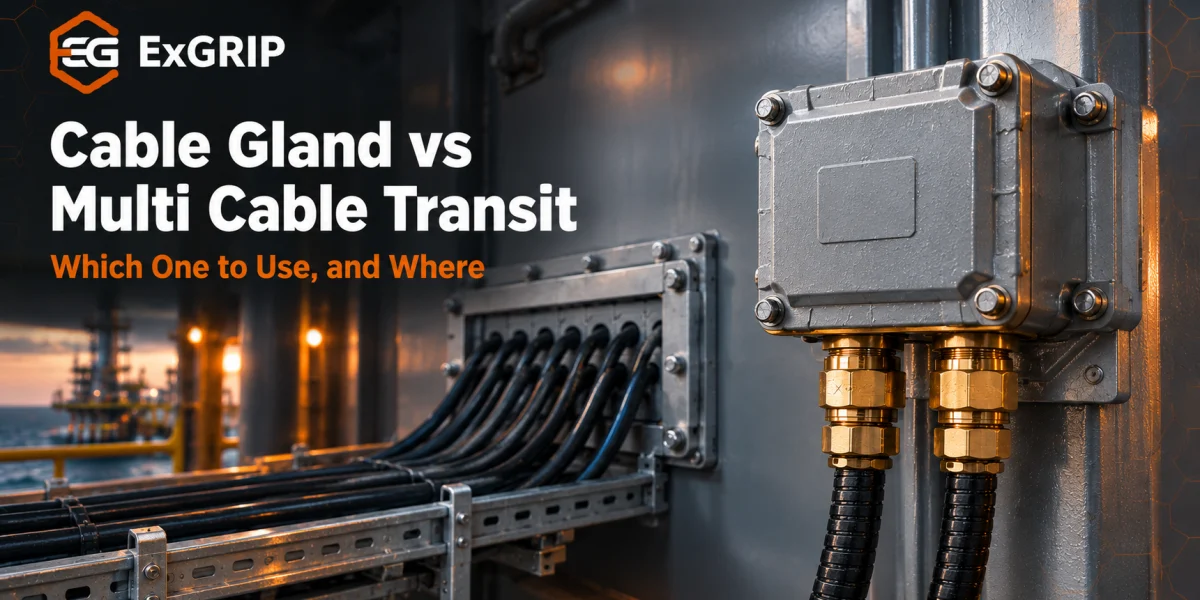
When a cable has to pass through a wall, there are two ways to seal the opening. A cable gland seals one cable in one threaded entry. A multi cable transit (MCT) seals many cables through one framed opening, using rubber modules packed around each cable. The cable gland vs MCT choice comes up on every ship, offshore module, substation and large control panel project, and the answer depends on what the opening is in and how many cables go through it.
Short version: use a multi cable transit where many cables pass through a deck, bulkhead, floor or wall that must stay fire-, gas- or water-tight. Use cable glands where a cable enters a piece of equipment such as a junction box, motor terminal box or control station, especially a flameproof one. Most large projects use both. This guide explains how each works, where each wins, and how to judge the space and time savings quoted in MCT brochures.
What Is a Multi Cable Transit (MCT)?
A multi cable transit is a sealing system for a group of cables passing through one opening. A metal frame is welded or bolted into the structure. Rubber sealing modules are packed into the frame, one around each cable, and a compression unit squeezes the whole pack tight. Many modules have removable layers, so one module can be peeled to fit a range of cable diameters; one major system covers cables from 4 to 99 mm with six basic module sizes. Empty spaces are filled with solid spare modules, which can be opened later to add a cable.
MCT systems were developed for ships and offshore structures, where cables cross decks and bulkheads that must hold back fire, smoke, gas and water. Depending on the version, transits carry marine classification approval for fire-rated A-class and H-class divisions, IP66/IP67 sealing, EMC shielding, and Ex ratings for some hazardous area protection types.
How a Cable Gland Seals a Cable Entry?
A cable gland screws into a threaded entry on an enclosure and seals one cable. Inside, elastomer seals grip the cable sheath. On armoured cable, a double compression gland also clamps the armour wires, which holds the cable mechanically and earths the armour through the gland body to the enclosure.
In hazardous areas, the gland becomes part of the enclosure’s explosion protection. A flameproof (Ex db) junction box needs flameproof-certified glands in every entry; an increased safety (Ex eb) box needs glands certified for that protection type. Our guide to flameproof cable glands covers this in detail.
Cable Gland vs MCT: Side-by-Side
| Cable gland | Multi cable transit (MCT) | |
|---|---|---|
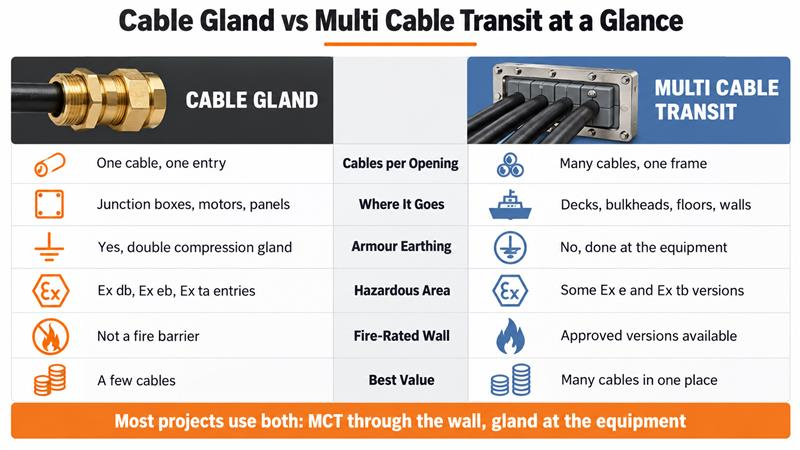
| Cables per opening | One | Many, through one framed opening |
| Typical location | Equipment entries: junction boxes, motors, panels | Structures: decks, bulkheads, floors, walls, large cabinets |
| Armour termination and earthing | Yes, in double compression glands | Not at the transit; armour is terminated at the equipment |
| Hazardous area protection | Certified for Ex db, Ex eb and Ex ta entries (model dependent) | Ex versions exist for some protection types (for example Ex e and Ex tb); check the certificate for the enclosure type |
| Fire-rated barriers | Not designed as a fire barrier | Versions approved for fire-rated divisions |
| Spare capacity | Spare entries closed with stopping plugs | Spare modules in the frame, opened later |
| Pre-terminated cables | Connector must pass through the gland, or be fitted after | Large opening lets connectors pass, then modules are fitted |
| Cost for a few cables | Low per entry | Frame, modules and compression unit cost more for small counts |
| Cost for many cables | Adds up with every entry and hole | Spread across many cables |
| Replacement and spares | Standard parts, easy to stock | System-specific modules and tools |
Where a Multi Cable Transit Makes Sense?
- Fire-rated decks and bulkheads on ships, FPSOs and offshore modules, where the penetration must keep the fire rating of the division.
- Floor and wall penetrations in substations, control buildings and switchrooms, where dozens of cables leave a cable cellar through one opening.
- Pressurised or gas-tight rooms, where every penetration must hold the room’s seal.
- Pre-terminated cables that cannot pass through a small gland.
- Projects that expect cable additions, since spare modules can be opened without cutting a new hole.
Where Cable Glands Make More Sense?
- Equipment entries on junction boxes, motor terminal boxes, local control stations and lighting fittings, which come with threaded entries designed for glands.
- Flameproof (Ex db) enclosures, where each entry is part of the flame path and must carry a flameproof-certified gland, reducer or stopping plug.
- Armoured cable, where the armour must be clamped and earthed at the termination.
- Small numbers of cables, where one gland per cable costs less than a frame and module system.
- Field maintenance, where any technician can replace a standard gland from site stock.
For spare entries on these enclosures, certified stopping plugs and reducers keep the protection intact; see our page on PESO certified cable glands, reducers and stopping plugs.
A Fair Look at the Space and Time Claims
MCT suppliers publish strong figures: up to 70 percent space saving and around half the installation time compared with glands. Those figures come from their own examples, usually a large cabinet with 20 or more cables, and in that situation the savings are real. One framed opening is smaller than 20 separately spaced gland holes, and fitting modules can be quicker than terminating 20 glands.
The picture changes as the cable count drops. A junction box with four cables has four threaded entries already drilled by its maker; adding a transit frame means cutting a new opening and buying a frame, modules and compression unit. Compare total installed cost, not cost per cable: the frame and compression unit, the modules, any special tools and training, and how spares will be stocked over the life of the plant. Also check that the transit is certified for the exact enclosure type if the area is hazardous.
Using Both on One Project
On most offshore and marine projects the two work together. A cable leaves a switchroom through an MCT in the fire-rated wall, runs along trays across the deck, and enters a motor terminal box through a double compression gland that clamps and earths its armour. The transit protects the structure; the gland protects and terminates at the equipment. For the equipment end in corrosive marine air, see our marine and offshore cable gland selection guide and our page on cable glands for marine and offshore. For listing every entry on a project, our cable gland schedule template for EPC projects helps keep glands and transits on separate lines.
Exgrip Cable Glands for Equipment Entries
Exgrip makes the gland side of the job. The E1FW double compression cable gland suits steel and aluminium wire armoured cable, and the A2F single compression cable gland suits unarmoured cable. Both are certified Ex db and Ex eb IIC Gb and Ex ta IIIC Da under ATEX, IECEx and PESO, rated IP66, IP67 and IP68, and made in brass, nickel plated brass and stainless steel in sizes M16 to M90. For offshore washdown conditions, our article on IP68 vs IP69K cable glands for offshore platforms covers the ratings.
Conclusion & Call-to-Action
The cable gland vs MCT debate is often framed as one product replacing the other, but on a well-designed project each has its own place. Put transits where many cables cross a fire-rated or watertight structure, and glands where each cable enters its equipment. Then compare total installed cost for the few cases in between, such as large panels, rather than relying on brochure percentages.
Send us your equipment list and cable schedule, and Exgrip’s team will specify the certified gland for every equipment entry, with the certificate numbers for your documentation.
📩 Talk to our technical team today at Exgrip.com
📞 Or call us directly for quick assistance!
Contact Us:
📞 Phone: +91 9537118899
🌐 Website: www.exgrip.com
📩 Request a Quote: Contact Page
FAQs
Can a multi cable transit replace cable glands?
At structural penetrations and some large cabinets, yes. At equipment entries such as junction boxes and motor terminal boxes, glands are still the standard, especially where armour must be earthed or the enclosure is flameproof.
Are multi cable transits certified for hazardous areas?
Some versions are, for protection types such as Ex e and Ex tb. Check the certificate for the exact enclosure type; a flameproof (Ex db) enclosure normally needs flameproof-certified glands in its threaded entries.
Is a multi cable transit cheaper than cable glands?
For many cables through one opening it can be, because the frame cost is spread across them. For a few cables, glands usually cost less. Compare total installed cost, including frames, modules, tools and spares.
Does an MCT earth the cable armour?
Not as a gland does. Some transits offer bonding and EMC versions, but armour is normally terminated and earthed at the equipment, usually with a double compression gland.
Can cables be added later?
With an MCT, spare modules can be opened to add cables. With glands, a spare entry closed with a certified stopping plug can be opened and fitted with a new gland.