
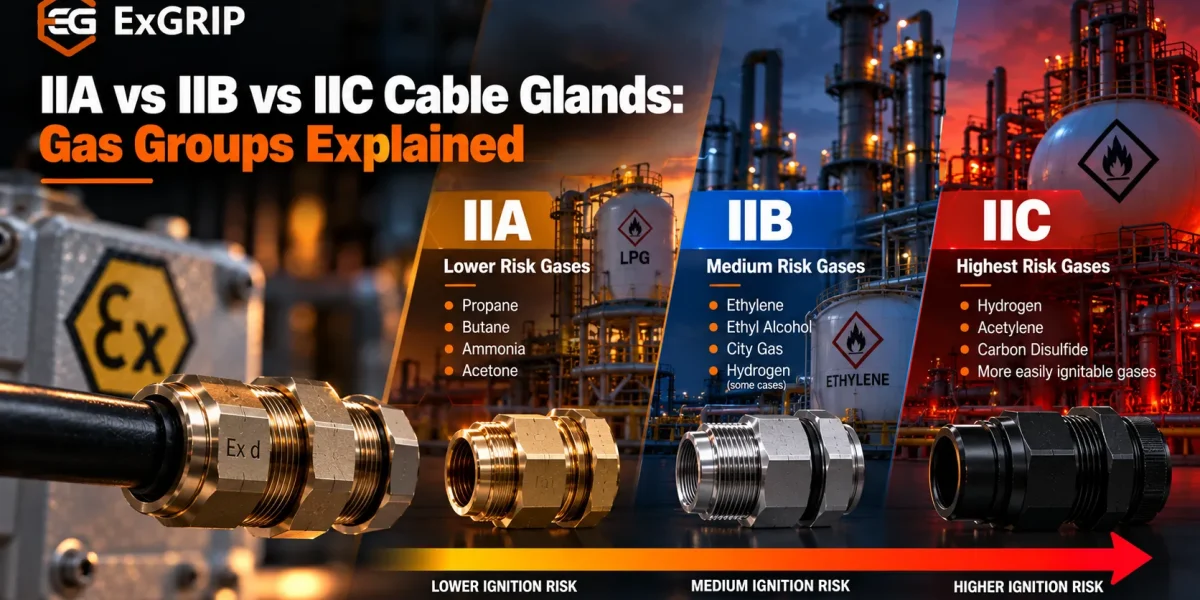
Every Ex marking carries a gas group. It sits in the middle of the string, between the protection concept and the equipment protection level, and it is the character most often skimmed over: the IIA, IIB or IIC in a marking such as Ex db IIC Gb.
That one letter decides whether a certified gland is legal in your area or not. Fit IIB equipment where hydrogen is present and the installation is unsafe, regardless of how good the gland is in every other respect. This guide explains what the groups actually measure, why IIC is the hardest to protect against, why equipment certified to a higher group covers the lower ones, and what the group changes when you select a cable gland.
Key points
- Gas groups rank how easily a gas carries a flame through a narrow gap, measured by MESG and MIC ratio.
- IIA is propane-like, IIB is ethylene-like, IIC is hydrogen and acetylene. IIC is the most demanding.
- Equipment certified IIC may be used in IIB and IIA areas. The reverse is never true.
- Exgrip glands are certified Ex db IIC Gb and Ex ta IIIC Da, the top of both the gas and dust ladders, so one part number suits every Group II and Group III area.
What a Gas Group Actually Measures
A gas group is not a measure of how flammable something is, or how toxic, or how likely it is to leak. It ranks gases by how easily a flame inside an enclosure can escape through a narrow gap and ignite the atmosphere outside.
Two laboratory measurements decide the group.
MESG: Maximum Experimental Safe Gap
A standard test vessel is filled with the gas mixture and ignited inside. The gap between the two halves of the vessel is adjusted until the flame can no longer travel out and ignite the surrounding mixture. The widest gap that still stops the flame is the MESG for that gas, expressed in millimetres.
The rule to remember is simple. The more dangerous the gas, the tighter the gap. Propane needs roughly 0.9 mm to be stopped. Hydrogen needs around 0.29 mm. That difference is why flameproof equipment for hydrogen is machined to tolerances that equipment for propane does not need.
MIC Ratio: Minimum Igniting Current
The second measure concerns electrical energy rather than gaps. The minimum igniting current is the smallest current in a standard spark test that will ignite the gas, expressed as a ratio against laboratory methane.
A gas with a low MIC ratio ignites from a smaller spark. This is the measure that matters most for intrinsically safe circuits, where the design limits the energy available rather than containing an explosion. For cable glands and flameproof enclosures, MESG does most of the work.
IIA, IIB and IIC Side by Side
Swipe to see the full table
| Group | MESG | MIC ratio | Representative gases | Where you meet it |
|---|---|---|---|---|
| IIA | 0.9 mm and above | Above 0.8 | Propane, butane, petrol vapour, ammonia, acetone | LPG handling, fuel storage and dispensing, paint and solvent areas, general process plant |
| IIB | Above 0.5 mm, below 0.9 mm | 0.45 to 0.8 | Ethylene, ethyl ether, hydrogen sulphide, town gas | Petrochemical and ethylene plants, sour gas service, sewage and biogas |
| IIC | 0.5 mm and below | Below 0.45 | Hydrogen, acetylene, carbon disulphide | Hydrogen production and storage, refinery hydrotreaters, battery charging rooms, acetylene handling |
The representative gases are worth memorising, because specifications often name the gas rather than the group. Propane means IIA. Ethylene means IIB. Hydrogen and acetylene mean IIC. Where several substances are present in one area, the equipment is selected for the most demanding of them.
Why IIC Is the Hardest to Protect Against
Hydrogen is a small, fast molecule with a wide flammable range and very little energy required to ignite it. It passes through gaps that stop heavier hydrocarbons, and it burns with a flame that is nearly invisible in daylight.
For equipment design, that has three consequences.
Tighter flamepaths
Every joint that contains an explosion, including the threads at a cable entry, has to be held to closer tolerances than the same equipment rated IIB.
Stricter entry rules
Installation standards treat IIC atmospheres differently when deciding whether a cable can be entered directly into a flameproof enclosure.
Less tolerance for drift
Corrosion, paint on a flamepath or a thread engaged two turns short matter more where the safe gap is a third of a millimetre.
This is also why IIC matters more in India every year rather than less. Green hydrogen projects, hydrogen blending trials in gas networks, refinery hydrogen units and battery energy storage with charging rooms all put Group IIC atmospheres onto sites that previously only handled IIA and IIB hydrocarbons.
Why IIC Equipment Covers IIA and IIB
The groups are a ladder, not a set of boxes. Equipment certified for a more demanding group is acceptable in areas with less demanding gases, because the protection it provides exceeds what those gases require.
Swipe to see the full table
| Equipment certified | IIA area | IIB area | IIC area |
|---|---|---|---|
| IIA | Yes | No | No |
| IIB | Yes | Yes | No |
| IIC | Yes | Yes | Yes |
There is a practical benefit in that table that procurement teams tend to discover late. A IIC certified gland can be used anywhere in Group II, which means one part number covers the LPG area, the ethylene unit and the hydrogen compressor house.
That matters for stores more than for engineering. Hazardous area installations are rarely damaged by a wrong purchase. They are damaged by a maintenance fitter reaching into a stores bin at two in the morning. If everything in the bin is IIC, there is no wrong gland to reach for.
The IIB + H2 Exception
Occasionally a marking reads IIB + H2 rather than IIB or IIC. It means the equipment is certified for Group IIB gases plus hydrogen specifically, rather than for the whole of Group IIC.
It exists because hydrogen and acetylene behave differently despite sharing a group. A design can be proven against hydrogen without being proven against acetylene or carbon disulphide. The marking is narrower than IIC and must be read literally: it does not authorise use in an acetylene atmosphere.
When a certificate is marked this way, check the specific conditions of use on it. Where a site handles hydrogen alongside other IIC gases, full IIC certification removes the question entirely.
Dust Groups: IIIA, IIIB and IIIC
Combustible dusts run on their own ladder, Group III, and the logic is different. Dust is not ranked by how it passes through a gap, because the protection concept is exclusion rather than containment. Dust groups are ranked by what the dust is and how it behaves electrically.
IIIA: combustible flyings
Fibres and lint, such as the airborne waste in textile mills and cotton processing. The lowest of the three.
IIIB: non-conductive dust
Most organic dusts, including flour, grain, wood dust and pharmaceutical powders, with resistivity above 103 ohm metres.
IIIC: conductive dust
Metal dusts such as aluminium, magnesium and titanium, plus coal dust and carbon, at or below 103 ohm metres. The most demanding.
Conductive dust is the serious case because burning is only half of what it does. It settles inside enclosures, bridges terminals and creates faults that become ignition sources, which is why IIIC equipment has to exclude dust completely rather than merely resist it.
The same ladder rule applies. Equipment certified Ex ta IIIC Da is acceptable in IIIA and IIIB areas. India has more Group III risk than its documentation usually reflects: grain handling, sugar mills, pharmaceutical powder plants, aluminium finishing and coal handling at thermal stations are all dust areas before they are anything else.
Reading the Gas Group in an Ex Marking
An Ex marking is read left to right, and each element answers a different question. Take Ex db IIC T6 Gb as an example.
- ExCertified explosion protected equipment.
- dbThe protection concept and its level. Here, flameproof. Ex eb is increased safety, Ex ta is dust protection by enclosure.
- IICThe gas group. The subject of this article, and the element that decides whether the equipment suits your atmosphere.
- T6The temperature class, capping the maximum surface temperature at 85 degrees Celsius.
- GbThe equipment protection level, which maps to the zone the equipment may be installed in.
All five have to be satisfied at once. A gland that is IIC but the wrong temperature class is still the wrong gland. Our guides to temperature classification and to equipment protection levels cover the other two elements of the marking in detail.
One habit prevents most marking errors: read the whole string before approving a submittal, not the first two characters. Ex db is the part people recognise, and it is the part that tells you the least about whether the equipment suits the area.
What the Gas Group Changes in Gland Selection
For a cable gland, the gas group affects three decisions.
Which Certificates You Can Accept
The gland must be certified for a group at least as demanding as the area. On Indian sites this is checked twice, once against the ATEX or IECEx certificate and again against the PESO approval, because the two are separate approvals covering the same product.
How the Cable Enters a Flameproof Enclosure
Installation standards treat Group IIC atmospheres more strictly when deciding whether a cable can be taken directly into a flameproof enclosure, or whether a barrier type entry device is required. The minimum external cable length that permits a direct entry is longer for IIC and for IIB plus hydrogen than it is for IIA and IIB. Where that length cannot be achieved, the answer is a barrier gland.
In practice this catches short connections: a junction box next to a motor, an instrument tail, a skid where everything sits within arm’s reach. Those are routine in IIA areas and a specification decision in IIC areas.
How Much Margin the Installation Has
A IIA installation tolerates small imperfections that a IIC installation does not. Corrosion at the entry, paint across a flamepath, a thread two turns short or a gland loosened by vibration all matter more where the safe gap is measured in tenths of a millimetre. Selecting IIC equipment does not remove that sensitivity, but it does mean the hardware is built to the tighter standard from the start.
The whole Exgrip explosion proof range is certified at the top of both ladders, IIC for gas and IIIC for dust, with IP66, IP67 and IP68 protection and PESO approval for Indian sites. There is no IIB variant to specify, no IIA variant to stock by mistake, and nothing to downgrade during value engineering. For the hazardous area background, see our guide to flameproof cable glands for hazardous areas in India.
Conclusion & Call-to-Action
Gas groups look like classification trivia until you see what they are measuring. IIA, IIB and IIC are three different answers to one physical question: how small a gap will still let this gas carry a flame out of an enclosure? Hydrogen needs roughly a third of the gap that propane does, and every tolerance on the equipment follows from that.
Two rules carry most of the practical weight. Equipment certified for a higher group is acceptable in lower group areas, never the other way round. And where several substances are present, the most demanding one sets the specification. Build your stores around the top of the ladder and the second rule takes care of itself.
Not sure which group your area needs?
Send us the area classification drawing or the gases handled, along with the cable types and entry threads, and our technical team will confirm the gas and dust groups that apply and give you the Exgrip part numbers certified for them, with PESO status against each one.
📩 Talk to our technical team at Exgrip.com
📞 Phone: +91 9537118899
🌐 Website: www.exgrip.com
📩 Request a Quote: Contact Page
FAQs
What is the difference between gas groups IIA, IIB and IIC?
They rank how easily a gas carries a flame through a narrow gap, measured by the maximum experimental safe gap and the minimum igniting current ratio. IIA covers gases such as propane with a MESG of 0.9 mm and above. IIB covers ethylene and similar gases between 0.5 and 0.9 mm. IIC covers hydrogen, acetylene and carbon disulphide at 0.5 mm and below, and is the most demanding.
Can IIC equipment be used in a IIA or IIB area?
Yes. The groups work as a ladder, so equipment certified for a more demanding group is acceptable where less demanding gases are present. IIC equipment may be used in IIB and IIA areas. The reverse is never acceptable: IIA equipment in a IIB or IIC atmosphere is unsafe, not just non-compliant.
What does a IIB + H2 marking mean?
It means the equipment is certified for Group IIB gases plus hydrogen specifically, rather than for the whole of Group IIC. It does not cover acetylene or carbon disulphide. Read it literally and check the specific conditions of use on the certificate, since full IIC certification avoids the ambiguity.
What are dust groups IIIA, IIIB and IIIC?
IIIA is combustible flyings such as fibres and lint. IIIB is non-conductive dust, including flour, grain, wood dust and pharmaceutical powders, with resistivity above 1,000 ohm metres. IIIC is conductive dust such as aluminium, magnesium, titanium, coal and carbon, at or below that figure, and is the most hazardous because it can bridge terminals inside an enclosure.
Which gas group are Exgrip cable glands certified for?
The Exgrip explosion proof range is certified Ex db and Ex eb IIC for gas and Ex ta IIIC for dust, which is the top of both ladders, with IP66, IP67 and IP68 protection and PESO approval for Indian sites. One part number therefore suits every Group II and Group III area.
Where do I find the gas group on a certificate?
In the Ex marking string, between the protection concept and the temperature class. In Ex db IIC T6 Gb, db is the protection concept, IIC is the gas group, T6 is the temperature class and Gb is the equipment protection level. All of them have to suit the installation, not just the gas group.