
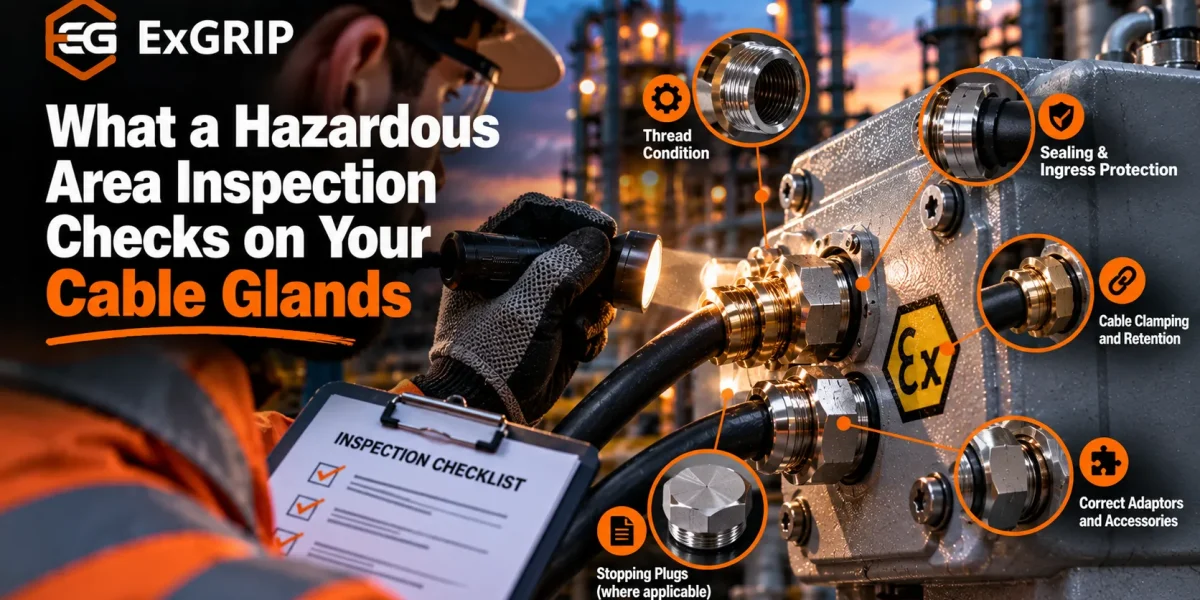
Every hazardous area installation in service is inspected on a cycle, and cable entries are one of the most commonly failed items on the list. They are exposed, they are mechanical, and they sit at the point where the installation meets the weather, the vibration and the people.
IEC 60079-17 is the standard that governs inspection and maintenance of Ex equipment in service. It is written for the people who keep a plant running rather than for the people who built it, and it answers a different question from the installation standard: not "is this correct?" but "is this still correct?". This guide covers the grades of inspection, what each one looks at on a cable gland, the findings that stop equipment immediately, and how to set an interval that holds up.
Key points
- Inspection comes in three grades: visual, close and detailed, each requiring more access and more time than the last.
- The standard does not fix an interval. It expects one justified by equipment type, environment and operating conditions.
- An open unstoppered entry and a damaged Ex e gasket are examples of findings that take equipment out of service straight away.
- Most gland findings trace back to the original installation rather than to wear.
What IEC 60079-17 Requires
IEC 60079-17 sets out the inspection and maintenance regime for electrical installations in explosive atmospheres. It sits alongside IEC 60079-14, which governs selection and installation. One gets the installation right at the start, the other keeps it right.
The core expectation is a documented regime: a schedule, a grade of inspection appropriate to the equipment and its environment, competent people doing the work, and records that let the next inspection start from the last one rather than from nothing.
Cable entries appear throughout that regime because they are where several protection concepts meet. On a flameproof enclosure the entry is part of the flamepath. On an increased safety enclosure it is part of the ingress protection that keeps the terminals clean and dry. On any enclosure it is part of the earthing and mechanical support of the cable.
The Three Grades of Inspection
The grades are not three levels of thoroughness applied to the same checks. They are three different jobs, distinguished by how much access they need.
Swipe to see the full table
| Grade | Access needed | What it can find |
|---|---|---|
| Visual | None. Carried out without opening or disturbing the equipment, usually without isolation | Physical damage, missing labels, corrosion, paint on flamepaths, obstructions |
| Close | Opening or accessing the equipment. Usually needs isolation and a permit | Everything visual, plus terminal connections, internal condition and gland thread engagement |
| Detailed | Full examination with tools and test equipment | Everything close, plus measured flamepath gaps and verification against the certificate |
The practical significance for cable entries is that a loose gland is a close inspection finding. A visual pass does not tell you that an entry has worked loose, because the gland still looks fitted. Plants that run only visual rounds between shutdowns are not wrong to do so, but they should know which failure modes that choice leaves undetected.
What an Inspector Looks At on a Gland
At Visual Grade
Physical damage to the gland body or cap. Corrosion, particularly where dissimilar metals meet or where a plated finish has worn through. Missing or illegible markings. Paint applied over flamepaths or over certification labels, which is a surprisingly common finding after a plant repaint. Cable entering at an angle or hanging on the gland without support. Any open entry.
At Close Grade
Thread engagement at the entry. Tightness of the gland and locknut. Condition of the sealing elements and washers. Armour clamping and earth continuity arrangements, including the condition of earth tags and serrated washers. Whether the gland in place matches the one recorded for that entry.
At Detailed Grade
Measurement rather than judgement. Flamepath dimensions checked against the certificate, internal condition examined with instruments, and the complete entry arrangement verified against the equipment documentation. This is the grade that finds a gland which has been correct in appearance for years and never matched the certificate.
Findings That Stop Equipment Immediately
Inspection results are graded by severity, and the most serious category requires the equipment to be taken out of service rather than scheduled for repair. Several of those findings sit at the cable entry.
Open unstoppered entry
An unused opening with no certified plug. The enclosure no longer provides its protection concept.
Missing or loose bolts on Ex d
A flameproof enclosure that cannot be held closed cannot contain an explosion.
Damaged or missing Ex e gasket
Moisture reaching the terminals defeats the basis of increased safety protection.
Gland loose in the entry
On a flameproof entry this is a shortened flamepath, not a loose fitting.
The reason these are immediate rather than scheduled is that each one removes a protection that the area classification assumes is present. There is no partial credit for an enclosure that is almost sealed.
Setting an Inspection Interval
IEC 60079-17 does not hand you a number. It expects an interval justified by the equipment type, the environment and the operating conditions, which is a harder thing to produce than a fixed rule but a far better fit to real plants.
Common operator practice settles around visual checks monthly or quarterly, close inspection annually or at planned shutdowns, and detailed inspection every three to five years. Treat that as a starting point to justify or adjust, not as the requirement.
- Start from the environmentCoastal salt air, washdown areas, high vibration and extreme temperature cycling all shorten intervals.
- Weight by consequenceEquipment in Zone 1 and equipment whose failure affects a safety function earns more attention than a lighting circuit in Zone 2.
- Use the findings to adjustA round that produces nothing for three cycles is telling you something. So is one that produces the same finding repeatedly.
- Record the justificationAn interval you can defend is worth more at audit than a short interval you cannot explain.
Environment drives material choice as much as it drives intervals. Where corrosion is the dominant factor, our comparison of SS 304, 316 and 316L cable glands is the right place to settle the specification before the next replacement cycle.
Common Findings and How to Prevent Them
Swipe to see the full table
| Finding | Usual root cause | Prevention |
|---|---|---|
| Corroded gland body | Wrong material for the environment | Stainless steel or correctly plated brass selected at design, not at replacement |
| Entry loose | Vibration, or never torqued correctly at installation | Locknut and correct tightening, recorded at commissioning |
| Open or badly blanked entry | Spare entry left for a future cable | Certified metal stopping plug fitted from day one |
| Cable unsupported at the gland | No cleat or tray support near the entry | Support within a short distance of the gland so weight is not carried by the entry |
| Wrong gland for the enclosure | Past repair with whatever was in stores | Recorded part numbers per entry and a small critical spares holding |
| Seal perished or flattened | Temperature cycling, or a cable at the edge of the seal range | Size the gland so the cable sits mid-range, and match the temperature class |
The pattern in that table is worth stating plainly. Most gland findings are not wear. They are original installation or specification decisions surfacing years later, which is why an inspection regime that only replaces parts never gets quieter.
Temperature class is the specification detail most often missed on older installations. Our guide to cable glands for high temperature environments covers how T6 through T1 maps onto real equipment.
Replacing a Gland Correctly
- Match the protection concept firstThe replacement must suit the enclosure type, the zone and the gas or dust group, before anything else is considered.
- Match the cable, not the old glandMeasure the actual cable outer diameter and armour type rather than assuming the previous gland was correct.
- Match the entry threadForm, diameter and pitch, with at most one certified adaptor if a mismatch cannot be avoided.
- Check the certification covers the installationEx marking, temperature class, IP rating and, on Indian sites, PESO approval.
- Record what went inPart number and certificate reference against that entry, so the next inspection is a condition check rather than an investigation.
Conclusion & Call-to-Action
Inspection under IEC 60079-17 is not a search for parts that have worn out. It is a check that the installation still matches the assumptions the area classification was built on. Cable entries fail that check often, and almost always for reasons that were set years earlier at specification or installation.
Plants that record what is fitted at each entry, hold a small stock of the right certified replacements, and choose an interval they can justify spend their inspection time on condition. The rest spend it on archaeology.
Turn your inspection findings into a replacement list
Send us the gland findings from your last inspection round, with the enclosure types, cable details and entry threads. Our technical team will return the correct certified replacement for each entry, with Ex marking, temperature class, IP rating and PESO status against every part number.
📩 Talk to our technical team at Exgrip.com
📞 Phone: +91 9537118899
🌐 Website: www.exgrip.com
📩 Request a Quote: Contact Page
FAQs
What is IEC 60079-17?
It is the international standard for inspection and maintenance of electrical installations in explosive atmospheres. Where IEC 60079-14 covers selection and installation, 60079-17 covers keeping the installation correct in service, through a documented regime of inspections carried out by competent people and recorded.
What are the three grades of inspection?
Visual, close and detailed. A visual inspection is carried out without opening or disturbing the equipment. A close inspection adds checks that require access, such as terminal connections and gland thread engagement, and usually needs isolation. A detailed inspection adds measurement with tools and test equipment, such as flamepath dimensions.
How often must hazardous area equipment be inspected?
The standard does not fix an interval. It expects a schedule justified by equipment type, environment and operating conditions. Common operator practice is visual checks monthly or quarterly, close inspection annually or at shutdowns, and detailed inspection every three to five years, adjusted by findings.
What gland faults take equipment out of service immediately?
An open unstoppered cable entry, missing or loose bolts on flameproof equipment, and a damaged or missing Ex e gasket that lets moisture reach the terminals are all in the most serious category. A gland loose in a flameproof entry belongs there too, because a shortened flamepath removes the protection the area classification assumes.
Can a cable gland be replaced like for like during maintenance?
Only if the original was correct and the replacement genuinely matches it on protection concept, cable size and armour, entry thread, temperature class and IP rating. Detailed inspections regularly find glands fitted during past repairs that are certified and in good condition but wrong for that enclosure and cable.
Who is allowed to carry out an Ex inspection?
Inspection and maintenance of Ex installations is work for competent people with hazardous area training appropriate to the grade of inspection and the protection concepts involved. The regime, the competence and the records are expected to be documented rather than assumed.