
Fibre optic cables are now standard in Indian plants, substations, solar parks and telecom cabinets, carrying SCADA, DCS and CCTV data that copper used to carry. They still have to pass through an enclosure wall, and that is where many get damaged. A cable gland for a fibre optic cable has to seal the entry just as well as a power cable gland, but without squeezing, bending or twisting the fibres inside.
Over-tighten a gland on a copper cable and little happens. Over-tighten one on a fibre cable and the extra pressure can raise signal loss, sometimes without any visible damage. This guide covers how fibre cables differ from copper, how to choose and fit a gland that seals without harming the fibres, and what changes for armoured fibre and hazardous areas.
Why Fibre Optic Cables Need a Different Approach
A copper conductor carries current whether it is straight, bent or squeezed. An optical fibre carries light, and light leaks out when the glass is bent too tightly or pressed unevenly. Engineers call these losses macrobending (a tight bend you can see) and microbending (tiny distortions caused by uneven pressure on the fibre). Both increase attenuation, the loss of signal along the link.
A cable gland applies exactly the kind of pressure that causes microbending: a seal squeezed radially around the cable. On a well-designed fibre cable the jacket, strength members and buffer tubes absorb normal gland pressure. Excessive torque, or a seal working at the very bottom of its range, can pass that pressure through to the fibres. The damage often shows up only later, as a link that fails its loss test or degrades as temperatures change.
| Copper power or control cable | Fibre optic cable | |
|---|---|---|
| What it carries | Current | Light |
| Sensitive to crushing? | Low | High (microbending loss) |
| Sensitive to tight bends? | Low to moderate | High (macrobending loss, broken fibre) |
| Typical outer diameter | 10 to 70 mm and more | Often 5 to 20 mm |
| Damage visible on the outside? | Usually | Often not |
| How a fault is found | Insulation and continuity tests | Optical loss test or OTDR |
Choosing the Right Gland for a Fibre Cable
Match the Seal Range to the Cable OD
Every gland has a sealing range, the minimum and maximum cable outer diameter it can seal. For fibre cables, choose a gland whose range puts the cable near the middle. At the bottom of the range the seal has to compress a long way to grip, which means more pressure on the cable. Measure the actual cable OD with a vernier rather than trusting the nominal figure; our guide on how to measure cable outer diameter shows the method.
Unarmoured Fibre Cable
Indoor and duct fibre cables are usually unarmoured. A single compression gland such as Exgrip’s A2F seals the outer jacket with one seal, which keeps the clamping force on the cable low and even. Small fibre cables typically fall in the M16 and M20 sizes.
Armoured Fibre Cable
Fibre cables buried or run on outdoor trays are often armoured against rodents and crushing. For steel or aluminium wire armoured fibre cable, a double compression gland such as the E1FW clamps the armour so pulling forces go into the gland body, not the fibres, and seals the inner and outer sheaths. Some fibre cables use corrugated steel tape instead of wire armour; check the armour type with the cable datasheet and confirm the gland’s armour clamp suits it before ordering.
Pre-Terminated Cables
Fibre cables bought with connectors already fitted cannot pass through a gland sized for the bare cable. The usual options are a gland large enough for the connector to pass, with a reducing seal for the cable, or terminating the connectors after the cable has gone through the gland. Plan this before ordering; it is a common reason for last-minute gland changes on site.
Installing a Gland on Fibre Without Damage
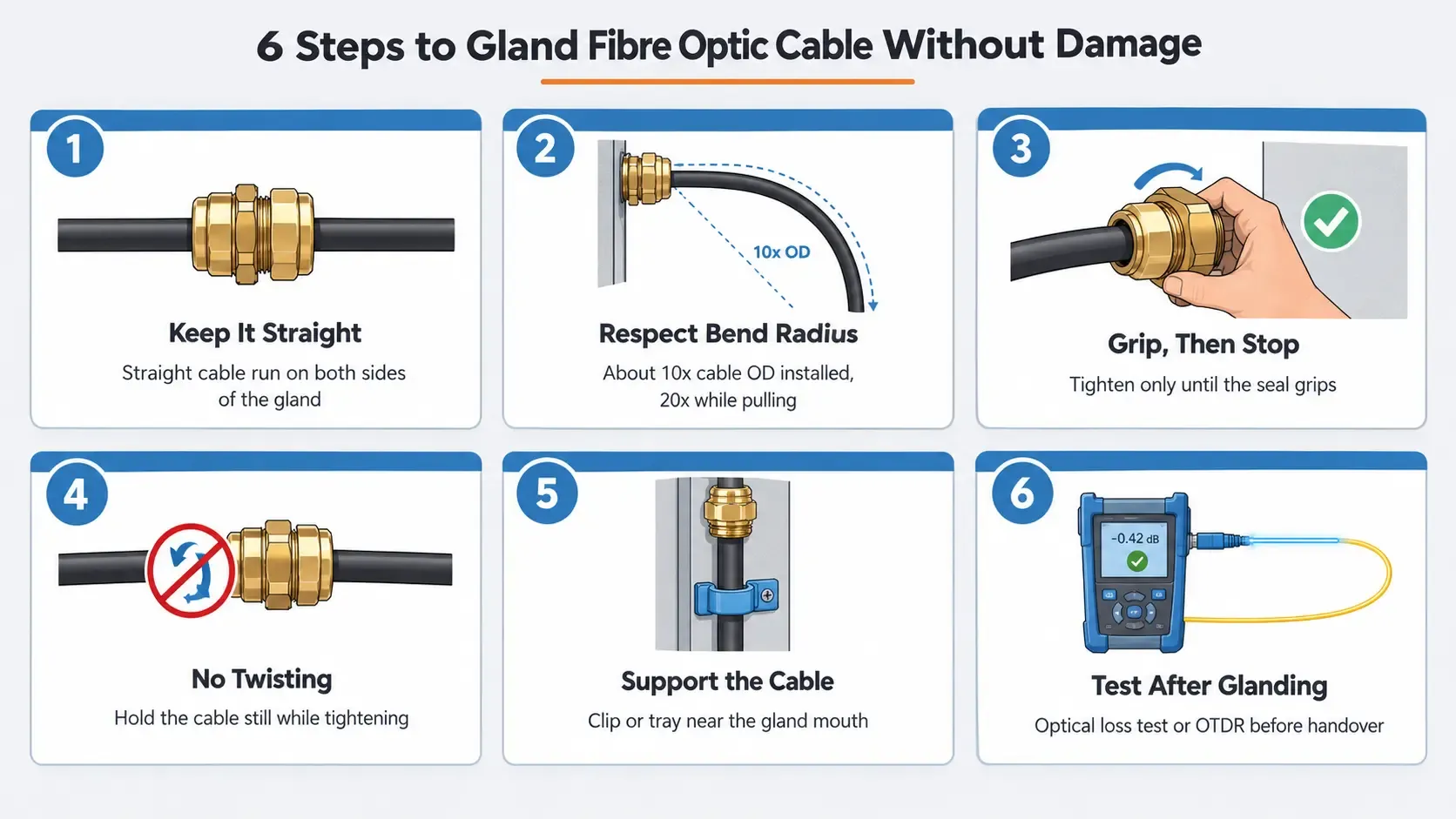
- Keep the cable straight through the gland. Leave a straight run of cable on both sides of the gland before any bend.
- Respect the minimum bend radius. A common rule is about 10 times the cable OD when installed and about 20 times while pulling, but the cable datasheet is the figure that counts.
- Tighten until the seal grips, then stop. Follow the gland maker’s tightening guidance. Extra turns add pressure on the fibres without improving the seal.
- Don’t twist the cable. Hold the cable still while turning the gland’s cap nut, so the jacket and fibres are not wound up inside.
- Support the cable outside the enclosure. A cable cleat or tray support near the gland stops the cable’s weight from bending it at the gland mouth.
- Test after installation. Run an optical loss test or OTDR trace after glanding, not only after splicing, so any gland-related loss is found before handover.
For general gland fitting faults that also apply to fibre, see our article on cable gland mistakes that cause water leakage.
Sealing Outdoors: IP Rating for Fibre Entries
Water inside a fibre enclosure does not cause a short circuit, but trapped moisture corrodes splice trays and contaminates connector end faces. Outdoor fibre termination boxes on solar plants, substations and telecom poles should use glands rated at least IP66, and IP68 where the box can sit in standing water. Exgrip’s glands are rated IP66, IP67 and IP68. Our guide to IP ratings for cable glands explains the difference between the levels.
Fibre Optic Cables in Hazardous Areas
Refineries, chemical plants and gas plants run fibre links through Zone 1 and Zone 2 areas for control and safety systems. The fibre itself is not the electrical risk, but the enclosure it enters often contains powered equipment such as media converters or switches. That enclosure’s cable entries must keep its protection concept intact, so the gland must be Ex certified for the enclosure type, for example Ex db for a flameproof box or Ex eb for an increased safety box. Optical radiation as an ignition source is covered by its own standard, IEC 60079-28, which applies to the optical equipment rather than the gland.
Exgrip’s A2F and E1FW are certified Ex db and Ex eb IIC Gb and Ex ta IIIC Da under ATEX, IECEx and PESO, so the same gland can be used on fibre and copper entries of the same enclosure. For zone selection, see our guide to Zone 1 vs Zone 2 cable glands.
Where Fibre Cable Glands Are Used
| Application | Typical fibre cable | Gland choice |
|---|---|---|
| Solar plant SCADA and inverter monitoring | Armoured outdoor fibre | Double compression, IP66/IP68, brass or nickel plated brass |
| Substation protection and control | Armoured or duct fibre | Double compression for armoured; single compression for duct cable |
| Refinery and chemical plant DCS links | Armoured fibre in Zone 1/2 | Ex certified double compression gland |
| Coastal and port installations | Armoured fibre | Stainless steel gland, IP68 |
| Indoor control rooms and data rooms | Unarmoured fibre | Single compression gland, small sizes |
For solar sites in particular, see our page on cable glands for solar power plants, and for refinery work, cable glands for oil and gas refineries.
Conclusion & Call-to-Action
Fibre links usually fail acceptance tests for one of three reasons: a bad splice, a tight bend, or a gland that squeezes too hard. The first gets tested every time; the other two often do not. Size fibre glands to the middle of their seal range, tighten only to grip, keep the cable straight through the entry, and test after glanding. Those four habits remove most gland-related fibre faults.
Send us your fibre cable datasheet (outer diameter, armour type and whether connectors are pre-fitted) and enclosure entry sizes, and Exgrip’s team will recommend the gland, seal range and certification for each entry.
📩 Talk to our technical team today at Exgrip.com
📞 Or call us directly for quick assistance!
Contact Us:
📞 Phone: +91 9537118899
🌐 Website: www.exgrip.com
📩 Request a Quote: Contact Page
FAQs
Can a normal cable gland be used on fibre optic cable?
Yes, if its sealing range suits the fibre cable’s outer diameter and it is tightened only until the seal grips. Choose a size that puts the cable in the middle of the seal range so the clamping pressure stays low.
Can over-tightening a cable gland damage fibre?
Yes. Excess pressure can cause microbending, which increases signal loss even when the cable looks undamaged. Test the link after glanding to catch it before handover.
Which gland is used for armoured fibre optic cable?
A double compression gland that clamps the armour, such as Exgrip’s E1FW for wire armoured cable. Check the armour type first, because tape-armoured fibre cables may need a different armour clamp.
How do you pass a pre-terminated fibre cable through a gland?
Use a gland large enough for the connector to pass, with a seal sized for the cable, or fit the connectors after the cable has gone through the gland. Decide this before ordering the glands.
Do fibre optic cables need Ex glands in hazardous areas?
Yes, when they enter a certified Ex enclosure. The gland must be certified for that enclosure’s type of protection, just as a power cable gland would be.
What IP rating should a fibre cable gland have?
At least IP66 outdoors, and IP68 where the enclosure can sit in water. Indoor dry locations can use lower ratings, but IP66 is a sensible minimum for industrial sites.