A cable gland specified in the wrong material doesn’t fail on day one. It fails eighteen months into service, usually during a shutdown inspection, when a maintenance engineer finds green corrosion streaking down a junction box in a coastal Gujarat refinery or pitting starting on a fitting near a cooling tower. By then the gland has already been replaced once, sometimes twice, and the real cost isn’t the part it’s the unplanned isolation, the permit-to-work paperwork, and the production hours lost re-terminating cable that should never have needed touching.
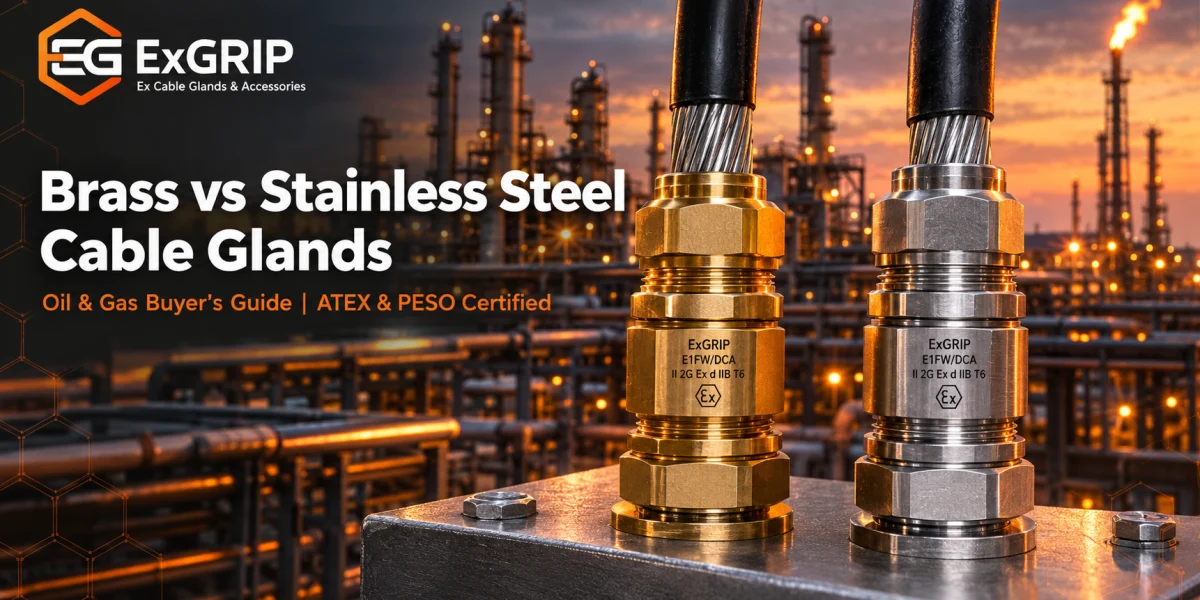
Brass and stainless steel cable glands both show up constantly in oil & gas and refinery specifications, and both are legitimate choices but they are not interchangeable, and treating the decision as a budget line item rather than an environmental one is where most of these premature failures start. This guide breaks down what actually changes between brass, nickel-plated brass, and 316 stainless steel cable glands, and where each one belongs across upstream, refinery, and offshore installations.
Brass, Nickel-Plated Brass, or 316 Stainless: What Actually Changes Between Them
All three materials can be manufactured to the same mechanical tolerances and pass the same IP66/IP67/IP68 ingress tests, the same ATEX Ex db/Ex eb ratings, and the same PESO approval process. The difference isn’t performance on day one it’s how each material behaves over years of exposure to a specific environment.
Standard brass is the default for a reason: it’s strong, machines to tight tolerances, conducts heat away from the termination point well, and costs less than stainless steel for the same gland size. In a dry, indoor, or well-ventilated process area with no direct salt or chemical exposure, brass performs for the full service life of the installation without issue. Nickel-plated brass adds a corrosion-resistant plated layer over the same base metal, closing the gap for installations with moderate humidity or occasional washdown exposure common in tank farm and pump station areas without moving up to stainless steel pricing. 316 stainless steel removes the corrosion question almost entirely: it resists chloride pitting, doesn’t require a plated barrier that can eventually wear through, and is the standard specification for coastal, marine, and aggressive chemical atmospheres.
| Property | Brass | Nickel-Plated Brass | 316 Stainless Steel |
|---|---|---|---|
| Ambient temperature range | -60°C to +160°C | -60°C to +160°C | -60°C to +160°C |
| Thread compatibility | Metric (M), PG, NPT | Metric (M), PG, NPT | Metric (M), PG, NPT |
| IP rating achievable | IP66 / IP67 / IP68 | IP66 / IP67 / IP68 | IP66 / IP67 / IP68 |
| ATEX / IECEx certification | Available (Ex db, Ex eb, Ex ta) | Available (Ex db, Ex eb, Ex ta) | Available (Ex db, Ex eb, Ex ta) |
| Chloride / salt-spray resistance | Low | Moderate | High |
| Relative material cost | Lowest | Mid | Highest |
| Best-fit environment | Dry indoor process areas | Occasional washdown, moderate humidity | Coastal, offshore, aggressive chemical |
What this table makes clear is that the certifications and mechanical specs stay constant the decision genuinely comes down to one variable: how corrosive is the environment the gland will sit in for the next ten to fifteen years.
Brass vs Stainless Steel Cable Gland: Head-to-Head Comparison
| Factor | Brass Cable Gland | 316 Stainless Steel Cable Gland |
|---|---|---|
| Corrosion resistance | Adequate in dry, low-salinity environments | Strong resistance to chlorides, marine air, and most process chemicals |
| Typical application | Onshore process units, panel rooms, dry switchgear areas | Coastal refineries, offshore platforms, chemical injection skids |
| Weight | Lighter | Heavier |
| Lead time (standard sizes) | Shorter, higher stock availability | Slightly longer for larger sizes |
| Cost per unit | Lower | 20-40% higher, depending on size and thread type |
| Long-term maintenance need | Periodic inspection recommended in humid zones | Minimal, even in aggressive atmospheres |
Neither material is universally “better.” A brass gland specified correctly for a dry indoor panel room will outperform a stainless steel gland on cost with zero corrosion risk, because the environment never puts that risk on the table. The failures happen when brass gets specified by default because it’s cheaper, or because it’s what the last project used into an environment it was never suited for.
Material Selection for Oil Refinery Installations
Refineries present a mix of microenvironments under one site boundary, which is exactly why a single blanket material choice across the whole facility usually gets it wrong somewhere. Process units near cooling towers or seawater intake systems see near-constant humidity and occasional saline drift. Tank farm areas see less direct exposure but longer dwell times between inspections. Indoor switchgear and MCC rooms are typically dry enough that brass performs without any corrosion concern for the full design life of the installation.
For a deeper look at how SWA armoured cable gland selection works specifically for Gujarat’s refinery belt including installation practices and EPC project considerations see our guide on SWA Cable Glands for Oil Refineries in Gujarat. That piece covers the broader refinery installation context; this section focuses specifically on where material choice changes within a single refinery footprint.
The practical approach most procurement teams land on is zone-based specification rather than a single site-wide standard: brass or nickel-plated brass for indoor and low-exposure process areas, 316 stainless steel for anything within reach of cooling tower drift, seawater intake, or open-air coastal exposure. Mixing materials by zone within one project isn’t a compromise it’s the specification that actually matches installed cost to real corrosion risk.
Coastal and Offshore Installations
Gujarat’s refinery and petrochemical corridor sits directly along the Saurashtra coast, and salt-laden air travels further inland than most site drawings account for. Offshore platforms and coastal terminal installations face this exposure constantly rather than occasionally, which is why 316 stainless steel is the default specification rather than an upgrade option in these settings.
Chloride-driven pitting corrosion on brass or even nickel-plated brass fittings in a marine atmosphere doesn’t announce itself early the plated or surface layer can look intact while pitting starts underneath, and by the time visible corrosion shows on an inspection, the gland’s ingress protection at the cable entry point may already be compromised. On offshore platforms specifically, where access for replacement means a planned shutdown or a helicopter-supported maintenance trip rather than a five-minute walk to a stores cabin, specifying 316 stainless from the outset removes a maintenance liability that’s disproportionately expensive to fix later compared to what it costs to get right at installation.
Sour Service: Cable Glands in H2S-Present Crude Environments
Sour crude handling where hydrogen sulphide is present in the process stream adds a chemical corrosion mechanism on top of any humidity or salinity exposure already in play. H2S attack on brass fittings can be more aggressive than general atmospheric corrosion alone, particularly at gasket interfaces and threaded connections where moisture can concentrate.
316 stainless steel’s chromium-nickel composition resists sulphide-driven corrosion meaningfully better than brass, which is why it’s the standard specification for cable glands anywhere near sour gas separation units, sour water strippers, or crude handling areas known to carry elevated H2S content. For sour service applications, treat stainless steel as the baseline material rather than an environmental upgrade the corrosion mechanism here isn’t marginal, and the cost difference between materials is small relative to the cost of an unplanned gland replacement inside a sour service unit.
Certification and Material: How ATEX, IECEx, PESO, and IS 2148 Fit In
Four certification frameworks are relevant to cable gland procurement for Indian oil & gas installations. They are not interchangeable, and a single project specification may genuinely require more than one.
ATEX
ATEX is the European Union’s framework for equipment used in explosive atmospheres, defined by two EU Directives: ATEX 114 (equipment) and ATEX 153 (workplaces). ATEX certification is issued by EU-notified bodies including SIRA, Intertek, TÜV Rheinland, and Bureau Veritas. It’s the most widely specified certification on Indian EPC projects with international FEED documentation projects for Shell, BP, TotalEnergies, ExxonMobil, and most Japanese and Korean engineering contractors reference ATEX as the minimum certification standard. An ATEX-certified gland carries the Ex marking with the notified body code, equipment group and category, protection concept, and temperature class for example, II 2G Ex d IIB T6 Gb.
IECEx
IECEx is the International Electrotechnical Commission’s global certification scheme for Ex equipment, operating through a mutual recognition framework: IECEx certificates are issued by IECEx-accredited certification bodies and accepted in over 50 participating countries without re-testing. For Indian EPC contractors working on international projects LNG terminals, offshore platforms, petrochemical plants with global licensor involvement IECEx is increasingly specified alongside or instead of ATEX. An IECEx certificate number takes the form IECEx XXX YY.NNNN, where XXX is the certification body code.
PESO
PESO approval is an Indian statutory requirement under the Petroleum Act 1934 and the Gas Cylinders Rules 2016. The Petroleum and Explosives Safety Organisation approves electrical equipment for use in petroleum-classified facilities through its own testing and certification process, conducted through recognised test houses. Every petroleum refinery, LPG filling plant, petroleum storage depot, and petroleum pipeline pumping station in India is a PESO-regulated facility. Cable glands installed in any of these locations must carry current PESO approval not a copy of someone else’s certificate, not a declaration of conformity, but a PESO approval number on the gland’s own certification documentation. PESO approval is renewed periodically, and procurement engineers should verify the approval is current before placing orders.
IS 2148
IS 2148 is the Bureau of Indian Standards specification for flameproof (Ex d) enclosures. It’s technically aligned with IEC 60079-1 but administered through BIS and specifically referenced in Indian government and PSU procurement standards. ONGC, IOCL, BPCL, HPCL, and GAIL vendor qualification documents require IS 2148 compliance for flameproof equipment. An imported gland with ATEX marking satisfies IS 2148 requirements only if the applicable BIS notification lists the ATEX standard as an acceptable equivalent — this needs verifying on a project-by-project basis. Exgrip’s Ex d cable gland range is manufactured in Jamnagar under IS 2148 and carries current PESO approval.
| Certification | Issuing Body | Required For | Applicable Standard |
|---|---|---|---|
| ATEX | EU Notified Body (SIRA, TÜV, Intertek) | International EPC projects with EU-origin FEED | IEC 60079-1, ATEX Directive 2014/34/EU |
| IECEx | IECEx-accredited body | International projects, global licensor requirements | IEC 60079 series |
| PESO | PESO India | All petroleum-classified facilities in India (statutory) | Petroleum Act 1934, Petroleum Rules 2002 |
| IS 2148 | BIS / Test House | Indian PSU projects (ONGC, IOCL, BPCL, HPCL, GAIL) | IS 2148 (aligned with IEC 60079-1) |
Why Exgrip for Oil & Gas Material-Critical Installations
Exgrip manufactures both brass and 316 stainless steel cable glands from the same Jamnagar facility, in the same ATEX, IECEx, and PESO-approved product lines, which means switching material specification between zones on the same project doesn’t mean switching suppliers or re-qualifying a new vendor mid-procurement. The A2F and E1FW ranges, along with the DCA and DCAB double compression armoured lines, are available in both materials with matching thread types (Metric, PG, NPT) and matching IP66/67/68 ingress ratings, so a project engineer specifying mixed materials by zone can source the entire package from one certified manufacturer.
Being based in Jamnagar a region with its own long-standing brass manufacturing base also means Exgrip works with material sourcing and machining tolerances the local industry has refined over decades, rather than treating brass as a commodity input. That matters for consistency across large orders, where dimensional tolerance variance between batches is what actually causes on-site fitment issues, not the material choice itself.
Conclusion & Call-to-Action
The brass-versus-stainless-steel decision for oil & gas cable glands isn’t really a single decision at all it’s a zone-by-zone environmental assessment that most projects benefit from documenting explicitly rather than defaulting to one material across an entire site. Indoor process areas and dry switchgear rooms rarely need to pay for stainless steel. Coastal exposure, offshore platforms, and sour service units rarely get away with brass holding up for the design life of the installation.
Getting this right at the specification stage, before procurement locks in a bill of materials, is meaningfully cheaper than discovering the mismatch during a shutdown inspection three years in. Exgrip’s engineering team reviews project-specific environmental conditions salinity exposure, H2S presence, indoor versus outdoor placement as part of standard technical support, and can help align gland material to zone rather than defaulting to a single site-wide specification.
📩 Talk to our technical team today at Exgrip.com
📞 Or call us directly for quick assistance!
Contact Us:
📞 Phone: +91 9537118899
🌐 Website: www.exgrip.com
📩 Request a Quote: Contact Page
FAQs
Is stainless steel always better than brass for oil & gas cable glands?
No. Stainless steel is better suited to corrosive environments like coastal, offshore, and sour service areas, but in dry indoor process or switchgear areas, brass performs equally well for the full design life at a lower cost. The right choice depends on environment, not a general performance ranking.
Can brass and stainless steel cable glands both be ATEX and PESO certified?
Yes. Certification and material are independent specifications. Exgrip manufactures both brass and 316 stainless steel cable glands with ATEX (Ex db, Ex eb, Ex ta), IECEx, and PESO approval available on the same product ranges.
Does nickel-plated brass eliminate the need for stainless steel in coastal areas?
Not for sustained coastal or offshore exposure. Nickel plating improves corrosion resistance over standard brass and works well for occasional humidity or washdown conditions, but the plated layer can eventually wear or pit under constant salt exposure, where 316 stainless steel remains the more reliable long-term choice.
What is sour service, and why does it change the material recommendation?
Sour service refers to process environments where hydrogen sulphide (H2S) is present in the crude or gas stream, commonly in certain upstream and refinery separation units. H2S can accelerate corrosion on brass fittings, which is why 316 stainless steel is generally specified as the baseline material near sour gas or sour water handling equipment.
How much more does a stainless steel cable gland cost compared to brass?
Typically 20-40% more per unit depending on size and thread type, though the exact difference varies by gland size and order volume. For projects with mixed environmental zones, the added cost applies only to the glands actually installed in corrosive-exposure areas, not the full site quantity.
Do brass and stainless steel cable glands have the same IP rating?
Yes. Both materials can be manufactured and certified to IP66, IP67, or IP68 depending on the specific gland design. Material affects corrosion resistance over time, not the ingress protection rating achievable at installation.
Where can I check which cable gland size and material fits my cable specification?
Exgrip’s Cable Gland Selection Chart and Selection Tool both allow you to cross-check cable outer diameter, thread type, and application environment against the available product range before finalising an order.