
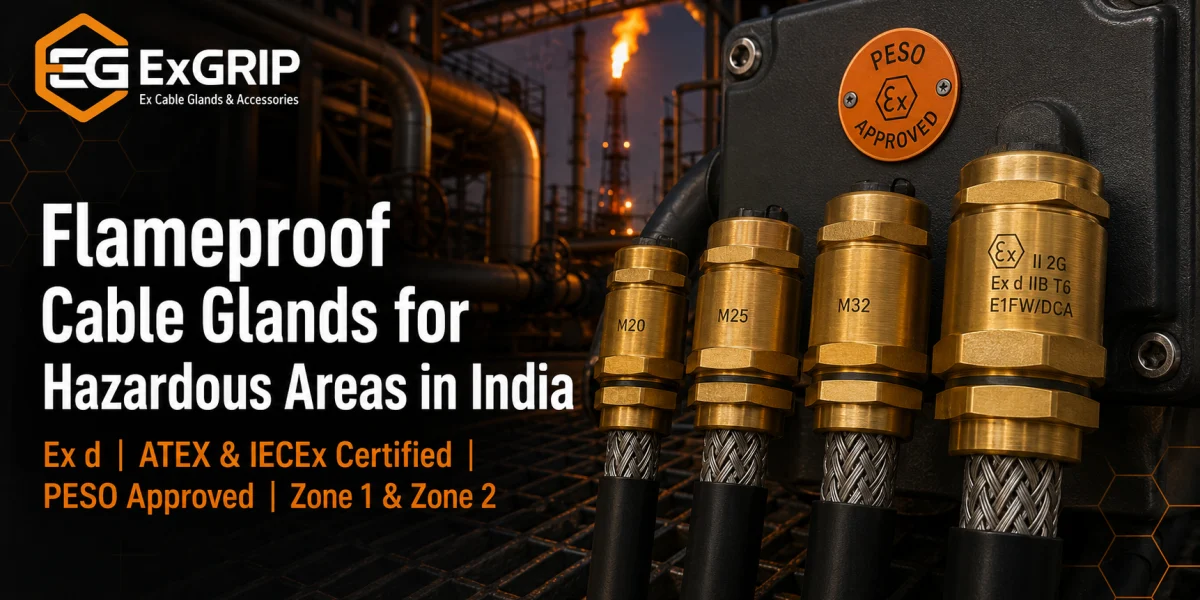
A cable gland that reaches a Zone 1 installation without Ex d certification does not get installed and corrected later. It gets rejected at third-party inspection, every cable entry in that enclosure gets flagged, and the electrical contractor faces a stop-work notice until replacements arrive. On a Gujarat refinery turnaround or a GIDC chemical plant commissioning schedule, that delay costs more than the entire cable gland order. The gland is a low-cost component. The consequence of specifying the wrong one is not.
This guide covers the Ex d protection concept and what it means in practice, hazardous area zone classification under Indian and international standards, when flameproof glands are mandatory versus when increased safety glands are permitted, correct cable gland sizing for armoured cable, and the certifications ATEX, IECEx, PESO, and IS 2148 that apply to hazardous area cable gland procurement in India.
What Is a Flameproof Cable Gland (Ex d)?
“Flameproof” is the protection concept; “Ex d” is its designation under IEC 60079-1, the international standard for flameproof enclosures. The protection mechanism is containment, not prevention. An Ex d cable gland does not stop ignition from occurring inside the fitting it constructs the flame path and internal volume so that if ignition does occur, the resulting pressure and flame cannot propagate through the gland body to the surrounding hazardous atmosphere. The gland itself becomes a flameproof enclosure at the cable entry point.
This is distinct from other Ex protection concepts. Increased safety (Ex e) prevents the conditions that cause ignition. Intrinsic safety (Ex i) limits the electrical energy available to below the minimum ignition energy of the surrounding gas. Flameproof (Ex d) assumes ignition may happen and contains it. The table below maps each protection concept to its zone applicability and cable gland relevance.
| Protection Concept | IEC Designation | Mechanism | Zone Applicability | Cable Gland Type |
|---|---|---|---|---|
| Flameproof | Ex d | Contains internal explosion flame path controlled | Zone 1, Zone 2 | Ex d double compression |
| Increased Safety | Ex e | Prevents ignition from occurring no arcing under normal or fault conditions | Zone 2 only | Ex e single or double compression |
| Intrinsic Safety | Ex i | Limits available energy below minimum ignition threshold | Zone 0, 1, 2 | Barrier-type cable gland or standard with barrier |
| Dust Ignition Protection | Ex t | Enclosure prevents dust cloud entry | Zone 21, Zone 22 | IP65 minimum, dust-rated gland |
The practical consequence of this table for procurement: if your hazardous area drawing specifies Zone 1, Ex d is the minimum gland protection concept. There is no substitute at that zone classification.
Hazardous Area Classification in India: Zones, Standards, and PESO
Hazardous area classification divides plant environments into zones based on the likelihood and duration of a flammable gas or vapour cloud being present. Zone 0 is where a flammable atmosphere is present continuously or for long periods typically the vapour space inside a crude oil storage tank or inside a distillation column. Zone 1 is where a flammable atmosphere is likely under normal operating conditions: the immediate surroundings of a pump seal housing in a Jamnagar refinery process unit, the area around a gas meter in a CNG compression facility, the interior of a paint spray booth in an automotive plant. Zone 2 is where a flammable atmosphere is not likely under normal operation but may occur in abnormal conditions the open process area surrounding Zone 1 equipment, or the area around a flanged joint on a high-pressure gas line.
For combustible dust environments, the equivalent classification is Zone 20 (continuous), Zone 21 (likely under normal operation), and Zone 22 (unlikely under normal operation). Flour mills, pharmaceutical solvent handling areas, and coal handling plants in India operate under this classification.
The Indian Regulatory Layer: PESO and IS 2148
International zone classification (IEC 60079-10-1 for gas, IEC 60079-10-2 for dust) defines where hazardous areas exist. Indian regulation defines what equipment is permitted inside them. The Petroleum and Explosives Safety Organisation (PESO), operating under the Ministry of Commerce and Industry, governs the use of electrical equipment in petroleum-classified areas under the Petroleum Act 1934 and the Petroleum Rules 2002. Any flameproof or Ex-certified component installed in a PESO-regulated facility which includes every petroleum refinery, LPG terminal, and petroleum storage depot in India must carry PESO approval in addition to any international certification.
IS 2148 is the Bureau of Indian Standards specification for flameproof enclosures for electrical apparatus. It is the Indian equivalent of IEC 60079-1. Public sector undertakings including ONGC, IOCL, BPCL, HPCL, GAIL, and Gujarat Gas specify IS 2148 compliance in their vendor qualification documents. An imported gland with ATEX marking alone does not satisfy IS 2148 unless it has additionally been tested and certified under that standard or under an approved equivalent recognised by BIS.
The consequence of this for procurement engineers: a gland carrying ATEX certification but no PESO approval cannot legally be installed in a petroleum-classified facility in India. Both are required. Neither replaces the other.
When You Need Ex d (Flameproof) vs Ex e (Increased Safety)?
The selection between Ex d and Ex e cable glands depends entirely on the zone classification at the point of cable entry. Zone 1 requires Ex d as the minimum protection concept. Zone 2 permits Ex e, but also accepts Ex d so a Zone 2 installation can use either type. Zone 0 does not permit Ex d or Ex e for cable glands; cable entries into Zone 0 equipment require Ex ia or Ex ib barrier glands with intrinsic safety barriers.
On large Indian EPC projects ONGC offshore platforms, HPCL refinery expansions, GIDC chemical complexes project electrical specifications frequently mandate Ex d throughout Zone 1 and Zone 2 rather than switching to Ex e at Zone 2 boundaries. The reason is installation simplicity: one gland type across the site reduces procurement complexity, eliminates the risk of fitting an Ex e gland at a Zone 1 entry point, and simplifies third-party inspection. The cost difference between Ex d and Ex e double compression glands at procurement scale is small. The cost of a mis-installed gland at TPIA is not.
| Parameter | Ex d (Flameproof) | Ex e (Increased Safety) |
|---|---|---|
| Zone 1 permitted | Yes | No |
| Zone 2 permitted | Yes | Yes |
| Protection mechanism | Contains internal ignition | Prevents ignition occurring |
| Gland body construction | Heavy-wall brass or SS, controlled flame path | Standard brass, IP-sealed entry |
| IP rating achievable | IP66 / IP68 | IP54 / IP66 |
| Cost vs Ex e | Higher | Lower |
| Common Indian EPC practice | Specified throughout Zone 1 and Zone 2 | Zone 2 only, where explicitly permitted by project spec |
Installing an Ex e gland at a Zone 1 cable entry is not a site-level discretion. It is a certification boundary failure. The ATEX scope of the enclosure is voided at that entry point, and the installation requires full rework before energisation.
Double Compression vs Single Compression Cable Glands in Hazardous Areas
Single compression cable glands are not permitted in Zone 1 installations. IEC 60079-1 requires that every cable entry into a flameproof enclosure provides an independent mechanical seal on both the cable outer sheath and the armour wire two separate compression actions. A single compression gland applies one clamping action to both simultaneously, which means neither the IP seal nor the armour grip meets the standard individually. The result is a cable entry that may grip adequately at installation but does not maintain its seal under thermal cycling, cable movement, or vibration conditions that are standard in oil refinery and chemical plant environments.
A double compression cable gland applies two independent compression actions. The inner compression ring grips and seals the cable outer sheath. The outer body compresses the armour wire through a separate locknut and backnut arrangement. These two actions are mechanically independent, which is why double compression glands achieve IP66 and IP68 ratings that single compression glands cannot sustain over the installation lifetime.
| Feature | Single Compression | Double Compression |
|---|---|---|
| Outer sheath seal | One combined compression action | Dedicated inner compression ring |
| Armour wire clamp | Shared with sheath grip | Independent backnut/locknut clamp |
| Zone 1 permitted | No | Yes |
| IP rating | IP54 typical | IP66 / IP68 achievable |
| Earth continuity via armour | Not reliable under vibration | Positive clamp continuous earth path |
| IEC 60079-1 compliance | Does not comply for Zone 1 | Complies for Zone 1 and Zone 2 |
For armoured SWA cable specifically, the earth continuity function of the armour wire is as important as the IP seal. Without a positive armour clamp, the steel wire braid loses its supplementary earth path at the termination point which in a Zone 1 area is not a wiring fault, it is a safety system failure. Exgrip’s Ex d double compression cable glands (DCA and E1FW series) provide independent armour clamp and sheath seal, achieving IP68 at 10 metres for 30 minutes on SWA armoured cable up to 85mm outer diameter.
Flameproof Cable Gland Sizes: How to Select the Right Size for Armoured Cable
Cable gland size refers to the outer diameter of the cable being terminated, not the conductor cross-section. A 95mm² four-core SWA cable from one manufacturer may have an outer diameter of 42mm; the same specification from another manufacturer may be 46mm. A gland sized for 42mm OD will not compress correctly on a 46mm cable the IP seal fails and the armour grip is insufficient. This is the most common cable gland sizing error on Indian EPC projects, and it consistently shows up during pre-commissioning electrical checks.
Measure the cable outer diameter from the drum label or the cable manufacturer’s data sheet before raising the purchase order. Do not size from standard tables that quote “typical” OD for a conductor size they represent averages, not the actual cable you have on site.
Double Compression Cable Gland Size Chart Armoured SWA Cable
| Gland Size (Metric) | Thread Entry | Cable OD Range (mm) | Armour Wire Grip Range (mm) | IP Rating | Typical SWA Application |
|---|---|---|---|---|---|
| M16 | M16×1.5 | 5.0 – 10.0 | 6.0 – 11.0 | IP68 | 2-core 1.5mm² SWA control cable |
| M20 | M20×1.5 | 8.0 – 13.0 | 9.5 – 14.5 | IP68 | 4-core 2.5mm² SWA instrumentation cable |
| M25 | M25×1.5 | 13.0 – 18.5 | 14.0 – 20.0 | IP68 | 4-core 6mm² SWA, multicore 7-core 1.5mm² |
| M32 | M32×1.5 | 18.0 – 25.0 | 19.5 – 27.0 | IP68 | 4-core 16mm² SWA, multicore 12-core 2.5mm² |
| M40 | M40×1.5 | 24.0 – 32.0 | 26.0 – 34.5 | IP68 | 4-core 35mm² SWA, 19-core 2.5mm² multicore |
| M50 | M50×1.5 | 32.0 – 42.0 | 34.0 – 44.5 | IP68 | 4-core 70mm² SWA, 37-core 2.5mm² multicore |
| M63 | M63×1.5 | 42.0 – 55.0 | 44.5 – 58.0 | IP68 | 4-core 120mm²–150mm² SWA, large multicore |
| M75 | M75×1.5 | 55.0 – 70.0 | 57.0 – 73.0 | IP68 | 4-core 185mm²–240mm² SWA power cable |
The OD ranges above are indicative. Always cross-reference against the Exgrip cable gland selection chart for the specific gland series. Download the cable gland size chart for a full range including NPT and BSP thread variants.
ATEX, IECEx, PESO, and IS 2148: Which Certifications Apply in India?
Four certification frameworks are relevant to flameproof cable gland procurement in India. They are not interchangeable, and a project specification may require more than one.
ATEX
ATEX is the European Union’s framework for equipment used in explosive atmospheres, defined by two EU Directives: ATEX 114 (equipment) and ATEX 153 (workplaces). ATEX certification is issued by EU-notified bodies including SIRA, Intertek, TÜV Rheinland, and Bureau Veritas. It is the most widely specified certification on Indian EPC projects with international FEED documents projects for Shell, BP, TotalEnergies, ExxonMobil, and most Japanese and Korean engineering contractors will reference ATEX as the minimum certification standard. An ATEX-certified gland carries the Ex marking with the notified body code, the equipment group and category, the protection concept, and the temperature class: for example, II 2G Ex d IIB T6 Gb.
IECEx
IECEx is the International Electrotechnical Commission’s global certification scheme for Ex equipment. It operates through a mutual recognition framework: IECEx certificates are issued by IECEx-accredited certification bodies and are accepted in over 50 participating countries without re-testing. For Indian EPC contractors working on international projects LNG terminals, offshore platforms, petrochemical plants with global licensor involvement IECEx is increasingly specified alongside or instead of ATEX. An IECEx certificate number takes the form IECEx XXX YY.NNNN where XXX is the certification body code.
PESO
PESO approval is an Indian statutory requirement under the Petroleum Act 1934 and the Gas Cylinders Rules 2016. The Petroleum and Explosives Safety Organisation approves electrical equipment for use in petroleum-classified facilities through its own testing and certification process, conducted through recognised test houses. Every petroleum refinery, LPG filling plant, petroleum storage depot, and petroleum pipeline pumping station in India is a PESO-regulated facility. Flameproof cable glands installed in any of these locations must carry current PESO approval not a copy of someone else’s certificate, not a declaration of conformity, but a PESO approval number on the gland’s certification documentation. PESO approval is renewed periodically, and procurement engineers should verify the approval is current before placing orders.
IS 2148
IS 2148 is the Bureau of Indian Standards specification for flameproof (Ex d) enclosures. It is technically aligned with IEC 60079-1 but is administered through BIS and is specifically referenced in Indian government and PSU procurement standards. ONGC, IOCL, BPCL, HPCL, and GAIL vendor qualification documents require IS 2148 compliance for flameproof equipment. An imported gland with ATEX marking satisfies IS 2148 requirements only if the applicable BIS notification lists the ATEX standard as an acceptable equivalent verify this on a project-by-project basis. Exgrip’s Ex d cable gland range is manufactured in Jamnagar under IS 2148 and carries current PESO approval.
| Certification | Issuing Body | Required For | Applicable Standard |
|---|---|---|---|
| ATEX | EU Notified Body (SIRA, TÜV, Intertek) | International EPC projects with EU-origin FEED | IEC 60079-1, ATEX Directive 2014/34/EU |
| IECEx | IECEx-accredited body | International projects, global licensor requirements | IEC 60079 series |
| PESO | PESO India | All petroleum-classified facilities in India (statutory) | Petroleum Act 1934, Petroleum Rules 2002 |
| IS 2148 | BIS / Test House | Indian PSU projects (ONGC, IOCL, BPCL, HPCL, GAIL) | IS 2148 (aligned with IEC 60079-1) |
Conclusion & Call-to-Action
India’s hazardous area installation base is expanding steadily. The Dahej petrochemical hub, the ONGC KG basin offshore developments, GAIL’s pipeline network expansions into eastern India, and the emerging green hydrogen projects in Gujarat and Rajasthan will all add new Zone 1 and Zone 2 classified areas to the procurement landscape over the next five years. Each of those projects will require Ex d double compression cable glands with ATEX and PESO dual certification and the demand for IS 2148 compliance on PSU-tendered work will not decrease.
Exgrip manufactures Ex d flameproof double compression cable glands in Jamnagar, Gujarat. The range covers M16 through M75 in brass, nickel-plated brass, and 316 stainless steel, certified ATEX II 2G Ex d and PESO approved, with IS 2148 test documentation available on request. Orders ship with full certification packs no follow-up required for TPIA documentation.
📩 Talk to our technical team today at Exgrip.com
📞 Or call us directly for quick assistance!
Contact Us:
📞 Phone: +91 9537118899
🌐 Website: www.exgrip.com
📩 Request a Quote: Contact Page
FAQs
What is the difference between a flameproof and an explosion-proof cable gland?
They are the same thing under different naming conventions. “Flameproof” is the IEC and ATEX term (Ex d under IEC 60079-1). “Explosion-proof” is the North American NEC/NFPA term for the same protection concept. Both describe a fitting that contains an internal explosion and prevents flame propagation to the surrounding atmosphere. In Indian project specifications, “flameproof” and “Ex d” are the standard terminology.
Can I use a single compression cable gland in a Zone 1 area?
No. IEC 60079-1 requires independent sealing of the cable outer sheath and independent clamping of the armour wire at any Zone 1 cable entry. A single compression gland applies one mechanical action to both, which does not satisfy this requirement. Zone 1 cable entries require double compression glands with Ex d certification. Using a single compression gland in Zone 1 voids the flameproof certification of the enclosure at that entry point.
What does the marking "Ex d IIB T6 Gb" mean on a cable gland?
“Ex d” is the flameproof protection concept. “IIB” is the gas group Group IIB covers gases including ethylene and town gas (Group IIC is the highest, covering hydrogen and acetylene). “T6” is the temperature class, meaning the gland surface temperature will not exceed 85°C under fault conditions. “Gb” is the equipment protection level Gb equipment is designed for Zone 1 use. A gland marked IIB is suitable for most petroleum and petrochemical applications; hydrogen service requires IIC.
Is ATEX certification sufficient for installing cable glands in Indian oil refineries?
No. Indian petroleum-classified facilities are regulated by PESO under the Petroleum Act 1934. ATEX certification alone does not satisfy the PESO requirement. Equipment in Indian refineries, LPG terminals, and petroleum depots must carry current PESO approval. ATEX and PESO are both required one does not substitute for the other. Exgrip supplies Ex d cable glands with both ATEX and PESO certification.
What precautions apply before starting maintenance on cable glands in a hazardous area?
Maintenance in a hazardous area must not be started without a valid Hot Work or Cold Work Permit issued by the facility safety officer, gas clearance certification confirming the area is below the Lower Explosive Limit (LEL) for the relevant gas, and isolation confirmation from the electrical permit-to-work system. Cable gland maintenance specifically retorquing backnuts, replacing seals, re-dressing cable entries also requires confirmation that the associated circuit is de-energised and locked out at the panel. No cable gland maintenance work is carried out on live circuits in a Zone 1 area under any circumstances.
Does Exgrip's flameproof cable gland range comply with IS 2148?
Yes. Exgrip’s Ex d double compression cable glands are manufactured in Jamnagar under IS 2148, carry current PESO approval, and are ATEX certified by an EU notified body. Documentation ATEX certificate, PESO approval, IS 2148 test report, and material test report is supplied with every order. No chasing for certification paperwork after dispatch.