
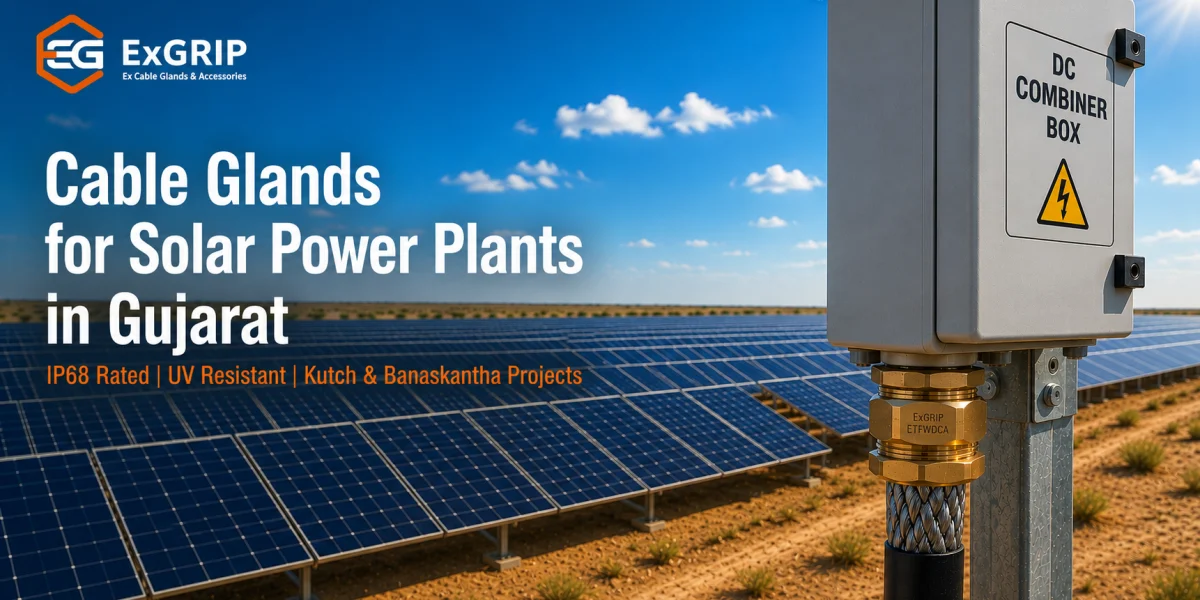
Gujarat’s solar projects operate in some of the most demanding cable termination environments in India. The Khavda Renewable Energy Park in Kutch currently the world’s largest solar park under development at 30 GW planned capacity and Charanka Solar Park in Patan (590 MW operational) represent what Gujarat’s terrain asks of electrical hardware: sustained UV exposure, ambient temperatures above 45°C during summer, direct cable burial in saline desert soil, and monsoon moisture that finds every weak seal. A cable gland that passes visual inspection at goods-in will still fail three years into a 25-year project lifecycle if the IP rating, gland type, or material was wrong from the start.
This guide covers the correct cable gland specification for each installation zone in a Gujarat solar power plant from DC string cables at panel level to underground armoured runs and AC distribution cable entries. Exgrip, based in Udhyognagar, Jamnagar, manufactures IP68-rated single and double compression cable glands in brass and stainless steel for solar plant cable terminations across Gujarat.
Where Cable Glands Are Installed in a Solar Power Plant?
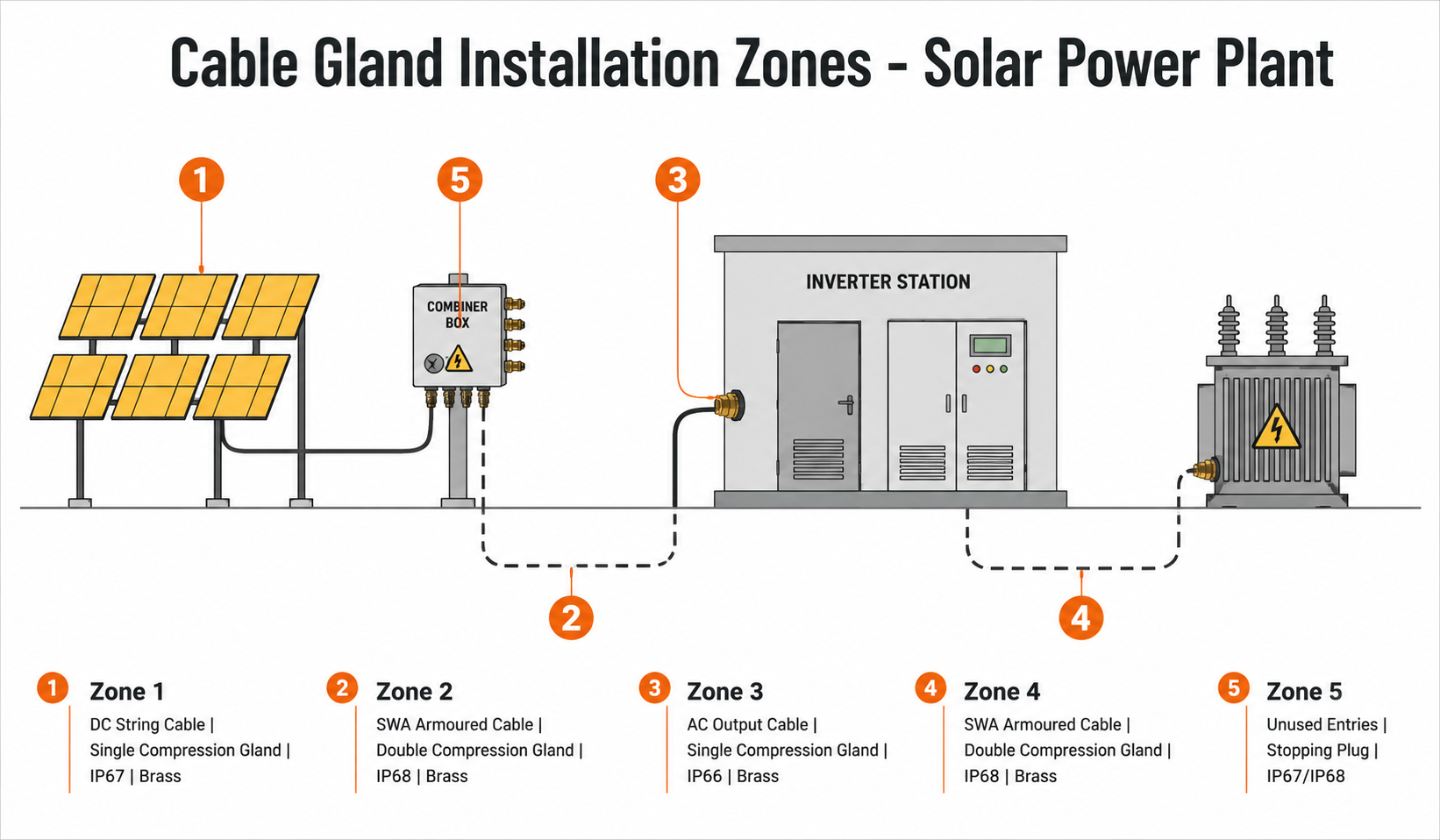
A solar power plant has six distinct cable entry points, each with different IP and gland type requirements. Specifying a single gland type across the whole project is the most common procurement error the DC string zone and the underground zone have different cable constructions and different minimum IP requirements.
- Panel string to combiner box: Unarmoured DC PV cable (4mm² to 16mm²) entering the combiner box single compression gland, IP67 minimum, UV-stabilised elastomer seal
- Combiner box to inverter (underground run): SWA armoured cable direct-buried between combiner bank and inverter station double compression gland at both termination ends, IP68 at the underground entry
- Inverter room cable entries: AC output cables and control cables entering the inverter enclosure single compression gland, IP66 minimum for enclosed rooms, IP67 if the room is not fully weather-sealed
- Inverter to grid connection (underground): MV or LV armoured cable between inverter LV board and transformer or grid tie point double compression gland, IP68
- Junction boxes and monitoring conduit entries: Data cables and monitoring lines at combiner and string monitoring boxes single compression gland, IP66 minimum
- Unused cable entries: Any unused threaded entry on a combiner box, junction box, or inverter enclosure must be sealed with an IP-rated stopping plug (Exgrip PLG or PLD) to maintain the enclosure’s rated IP
Cable Gland Specifications by Solar Plant Installation Zone
The table below maps each installation zone to the correct gland type, minimum IP rating, and the Exgrip product range that covers it. Use this alongside the cable OD from the cable manufacturer’s datasheet to confirm the correct gland size.
| Installation Zone | Cable Type | Gland Type | Min IP Rating | Exgrip Models |
|---|---|---|---|---|
| Panel to combiner box (DC string) | Unarmoured PV cable (4–16mm²) | Single compression | IP67 | A2F, SCU, SCA |
| Combiner to inverter (direct burial) | SWA armoured cable | Double compression | IP68 | E1FW, DCA, DCU |
| Inverter room AC cable entries | Unarmoured AC output cable | Single compression | IP66 | A2F, SCU, SCA |
| Inverter to transformer (underground) | SWA armoured MV/LV cable | Double compression | IP68 | DCA, DCU, E1FW |
| Junction and monitoring boxes | Unarmoured data/control cable | Single compression | IP66 | A2F, SCU |
| Unused enclosure entries | N/A blank seal | Stopping plug | IP67/IP68 | PLG, PLD |
IP Rating Requirements for Gujarat Solar Installations
Gujarat’s climate determines the minimum IP requirement at each zone not just the cable type. The Kutch region in particular combines high UV index, saline soil, and monsoon flooding that pushes ground-level cable entries to IP68 as a minimum rather than a guideline.
| Installation Environment | Minimum IP Required | Reason Specific to Gujarat |
|---|---|---|
| Direct burial Kutch saline soil | IP68 | Seasonal waterlogging; saline groundwater accelerates seal degradation on IP67-only glands |
| Exposed outdoor combiner boxes | IP67 | Monsoon-driven horizontal rain at Banaskantha and Surendranagar sites exceeds IP66 spray tolerance |
| Open-air junction boxes on panel frames | IP67 | Direct solar heating to 70°C+ inside the enclosure degrades IP66 elastomer seals faster |
| Enclosed inverter rooms (weather-sealed) | IP66 | Protected environment IP66 sufficient provided room maintains positive pressure and sealed penetrations |
| Outdoor inverter stations (open-air) | IP67 | No building protection treats as exposed outdoor installation |
Sizing Cable Glands for Solar Plant Cables
Gland size is determined by cable outer diameter, not conductor cross-section. On a solar project with cables from multiple manufacturers, the OD of a 10mm² PV cable varies by supplier confirm from the cable datasheet before ordering glands.
- DC string cable (4–16mm²): Confirm OD from the PV cable manufacturer’s datasheet PV cable OD is not standardised across suppliers
- Underground SWA cable: OD includes armour wire layer get cable OD and armour wire diameter from the cable spec sheet, not from conductor size alone
- Thread type: Most solar plant enclosures in India use Metric (M) threads; imported junction boxes may use PG verify before ordering
- Bulk orders: On large Gujarat solar projects with multiple cable sizes, use Exgrip’s cable gland selection chart to build a complete gland schedule from the cable schedule OD column
The Exgrip cable gland selection tool allows engineers to input the cable OD and entry thread and returns the correct gland size and model useful when finalising a bill of materials against the cable schedule.
Brass Cable Glands: Why Material Matters
The material of a cable gland directly determines its performance in terms of corrosion resistance, mechanical strength, electrical conductivity, and service life. Exgrip specialises in brass cable glands the industry’s most widely preferred material for industrial cable entry applications.
Advantages of Brass Cable Glands
- Excellent machinability enabling tight dimensional tolerances
- Natural corrosion resistance suitable for most industrial environments
- Good electrical conductivity supporting EMC (electromagnetic compatibility) earthing
- High mechanical strength for armoured cable retention
- Compatible with standard thread standards including metric, PG, and NPT
- Widely available in Jamnagar’s local supply chain, supporting consistent quality and competitive pricing
In addition to standard brass, Exgrip also produces nickel-plated brass cable glands for environments requiring enhanced corrosion protection, and stainless steel variants for the most demanding chemical and marine applications.
Why Gujarat Solar Projects Specify Brass Cable Glands from Jamnagar?
Exgrip’s brass cable glands are manufactured in Jamnagar, which means the raw material brass alloy is sourced and machined in the same industrial district. The consistency of alloy composition matters in a solar application because brass glands that degrade structurally in the field, even slowly, produce micro-gaps at the compression seal that let moisture past an otherwise intact elastomer. Exgrip’s brass glands are rated for an operating temperature of -60°C to +160°C, which covers the full thermal cycle at a Kutch solar plant: ambient cold in December nights and internal enclosure temperatures above 70°C in June afternoons.
For saline terrain in Kutch or coastal proximity near the Gulf of Khambhat, nickel-plated brass adds a surface corrosion barrier. For projects where the specification calls out stainless steel common on Adani and NTPC solar tenders that reference IEC 60529 for cable entry hardware Exgrip’s stainless steel range covers the same single and double compression models with the same IP ratings. The full solar industry range is on the Exgrip solar industry page.
Conclusion & Call-to-Action
On a 25-year solar project lifecycle, the cable gland is one of the few electrical components that cannot be easily replaced in service without cable rework. Specifying the correct gland type single compression for unarmoured DC and AC cables, double compression for any SWA armoured underground run and confirming the IP rating matches the actual installation environment rather than the minimum on the drawing, is procurement work that pays back across the project lifetime.
Gujarat’s solar geography from Kutch’s saline desert to Banaskantha’s agricultural clay is not uniform, and the IP specification should reflect the actual installation zone, not a blanket IP66 applied across the whole bill of materials. Exgrip supplies certified cable glands for every zone in a Gujarat solar power plant project, from DC string glands to IP68 underground armoured cable terminations, from a manufacturing facility in Jamnagar with no import lead time. Browse the certified range on the products page or use the selection tool to build your gland schedule.
📩 Talk to our technical team today at Exgrip.com
📞 Or call us directly for quick assistance!
Contact Us:
📞 Phone: +91 9537118899
🌐 Website: www.exgrip.com
📩 Request a Quote: Contact Page
FAQs
What IP rating do cable glands need for a solar power plant in Gujarat?
It depends on the installation zone. Underground cable entries require IP68 especially in Kutch where seasonal waterlogging and saline groundwater can compromise IP67 seals over time. Exposed outdoor combiner boxes need IP67 as a minimum due to monsoon rain exposure. Enclosed inverter rooms with sealed penetrations can use IP66, but open-air inverter stations should be treated as IP67 zones. A single IP rating applied blanket across a Gujarat solar BOM is almost always wrong for at least one zone.
Which cable gland type is required for underground solar cable runs?
Underground runs between combiner boxes and inverters, and between inverters and grid connection points, almost always use SWA armoured cable. This requires a double compression cable gland the first compression clamps the steel wire armour for earth continuity, the second seals the outer sheath for IP68. Exgrip’s E1FW, DCA, and DCU models cover the full range of armoured cable ODs used on Gujarat solar projects.
Do solar plant cable glands in Gujarat need ATEX certification?
Not for standard solar plant installations solar plants are not classified as hazardous areas under IEC 60079. ATEX certification applies to Zone 1 and Zone 2 hazardous areas such as refineries and chemical plants. However, if a solar project has an associated battery energy storage system (BESS) with a hydrogen venting risk, or is co-located with a petrochemical facility, the relevant cable entries may fall under a hazardous area classification and require ATEX-certified glands. Confirm with the project’s area classification drawing before specifying.
What stopping plugs should be used for unused entries on solar combiner boxes?
Unused threaded entries on outdoor combiner boxes and junction boxes on Gujarat solar plants need IP67 or IP68 rated stopping plugs not standard plastic blanking plugs, which are not rated for sustained outdoor UV and moisture exposure. Exgrip’s PLG (solid) and PLD (with drain facility) stopping plugs are rated to match the enclosure’s IP rating and are available in Metric, PG, and NPT thread sizes to match standard combiner box entries.
Can I use the same cable gland for DC string cable and underground armoured cable?
No. DC string cables from panels to combiner boxes are unarmoured PV cable a single compression gland (A2F, SCU) is the correct fit. Underground cables between combiner boxes and inverters are SWA armoured a double compression gland (E1FW, DCA) is required. Using a single compression gland on armoured cable leaves the armour unterminated, which means no earth continuity on the underground run.