
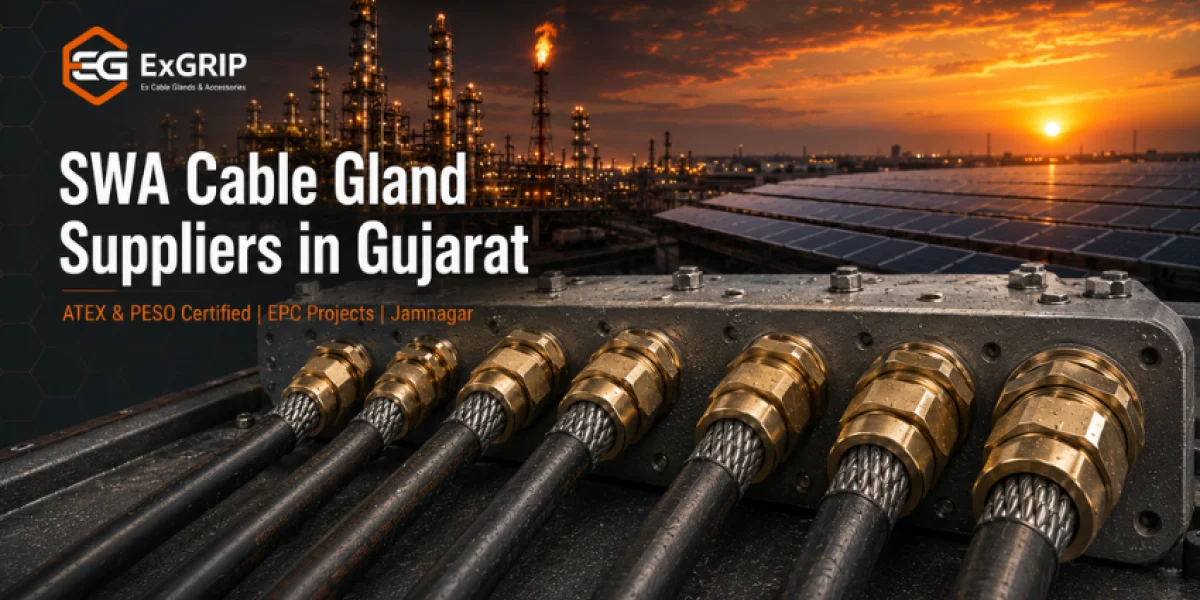
EPC projects in Gujarat refineries in Jamnagar, solar parks across Kutch and Banaskantha, port infrastructure at Mundra and Kandla, chemical plants along the Dahej–Bharuch corridor share a procurement problem that typically surfaces at the commissioning stage rather than the ordering stage: the cable glands specified for SWA armoured cable were the wrong type. The gland may have passed goods inspection. The cable may have been pulled and terminated. But somewhere in the process, a single compression gland was used where a double compression gland was required, or a gland was sized off the conductor cross-section rather than the actual cable outer diameter. In a Zone 1 hazardous area at a Gujarat refinery, that is not an installation defect that gets patched at a snag meeting. It is an ATEX compliance failure that stops commissioning.
This guide covers which cable gland type is correct for SWA armoured cable, how to size glands accurately from the cable datasheet, what certifications are non-negotiable on Gujarat EPC projects, and which suppliers in Gujarat manufacture double compression cable glands that carry both ATEX and PESO approval. Exgrip, based in Udhyognagar, Jamnagar, manufactures the E1FW, DCA, and DCU double compression range supplied to EPC contractors, instrumentation engineers, and panel builders across Gujarat for armoured cable terminations in refineries, solar plants, ports, and chemical facilities.
What SWA Cable Is and Where EPC Projects in Gujarat Use It?
SWA stands for Steel Wire Armoured. The armour layer galvanised steel wires wound helically around the cable cores between the inner bedding and the outer PVC sheath gives SWA cable two properties that make it the standard choice for most Gujarat EPC cable runs: resistance to mechanical damage during and after installation, and a continuous conductive path along the length of the cable that serves as a supplementary earth when correctly terminated at both ends.
That second property is precisely what determines which cable gland type is required. The armour only functions as an earth path if it is clamped and connected at the termination point. A cable gland that seals around the outer sheath but does not clamp the steel wire armour leaves the armour layer floating and electrically disconnected which defeats one of the two reasons SWA cable was specified in the first place.
Across Gujarat’s EPC project landscape, SWA and other armoured cable types appear in the following applications:
- Underground power distribution at solar parks in Kutch, Banaskantha, and Patan direct-buried SWA cable requires IP68-rated glands at both termination ends of every run
- Motor feeder cables at petrochemical plants and refineries in Jamnagar, where 3-phase armoured cable connects switchgear to motors in Zone 1 and Zone 2 classified areas requiring ATEX-certified termination hardware
- MV substation feeder cables and power distribution runs at port infrastructure projects at Mundra and Kandla
- Instrumentation and control cable in chemical plants along the Ankleshwar, Vadodara, and Dahej corridor, where multicore armoured cable provides mechanical protection and screening across long tray runs
- Main distribution board incoming feeder cables in infrastructure EPC projects metro rail, airports, and data centre builds in Ahmedabad and Gandhinagar
Armoured Cable Types Used on Gujarat EPC Projects
SWA is the most common armoured cable type on Gujarat EPC projects, but EPC procurement teams regularly work with several variants. The table below summarises the main types, their construction, and their typical project application in Gujarat.
| Cable Type | Construction | Voltage Rating | Typical Gujarat EPC Application |
|---|---|---|---|
| SWA 2-core single phase | Galvanised steel wire armour | 600/1000V | Lighting circuits, small motor feeders, instrumentation loops |
| SWA 3-phase armoured cable (3 or 4-core) | Galvanised steel wire armour | 600/1000V to 3.3kV | Power distribution, pump and compressor drives at refineries and solar plants |
| SWA Multicore (7 to 37-core) | Galvanised steel wire armour | 300/500V | Control cable and instrumentation runs in chemical plants and process facilities |
| AWA (Aluminium Wire Armoured) | Aluminium wire armour | 600/1000V | Cost-sensitive power distribution; avoided in coastal Gujarat due to galvanic corrosion risk |
| XLPE/SWA | Cross-linked polyethylene insulated, steel wire armoured | 3.3kV, 6.6kV, 11kV | MV substation feeders, large transformer connections at port and refinery projects |
Double compression cable glands are required for every armoured cable type in the table above SWA, AWA, and XLPE/SWA. The armour construction varies between SWA (steel wire) and AWA (aluminium wire), but both require a gland that clamps the armour and seals the outer sheath as two independent mechanical actions.
Why Gland Type Determines Compliance, Not Just Installation Quality?
A cable gland on an armoured cable termination does two distinct mechanical jobs: it maintains the IP ingress protection rating of the cable entry into the enclosure, and it terminates the armour to maintain earth continuity. On SWA cable, both depend entirely on the physical compression of the gland components against the cable construction. Neither is achieved by tightening alone the gland design must be matched to the cable type.
A double compression cable gland achieves both with two separate compression actions. The first compression cone closes down onto the steel wire armour wires, holding them in position and making electrical contact for the earth continuity path. The second sealing ring compresses against the cable outer PVC sheath, maintaining the cable entry IP rating. The body and locknut hold both in place once tightened to the specified torque.
A single compression gland provides the outer sheath seal and nothing else. It has no cone to clamp the armour wires. On an SWA cable installed with a single compression gland, the armour layer is unterminated: no earth continuity, no mechanical retention of the armour at the entry point. In a general industrial installation, this appears as an earth continuity fault at commissioning testing. In a Zone 1 hazardous area at a Jamnagar refinery or Dahej chemical plant, it is a non-conformance under IEC 60079-14 and a failure at any ATEX or PESO third-party audit.
Single Compression vs Double Compression The Specification Difference
| Specification | Single Compression | Double Compression |
|---|---|---|
| Cable type | Unarmoured cable only (PVC or rubber sheath) | SWA, AWA, and XLPE armoured cable |
| Armour termination | No | Yes first cone clamps steel or aluminium wire armour |
| Earth continuity path | Cable earth conductor only | Armour wire braid plus cable earth conductor |
| IP rating achievable | IP66 / IP67 | IP66 / IP67 / IP68 |
| Hazardous area suitability | Not suitable for Zone 1 or Zone 2 | Zone 1 and Zone 2 rated (with ATEX certification) |
| Exgrip models | A2F, SCU, SCA | E1FW, DCA, DCU, DCAB, DCUB |
How to Size Cable Glands for SWA Cable on EPC Projects
Cable gland size is determined by the cable outer diameter the overall OD measured across the outer PVC sheath not by the conductor cross-section. This is the specification error that causes the most rework on Gujarat EPC projects, because procurement engineers are accustomed to specifying cable by its conductor rating and assume the gland size follows from that.
It does not. Two 35mm² 4-core SWA cables from different manufacturers carry the same conductor cross-section and voltage rating, but their overall outer diameters can differ by three or four millimetres depending on the insulation compound, bedding thickness, and armour wire gauge the manufacturer used. A gland sized to the conductor rating rather than the actual cable OD will either fail to compress the armour correctly (gland bore too large) or refuse to fit over the cable during installation (gland bore too small). Both outcomes mean pulling the cable back out and reordering.
The correct cable gland sizing process for an EPC project:
- Obtain the cable outer diameter from the cable manufacturer’s technical datasheet the OD figure, not the conductor size or catalogue number
- Note the armour wire diameter, which determines the depth of the first compression cone required
- Confirm the entry thread type on the equipment enclosure: Metric (M), PG, or NPT these are not interchangeable
- Cross-reference the cable OD against the gland manufacturer’s size compatibility table to confirm the correct gland size and thread
- Verify that the selected gland’s IP rating and certification markings match the area classification and project specification
Exgrip’s cable gland selection chart is indexed by cable outer diameter across the full double compression range, so engineers can confirm gland size directly from the cable datasheet. The cable gland selection tool on the Exgrip website steps through the same parameters and returns the correct model and size without manual cross-referencing.
What EPC Procurement Teams in Gujarat Must Verify Before Raising a Purchase Order?
Most specification errors on Gujarat EPC projects do not come from choosing the wrong gland type. They come from procurement teams ordering from a generic line item “brass double compression cable gland, M25” without confirming that the specific gland they are ordering carries the certifications the project area classification actually requires. By the time the audit flags it, the glands are installed.
Certifications
ATEX: Required for all cable glands installed in Zone 1 and Zone 2 classified hazardous areas. The ATEX marking must specify the protection concept: Ex db (flameproof enclosure), Ex eb (increased safety), or Ex ta (dust ignition protection by enclosure). Exgrip holds ATEX certification across all three categories. Specifying “double compression” is not enough the ATEX certificate must be present and must name the gland model being ordered.
IECEx: The international certification scheme accepted in countries outside the EU where ATEX alone is not sufficient. On projects where the project specification calls for IECEx marking, confirm that the gland supplier holds IECEx certification not just ATEX. Exgrip’s double compression range carries both.
PESO: Petroleum and Explosives Safety Organisation approval is a mandatory Indian regulatory requirement for cable glands installed in petroleum storage facilities, refineries, and petrochemical plants operating under Indian petroleum legislation. This is separate from ATEX and IECEx and cannot be substituted by either. EPC contractors working on projects in the Jamnagar refinery belt including Reliance Industries and HPCL Rajasthan Refinery facilities must confirm PESO approval on every gland certificate before installation and commissioning sign-off.
IP Rating
IP66 is the minimum requirement for most covered indoor industrial enclosures. Direct-buried cable terminations on Gujarat solar projects where the gland is underground, potentially in waterlogged soil require IP68. Glands at port and marine installations on the Saurashtra coast and at Mundra or Kandla may require IP68 plus resistance to salt spray, which influences material choice as much as IP rating. Exgrip’s double compression range is rated to IP66, IP67, and IP68.
Material
Brass is the correct default material for the majority of Gujarat EPC project environments. Jamnagar-manufactured brass glands offer consistent alloy quality from a supply chain that has served industrial export markets for decades a meaningful difference from imported hardware where alloy composition and dimensional tolerances are harder to verify. Nickel-plated brass provides enhanced surface corrosion resistance where the installation environment is mildly aggressive but does not require full stainless steel. Stainless steel is the correct specification for marine environments on the Saurashtra coast, port installations at Mundra and Kandla, and chemical plants handling halogenated or oxidising compounds.
Exgrip ATEX and PESO Certified SWA Cable Gland Manufacturer in Gujarat
Exgrip manufactures its full armoured cable gland range at its facility in Udhyognagar, Jamnagar. The production base draws on Jamnagar’s established brass manufacturing infrastructure skilled machinists, quality alloy supply, and precision engineering capability built over decades of serving export markets. Every gland in the double compression range is manufactured, tested, and certified in Gujarat, which means no import lead times, no third-party certification lag, and direct technical support from the manufacturer for EPC project procurement queries.
The Exgrip double compression range for SWA and AWA armoured cable applications:
| Model | Type | Material | ATEX | IECEx | PESO | Max IP | Hazardous Area |
|---|---|---|---|---|---|---|---|
| E1FW | Double compression | Brass | Yes | Yes | Yes | IP68 | Zone 1, Zone 2 |
| DCA | Double compression | Brass | Yes | Yes | Yes | IP68 | Zone 1, Zone 2 |
| DCU | Double compression | Brass | Yes | Yes | Yes | IP68 | Zone 1, Zone 2 |
| DCAB | Double compression barrier | Brass | Yes | Yes | Yes | IP68 | Zone 1, Zone 2 |
| DCUB | Double compression barrier | Brass | Yes | Yes | Yes | IP68 | Zone 1, Zone 2 |
Thread size options across the range cover Metric (M), PG, and NPT entries. Full product dimensions, cable OD compatibility ranges, and certification documents are on the Exgrip products page. For oil and gas and refinery project requirements including PESO compliance documentation the oil and gas industry page covers gland selection for Jamnagar refinery belt and petrochemical project environments specifically. For port, metro rail, and data centre infrastructure EPC projects, the infrastructure industry page covers the applicable IP and mechanical specification requirements.
Conclusion & Call-to-Action
Getting the SWA cable gland specification right on a Gujarat EPC project is a procurement decision, not an installation afterthought. The hardware cost difference between a single compression and double compression gland is small. The cost of replacing incorrectly installed glands on a partially commissioned refinery installation or failing a PESO audit because armour termination was not completed correctly is not. The gland type, the gland size, the certifications, and the material all need to be confirmed before the purchase order is raised, not after the cable is pulled.
Exgrip’s double compression range covers every armoured cable gland requirement on Gujarat EPC projects, from IP66-rated brass glands for standard industrial cable entries to IP68-rated ATEX Ex db stainless steel glands for marine, chemical, and hazardous area applications. The cable gland selection tool allows procurement engineers to confirm the correct model, size, and thread from the cable specification sheet before the order is placed. For a new project enquiry or a certification query, use the contact details below.
📩 Talk to our technical team today at Exgrip.com
📞 Or call us directly for quick assistance!
Contact Us:
📞 Phone: +91 9537118899
🌐 Website: www.exgrip.com
📩 Request a Quote: Contact Page
FAQs
What type of cable gland is required for SWA armoured cable?
SWA cable requires a double compression cable gland. The double compression design grips the steel wire armour at the first compression cone maintaining the earth continuity path and seals against the cable outer PVC sheath at the second compression point to maintain the IP rating of the cable entry. A single compression gland does not clamp the armour and is not suitable for any armoured cable installation, regardless of the area classification.
Can a single compression cable gland be used on SWA cable?
No. A single compression gland is designed for unarmoured cable. It seals against the outer sheath only, leaving the steel wire armour on an SWA cable unterminated, ungrounded, and providing no earth continuity. In hazardous area installations classified as Zone 1 or Zone 2, this also constitutes a non-conformance under IEC 60079-14. The correct gland for SWA cable is always a double compression type Exgrip’s E1FW, DCA, or DCU for standard armoured cable, or DCAB/DCUB for gas-tight barrier gland applications.
Do cable glands for EPC projects in Gujarat need PESO approval?
Yes, for any installation within a petroleum storage facility, refinery, or petrochemical plant regulated under Indian petroleum legislation. PESO Petroleum and Explosives Safety Organisation approval is a mandatory Indian requirement that is separate from ATEX or IECEx certification and cannot be substituted by either. EPC contractors on Jamnagar refinery belt projects must confirm PESO approval on the gland certificate before installation. Exgrip’s double compression range carries PESO approval across the full product line.
What is the difference between SWA and AWA cable, and does it change which gland is needed?
SWA (Steel Wire Armoured) uses galvanised steel wires for the armour layer. AWA (Aluminium Wire Armoured) uses aluminium wires lighter and lower cost, but more susceptible to galvanic corrosion in coastal environments. AWA is generally avoided on Gujarat port and marine projects for this reason. Both SWA and AWA require the same gland type: double compression. The first compression cone clamps the armour wires regardless of whether they are steel or aluminium.
Are Exgrip cable glands suitable for 3-phase armoured cable installations?
Yes. The E1FW, DCA, and DCU double compression range covers 3-phase armoured cable across the full range of conductor cross-sections and cable outer diameters used on Gujarat EPC projects. Thread size options include Metric (M), PG, and NPT. For large-diameter 3-phase SWA cables used in MV substation feeder applications, confirm the cable OD from the cable datasheet and cross-reference with the Exgrip selection chart or contact Exgrip directly to confirm the correct gland size.
Which gland material should I specify for SWA cable glands in coastal Gujarat?
Stainless steel for direct marine exposure port installations at Mundra, Kandla, and Jamnagar, coastal substations on the Saurashtra coast, and any installation with sustained salt spray exposure. Nickel-plated brass for moderately corrosive inland environments where the project specification does not call for full stainless steel. Brass is the correct default for refinery, solar, chemical, and infrastructure EPC projects across Gujarat where the installation environment does not involve salt spray or aggressive chemical contact.