
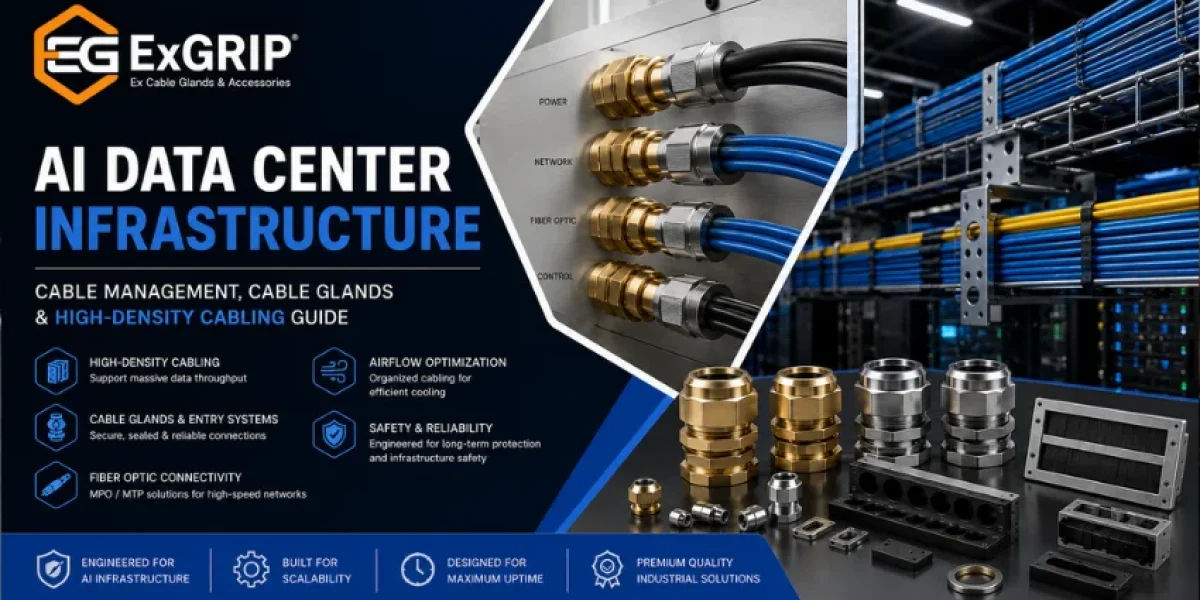
Artificial Intelligence (AI) is transforming the data center industry. Modern AI facilities need more computing power than traditional data centers. They also require stronger networks, more fiber optic cables, and reliable power systems.
As a result, organizations are investing heavily in AI data center infrastructure, high-density cabling systems, and reliable cable management solutions.
Furthermore, a well-designed cabling infrastructure improves safety, maintenance efficiency, airflow management, and long-term operational reliability.
This guide explains the key components of AI data center infrastructure, the role of cable management, the importance of cable glands and cable entry systems, and best practices for deploying high-density cabling networks.
What Is AI Data Center Infrastructure?
AI data center infrastructure includes the systems that support AI workloads. These systems provide computing power, networking, cooling, and cable management for AI applications.
Unlike traditional enterprise data centers, AI facilities must handle:
- High-density GPU clusters
- Massive fiber optic connectivity
- Increased power distribution
- Advanced cooling systems
- High-speed networking
- Large-scale structured cabling
These environments are designed to process enormous volumes of data while maintaining low latency and high computational performance.
Why AI Data Centers Require Advanced Cabling Infrastructure
AI applications create much more network traffic than traditional workloads.
Common AI infrastructure challenges include:
- Higher cable density
- Increased fiber connections
- Complex cable routing
- Greater power requirements
- Faster network speeds
- Limited rack space
Proper data center cable management helps prevent cable congestion, improves maintenance access, and supports future expansion.
Key Components of AI Data Center Infrastructure
GPU clusters perform AI model training and inference operations.
These clusters require:
- High-bandwidth networking
- Dense fiber connections
- Reliable power delivery
- Efficient cable organization
Modern AI facilities commonly deploy:
- 100G Ethernet
- 200G Ethernet
- 400G Ethernet
- 800G Ethernet
These networking systems require advanced structured cabling designs to maintain signal integrity and performance.
Fiber Optic InfrastructureFiber optic cables connect servers, switches, and storage devices. They help AI systems transfer large amounts of data quickly.
Benefits include:
- High bandwidth
- Low latency
- Scalability
- Reduced interference
Common fiber types include:
- Single-mode fiber
- Multi-mode fiber
- MPO cabling
- MTP cabling
AI servers consume substantially more power than traditional servers.
Power infrastructure typically includes:
- Busway systems
- Power distribution units (PDUs)
- High-capacity power cables
- Cable protection accessories
Understanding High-Density Cabling
High-density cabling refers to environments where a large number of network, fiber, and power cables are installed within limited physical space.
Characteristics of High-Density Cabling- Thousands of cable connections
- Dense rack configurations
- Multiple cable pathways
- High-speed data transmission
- Continuous scalability requirements
- Cable congestion
- Airflow restrictions
- Troubleshooting complexity
- Expansion limitations
- Physical cable damage
Proper cable management becomes critical in these environments.
Importance of Cable Management in AI Data Centers
Effective cable management directly impacts system reliability and operational efficiency.
Benefits of Proper Cable Management- Improved airflow
- Easier maintenance
- Faster troubleshooting
- Enhanced safety
- Better scalability
- Reduced downtime
- Cable trays
- Ladder racks
- Fiber raceways
- Cable organizers
- Cable ties and straps
- Cable entry systems
Role of Cable Glands in AI Data Center Infrastructure
Although networking receives significant attention, cable protection is equally important.
Cable glands provide secure cable entry, environmental sealing, strain relief, and mechanical protection.
Functions of Cable Glands- Secure cable termination
- Dust protection
- Moisture protection
- Vibration resistance
- Cable retention
- Equipment protection
- Outdoor equipment enclosures
- Power distribution units
- Generator systems
- UPS systems
- Electrical panels
- Cooling equipment
Types of Cable Glands Used in Data Centers
EMC Cable Glands
Designed to provide electromagnetic compatibility protection.
Best for:
- Sensitive electronic equipment
- Network cabinets
- Communication systems
Brass Cable Glands
Widely used due to durability and corrosion resistance.
Advantages:
- Long service life
- Mechanical strength
- Reliable sealing
Stainless Steel Cable Glands
Ideal for demanding environments.
Applications include:
- Outdoor installations
- Corrosive environments
- High-humidity facilities
Double Compression Cable Glands
Provide enhanced cable retention and sealing.
Used for:
- Armoured cables
- Heavy-duty installations
- Industrial power systems
Cable Entry Systems for Modern Data Centers
Cable entry systems allow multiple cables to enter enclosures while maintaining protection and organization.
Benefits include:
- Faster installation
- Improved cable routing
- Reduced enclosure modifications
- Better sealing performance
Typical installations include:
- Control panels
- Network cabinets
- Power distribution systems
- Equipment enclosures
Fiber Optic Cabling in AI Facilities
AI workloads require extensive fiber connectivity.
| Technology | Typical Application |
|---|---|
| Single-Mode Fiber | Long-distance communication |
| Multi-Mode Fiber | Short-range connectivity |
| MPO Cabling | High-density environments |
| MTP Systems | AI cluster networking |
- High bandwidth
- Low latency
- Future scalability
- Reduced signal loss
High-Density Cabling Best Practices
Always design infrastructure with expansion capacity.
Separate Power and Data CablesHelps reduce interference and simplifies maintenance.
Use Structured Cable PathwaysImplement:
- Cable trays
- Ladder racks
- Fiber raceways
Install suitable cable glands and cable entry systems.
Label EverythingProper identification reduces troubleshooting time.
Maintain Bend RadiusCritical for fiber optic performance.
AI Data Center Infrastructure Comparison
| Feature | Traditional Data Center | AI Data Center |
|---|---|---|
| Server Density | Moderate | Very High |
| Fiber Requirements | Medium | Extremely High |
| Network Speed | 10G–100G | 100G–800G+ |
| Power Consumption | Moderate | High |
| Cooling Demand | Standard | Advanced |
| Cable Density | Medium | Very High |
| Scalability Needs | Moderate | Significant |
Related Components and cable gland Accessories
A complete AI infrastructure solution often includes:
- Cable glands
- Cable cleats
- Locknuts
- Earth tags
- Reducers
- Adaptors
- Breather drains
- Cable entry frames
- Fiber management accessories
These components improve system reliability and installation quality.
Downloadable Resources for Engineers
Conclusion & Call-to-Action
As facilities adopt GPU clusters, high-speed networking, and advanced cooling systems, the importance of robust AI data center infrastructure continues to grow.
Effective cable management, reliable high-density cabling, proper fiber optic routing, and secure cable gland solutions play a crucial role in maintaining performance, safety, and scalability.
📩 Talk to our technical team today at Exgrip.com
📞 Or call us directly for quick assistance!
Contact Us:
📞 Phone: +91 9537118899
🌐 Website: www.exgrip.com
📩 Request a Quote: Contact Page
FAQs
Why are cable glands important in AI data center infrastructure?
Cable glands provide secure cable entry, strain relief, and environmental protection, helping maintain reliable power and network connections in AI data centers.
Which type of cable gland is best for AI data centers?
The choice depends on the application. Brass cable glands, EMC cable glands, and stainless steel cable glands are commonly used for power distribution systems, network cabinets, and equipment enclosures.
Can brass cable glands be used in data center applications?
Yes, brass cable glands are widely used in data centers due to their durability, corrosion resistance, and reliable cable sealing performance.
What are EMC cable glands used for in AI facilities?
EMC cable glands help reduce electromagnetic interference and are commonly installed in sensitive networking, communication, and control systems.
When should double compression cable glands be used in data centers?
Double compression cable glands are recommended for armoured cables and heavy-duty power applications that require enhanced sealing and cable retention.
How do cable glands improve cable management in AI data centers?
Properly selected cable glands organize cable entry points, protect cables from damage, and contribute to safer and more efficient cable management systems.
What is the difference between EMC cable glands and standard cable glands?
EMC cable glands provide electromagnetic shielding, while standard cable glands mainly offer cable sealing, strain relief, and mechanical protection.