
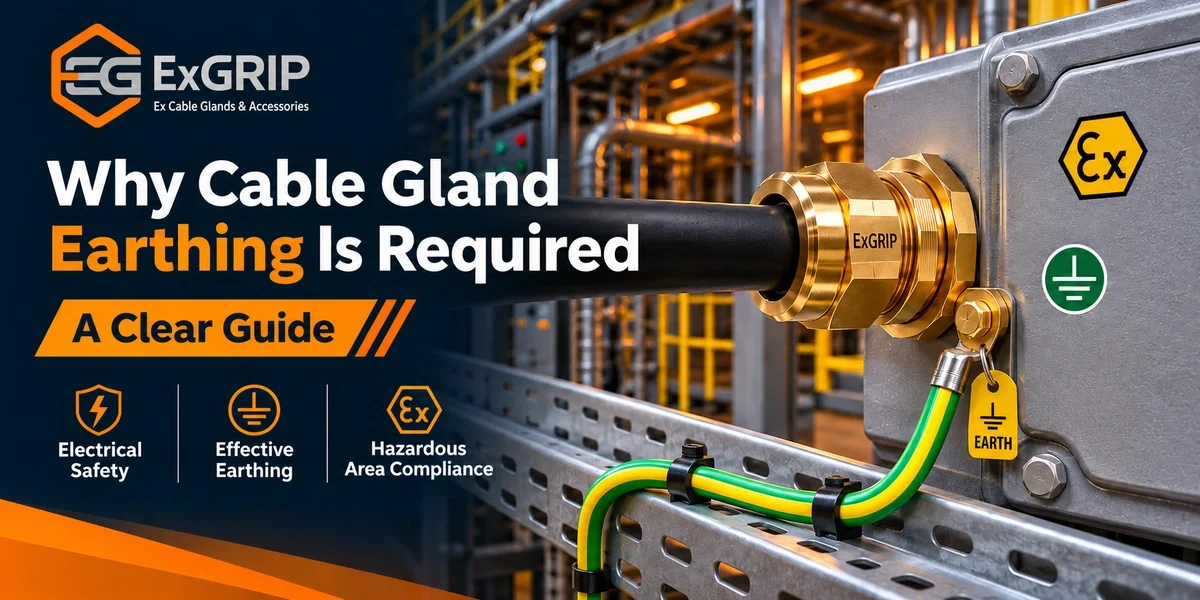
Why is cable gland earthing required? Because an armoured cable can become live if its insulation fails. The gland is the part that gives that fault current a safe way to earth.
This guide explains what earthing does, which glands need it, how to fit it and what to check in hazardous areas. To pick the right gland size first, use our cable gland selection chart.
What cable gland earthing means
Many power cables have a metal armour layer, such as steel wire or braid. The armour protects the cable from damage. It can also carry fault current.
Earthing a cable gland means joining the cable armour, the gland and the equipment enclosure into one low resistance path to earth. This path is often called earth continuity.
Why cable gland earthing is required
There are four main reasons. Each one applies to a different kind of site.
It gives fault current a safe path
If the insulation fails, the live conductor can touch the armour. If the connection between armour and earth is good, the fault current has a good path to earth. The protective device then trips quickly. If the connection is poor, the armour and the enclosure can stay live.
It protects people from shock
A live enclosure is a shock risk for anyone who touches it. A solid earth path keeps the enclosure at earth potential and lets the breaker or fuse clear the fault.
It reduces the risk of heat, sparks and fire
A loose or corroded joint has high resistance. Fault current then heats the joint and can cause sparks. A tight armour clamp and a proper earth connection keep the path low in resistance.
It supports hazardous area safety
In a classified area, a spark can ignite gas or dust. The gland, the armour and the enclosure must be bonded so that no part floats at a different voltage. Read more in our guide to ATEX and IECEx certified cable glands.
Which cable glands need earthing
It depends on the cable, the gland and the enclosure. Use this table as a starting point, and follow your project specification.
| Case | Earthing needed? | How it is usually done |
|---|---|---|
| Armoured cable, metal gland, metal enclosure | Yes | Armour clamp in the gland, locknut tight on the enclosure, earth tag where the design needs it |
| Armoured cable, metal gland, plastic enclosure | Yes | Earth tag between gland and enclosure, joined to the earth bar with a copper conductor |
| Unarmoured cable, metal gland, metal enclosure | Bonding of the gland to the enclosure | Locknut and serrated washer on a metal enclosure |
| Plastic (nylon) gland | No earth path through the gland | Earth the cable armour a different way if it has armour |
| Braid armour or screen | Yes, with limits | Check the fault current rating of the braid and the gland |
A plastic gland is not conductive, so it cannot earth the armour. For armoured cable on a plastic enclosure, use a metal armoured gland with an earth tag.
How to earth a cable gland
There are three common methods. Pick the one that matches the enclosure.
Metal enclosure with a locknut
A metal gland screwed into a metal enclosure can use the locknut to make the bond. A serrated washer helps the nut bite through paint and keeps the joint tight.
Earth tag between the gland and the enclosure
An earth tag, also called a banjo, sits between the gland and the enclosure wall. It has a second hole for a copper earth conductor, which goes to the earth bar. Use it with plastic enclosures, and with metal enclosures when the design needs it.
Earthing locknut or earth stud
Some designs use an earthing locknut or a gland with a built in earth stud. These save space and give a visible earth point. Check the fault current rating before you use them.
Whichever method you use, follow this order.
- Strip the cable to the sizes in the gland instructions
- Clamp the armour fully, without cutting or twisting the wires
- Fit the earth tag or earthing locknut and tighten the gland
- Join the earth conductor to the earth bar with a lug and a bolt
- Test continuity from the armour to the earth point
Earthing in hazardous areas
In Zone 1 and Zone 2 areas, the rules are stricter. The gland must carry an Ex certificate for the zone and the protection type, such as Ex d or Ex e. Installation follows IEC 60079-14, and equipment rules follow IEC 60079-0.
Three points matter most.
- The gland and the enclosure must be certified together, so use the thread and sealing washer in the certificate.
- The armour clamp must hold the armour firmly, so it keeps the earth path under vibration.
- The enclosure needs its own external earth connection, as the equipment standard requires.
For the full set of rules, see the IECEx system and your project specification. If your site is in the Gulf, our guides for the UAE and Saudi Arabia show which documents to ask for.
Common earthing mistakes
- Using a plastic gland on armoured cable and leaving the armour unearthed
- Clamping only part of the armour wires
- Leaving paint or powder coat under the earth tag or locknut
- Using an earth conductor that is too thin for the fault current
- Skipping the earth tag on a plastic enclosure
- Forgetting to retest after a gland is opened and closed again
Earthing checklist before commissioning
- Gland size matches the cable, checked against the cable gland size chart
- Armour is clamped on its full circle
- Earth tag or earthing locknut is fitted and tight
- Earth conductor size and lug suit the project specification
- Continuity test is done and written down
- Ex certificate and marking match the zone
Cable glands from ExGrip
ExGrip makes cable glands in Jamnagar, India, and ships to all GCC countries. The range covers armoured and unarmoured cable, single and double compression, and barrier types, with ATEX and IECEx certification. Read about cable gland types to see which one fits your cable.
GET THE RIGHT CABLE GLAND
Send your cable details to ExGrip
Tell us your cable type, size, enclosure material and zone, and we will reply with the matching gland and the earthing parts that suit it.
For a manufacturer based in India, see our page on cable gland manufacturers and suppliers in India.
Frequently asked questions
Short answers to common questions about earthing cable glands.
Why is a cable gland earthed?
The gland clamps the armour of the cable and joins it to the enclosure and to earth. This gives fault current a safe path and protects people and equipment.
Does every cable gland need an earth tag?
No. A metal enclosure may already give a good earth path through the locknut. A plastic enclosure needs an earth tag. Follow your project specification.
Do plastic cable glands need earthing?
A plastic gland is not conductive, so it does not carry an earth path. If the cable is armoured, earth the armour a different way or use a metal gland.
What is the earth tag on a cable gland?
It is a flat metal washer with an extra hole. It fits between the gland and the enclosure. A copper conductor joins it to the earth bar.
Is earthing the same as bonding?
They are close. Earthing joins metal parts to the earth. Bonding joins metal parts to each other so that they stay at the same voltage. A gland often does both.
How do I test cable gland earth continuity?
Use a low resistance tester between the armour and the earth bar. Compare the reading with your project limit and record it.
Is earthing different for Ex cable glands?
The principle is the same, but the gland and enclosure must be certified together and installed to IEC 60079-14. Always check the certificate for the thread, washer and earth tag it allows.
with your cable size, enclosure material and zone, and we will reply with the matching gland.
Request a quote