
Monsoon conditions can turn a routine outdoor EV charging installation into a demanding cable-entry application. Heavy rain, wind-driven water, standing water, humidity and repeated wet-dry cycles can expose charger enclosures and their cable entry points to moisture. For EV charging stations in India, especially outdoor installations, protection therefore depends on more than the enclosure itself.
The cable gland is one of the points where the protected enclosure meets the external cable. If the gland is incorrectly sized, poorly installed, incompatible with the cable or unsuitable for the required ingress protection, water can find a path into the enclosure. This is why selecting an appropriate IP67 cable gland can be an important part of an outdoor EV charging station design. The correct choice should still be based on the actual installation environment, cable construction, entry arrangement and required IP protection rather than assuming that every EV charger needs the same gland.
Why Monsoon Rain Creates a Cable Entry Problem?
Rain, Splash, Pooling Water and Humidity Are Different Exposures
Monsoon exposure is not simply a question of whether rain reaches the charger. An EV charging station may experience direct rainfall, wind-driven spray, water splashing from vehicles, drainage problems, temporary pooling around the base and high ambient humidity.
These conditions place different demands on the electrical enclosure and cable entry system. A charger installed beneath a properly designed canopy may experience mainly airborne rain and splash, while a low-mounted outdoor enclosure may face much greater exposure to water accumulating around the installation. An underground or below-grade cable entry can introduce another level of concern where the surrounding installation is designed for temporary or continuous immersion conditions.
Therefore, the phrase waterproof cable gland should not replace an actual engineering assessment. The required IP rating needs to match the intended environmental exposure and the tested performance of the complete cable-entry arrangement.
Why the Cable Entry Can Become the Weak Point?
An enclosure can have a high IP rating while the overall installation is still vulnerable at a cable entry. The opening created for a cable must be sealed around the cable and properly interfaced with the enclosure. The gland also needs to provide suitable cable retention and sealing for the actual cable diameter.
Common causes of water ingress include selecting the wrong gland size, using a gland outside its specified cable diameter range, damaging the sealing element during installation, leaving unused entries inadequately sealed, or failing to establish a proper interface between the gland and enclosure.
For an outdoor EV charging station, the gland should therefore be treated as part of the enclosure protection system rather than as a simple cable-routing accessory.
What IP66, IP67 and IP68 Actually Mean for EV Chargers?
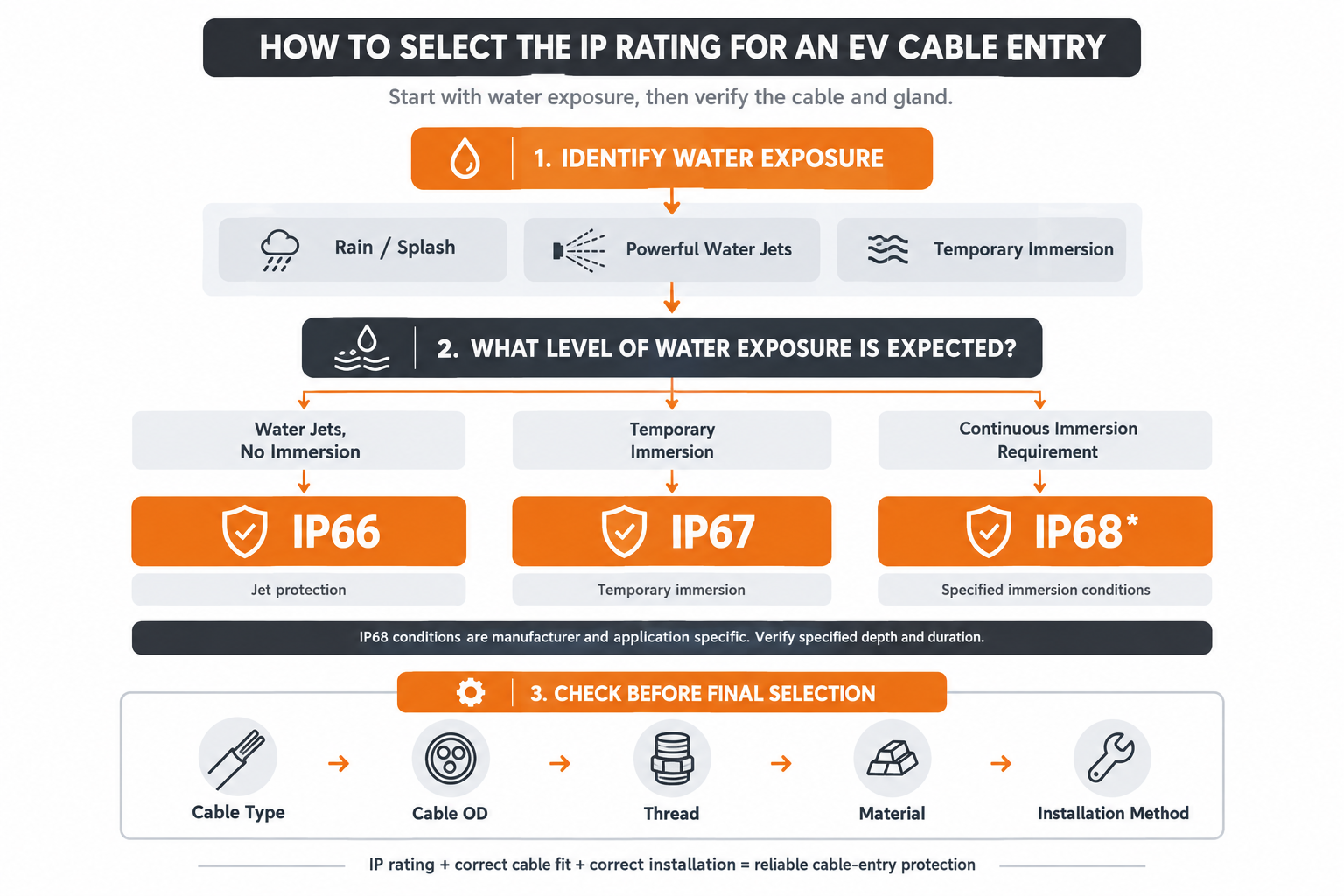
IP ratings are defined under IEC 60529, which classifies degrees of protection provided by enclosures against ingress. The first digit relates to protection against solid objects and dust, while the second digit describes protection against water under specified test conditions.
IP66 for Outdoor Charger Enclosures
IP66 indicates a high level of protection against dust ingress and protection against powerful water jets. This can be relevant where an outdoor EV charging enclosure needs protection from heavy rain and water jets but is not intended to withstand immersion.
IP66 should not, however, be interpreted as an immersion rating. If an installation can experience temporary immersion, the project specification should consider an appropriate immersion-rated solution.
IP67 for Temporary Water Exposure
IP67 adds protection against the effects of temporary immersion under the standardized conditions defined by the applicable IP test. This makes IP67 cable glands relevant for installations where the cable entry may experience significantly higher water exposure than ordinary rain or splashing.
For monsoon-prone installations, IP67 can therefore provide an additional level of protection where the cable entry design and environmental assessment call for temporary immersion protection. It does not mean that every outdoor EV charger automatically requires IP67.
IP68 When the Installation Requires Specified Immersion Protection
IP68 relates to protection against continuous immersion under conditions agreed between the manufacturer and user that are more severe than the conditions for IP67. The exact depth, duration and test conditions therefore need to be checked in the product documentation rather than assuming that every IP68 product has the same immersion capability.
IP68 can become relevant for cable entries exposed to particularly demanding installation conditions, but it should be selected according to the actual project requirement rather than simply because a higher number appears more protective.
| IP Rating | Water Protection | Typical EV Application Consideration | Key Limitation |
|---|---|---|---|
| IP66 | Protection against powerful water jets | Outdoor exposure where immersion is not expected | Not an immersion rating |
| IP67 | Protection against temporary immersion under specified test conditions | Higher water-exposure locations where temporary immersion protection is required | Does not automatically define continuous immersion performance |
| IP68 | Protection against continuous immersion under specified conditions | Installations requiring a manufacturer-defined immersion level beyond IP67 | Exact depth and duration must be verified |
IP Rating for EV Charger: Why the Gland Matters as Much as the Enclosure?
The enclosure and cable gland work together to maintain environmental protection. A charger enclosure may be designed and tested to a particular IP level, but the cable-entry arrangement must also be suitable for the intended protection level.
Consider a charger cabinet with several incoming power and communication cables. Each cable creates an entry point. The installation therefore depends on correct gland dimensions, compatible threads, appropriate sealing elements and correct installation torque or assembly procedure according to the manufacturer’s instructions.
This is particularly important when selecting an EV charging station cable gland. The gland must match the cable’s actual outer diameter and construction. If the sealing range is unsuitable, tightening the gland does not necessarily create a reliable seal.
| Potential Weak Point | What to Check | Possible Consequence |
|---|---|---|
| Gland size | Cable outer diameter and manufacturer’s sealing range | Incomplete cable sealing |
| Thread interface | Metric, NPT, BSP or specified enclosure thread | Improper enclosure connection |
| Unused entries | Correct stopping plug or sealing arrangement | Open path for dust or moisture |
| Cable construction | Armoured or unarmoured design | Incorrect gland construction |
| Installation | Manufacturer’s assembly instructions | Reduced sealing or cable retention |
This is why IP protection should be considered as a complete cable-entry system rather than a label attached to the charger enclosure alone.
Choosing the Right Cable Gland for Outdoor EV Charging Stations
Start With Cable Type and Outer Diameter
The first selection step is to identify the cable construction and measure its actual outer diameter. Cable gland sizing should not be based only on nominal cable cross-sectional area. The gland must be compatible with the physical cable diameter and construction.
Exgrip’s existing EV charging station cable gland selection guide also emphasizes matching cable construction, cable diameter and gland type during selection.
Armoured vs Unarmoured EV Charging Cables
Unarmoured cables generally require a gland designed for unarmoured cable construction. Armoured cables require a gland that can properly accommodate and retain the armour while maintaining the required environmental seal.
For high-power or industrial EV charging infrastructure using armoured power cables, a double compression or other appropriate armoured-cable gland may be considered when the cable construction and project specification call for it. A double compression gland should not, however, be treated as automatically necessary for every EV charger.
AC Chargers vs DC Fast Charging Cabinets
AC and DC charging systems can have substantially different cable arrangements, enclosure designs and installation requirements. A DC fast charging cabinet may use larger power cables and may be installed in commercial, highway or industrial environments with significant weather exposure.
Instead of selecting a gland simply because a charger is labelled AC or DC, evaluate the complete installation: cable type, cable diameter, enclosure entry, environmental exposure, mechanical loading and required IP level.
| Installation Condition | Primary Selection Check | Gland Considerations |
|---|---|---|
| Indoor AC charging | Cable construction and enclosure interface | Correct size, thread and sealing |
| Outdoor AC charging | Rain, splash and humidity exposure | Appropriate IP-rated gland and material |
| Outdoor DC fast charging | Large cable size and environmental exposure | Cable OD, mechanical retention and required IP protection |
| Armoured power cable | Armour construction and cable dimensions | Appropriate armoured cable gland design |
| High water-exposure location | Temporary or continuous immersion requirement | Verify applicable IP rating and product test conditions |
7 Cable Gland Mistakes That Can Cause EV Charger Water Ingress
- Choosing the gland from cable size alone: Always verify the actual cable outer diameter and the gland’s specified sealing range.
- Assuming every outdoor charger needs IP67: IP selection should follow the actual water exposure and project requirement.
- Ignoring the enclosure thread: A correctly sized cable gland still needs a compatible enclosure interface.
- Using an armoured gland on the wrong cable: Gland construction must match the actual cable design.
- Ignoring unused cable entries: Open or poorly sealed entries can create an easy path for water and dust.
- Overlooking installation instructions: Incorrect assembly can compromise sealing even when the gland itself has been tested.
- Confusing corrosion resistance with IP protection: Stainless steel may address a corrosion concern, but it does not replace the need for the correct ingress protection.
Pre-Monsoon EV Charging Station Cable Entry Checklist
- Confirm the required IP rating from the project specification and actual installation exposure.
- Inspect every cable gland for visible damage, cracking, deformation or seal deterioration.
- Verify that the gland matches the cable’s actual outer diameter.
- Check that gland threads match the charger enclosure entries.
- Inspect unused entries and confirm that suitable sealing components are installed.
- Check cable routing for low points where water can collect around cable entries.
- Confirm that cables are adequately supported and are not placing excessive mechanical load on the gland.
- Inspect exposed metal components for corrosion, especially in coastal or high-humidity locations.
- Verify installation and tightening according to the gland manufacturer’s instructions.
- Where IP performance is critical, confirm the product documentation and applicable test information before installation.
Why Exgrip Cable Glands for IP66, IP67 and IP68 EV Applications?
Exgrip manufactures industrial cable glands for applications where secure cable entry, environmental protection and mechanical cable retention are important. Its product range includes glands for armoured and unarmoured cables and products with IP66, IP67 and IP68 ratings.
For EV charging applications, the selection should begin with the cable and installation requirements rather than a product name alone. Exgrip’s EV charging selection resources provide guidance on cable construction, gland selection and installation considerations.
For demanding environments, Exgrip also offers cable gland materials including brass, nickel-plated brass and stainless steel on applicable product ranges. Material should be selected according to the environment, while the required IP protection should be verified separately.
Where an EV charging installation is located in a classified hazardous area, the applicable hazardous-area certification must be considered separately from the IP rating. ATEX, IECEx or PESO requirements should only be applied where the installation specification and hazardous-area classification require them.
Conclusion & Call-to-Action
Monsoon protection for EV charging stations is not achieved by choosing the highest IP number available. The better approach is to evaluate the actual installation environment, water exposure, cable construction, cable diameter and enclosure interface before selecting the gland.
For outdoor EV charging stations, an IP67 cable gland can be relevant where temporary immersion protection is required, while IP66 or IP68 may be appropriate for different exposure conditions. The correct choice depends on the tested product performance and project requirements.
Before installation, check these five points: cable outer diameter, cable construction, enclosure thread, environmental exposure and required IP protection. When these factors are evaluated together, the cable entry becomes an engineered part of the EV charging station rather than an overlooked accessory.
📩 Talk to our technical team today at Exgrip.com
📞 Or call us directly for quick assistance!
Contact Us:
📞 Phone: +91 9537118899
🌐 Website: www.exgrip.com
📩 Request a Quote: Contact Page
FAQs
What IP rating should an outdoor EV charger have during monsoon?
The required IP rating depends on the charger’s installation environment and expected water exposure. IP66 protects against powerful water jets, IP67 addresses temporary immersion under specified test conditions, and IP68 covers continuous immersion under manufacturer-defined conditions.
Is IP67 required for every EV charging station cable gland?
No. An outdoor location does not automatically mean that IP67 is required. The appropriate rating should be selected based on exposure, installation position, project specification and the tested performance of the complete cable-entry arrangement.
What is the difference between IP66 and IP67 for EV chargers?
IP66 provides protection against powerful water jets, while IP67 provides protection against temporary immersion under specified test conditions. Therefore, IP67 addresses a different water-exposure condition rather than simply being a stronger version of IP66 for every application.
When should an EV charging installation use IP68?
IP68 should be considered when the installation requires continuous immersion protection under specified conditions. The exact immersion depth and duration should be confirmed from the manufacturer’s product documentation because IP68 conditions are not universally identical.
Can a cable gland cause water ingress even when the charger enclosure is IP67?
Yes. Incorrect gland sizing, incompatible threads, damaged seals, poor installation or inadequately sealed unused entries can compromise the cable-entry arrangement. The enclosure rating should therefore be considered together with the cable gland and installation method.
What cable gland should be used for a DC fast charger?
There is no single gland type that applies to every DC fast charger. Selection should consider the cable construction, outer diameter, armour, enclosure interface, environmental exposure and required IP protection. For armoured cables, an appropriate armoured cable gland should be selected according to the cable construction.