
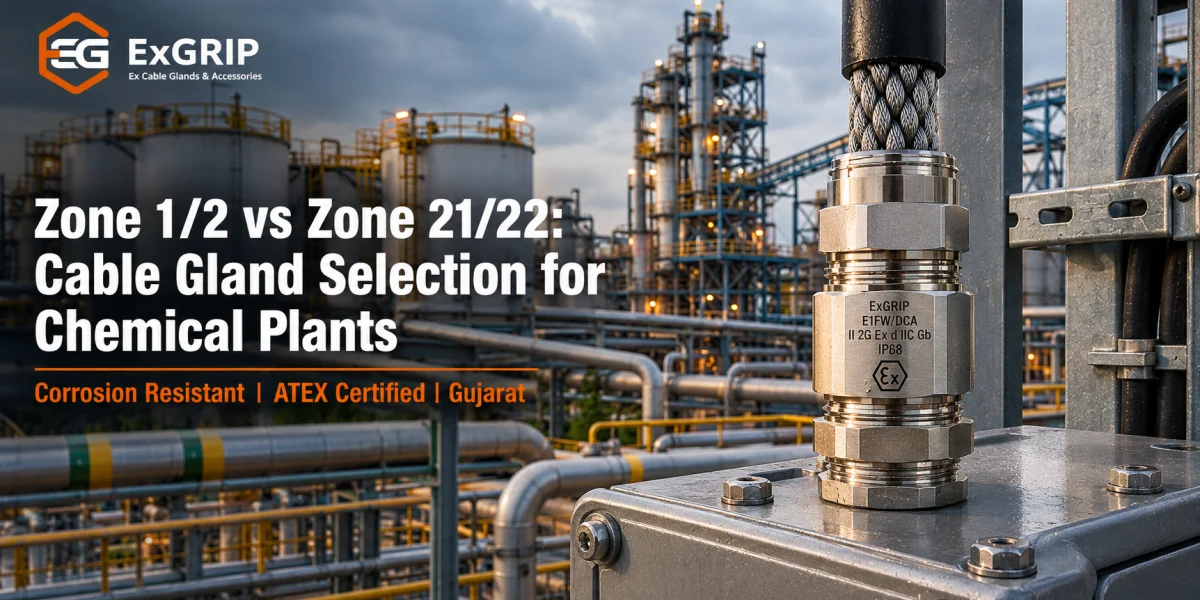
A chemical plant’s solvent transfer area gets its cable glands specified correctly for Zone 1 gas hazards, ATEX certificate on file, PESO approval confirmed. Fifty metres away, the powder-milling and bagging line generating combustible dust during every batch runs under the same blanket “hazardous area” line item because nobody separated it out as Zone 21, and a gas-rated Ex d gland doesn’t automatically carry the Ex ta dust protection concept that zone actually requires.
Chemical and pharmaceutical plants are one of the few industries where gas and dust hazards genuinely coexist on the same site, sometimes in adjoining process bays. This guide breaks down what Zone 1/2 and Zone 21/22 actually classify, where each shows up on a typical chemical plant, the certification differences between gas and dust protection concepts, and which Exgrip range DCAB or A2F fits each zone type.
Zone 1/2 vs Zone 21/22: What These Classifications Actually Mean?
Hazardous area classification groups a location by how likely it is that a dangerous atmosphere is present, and by what kind of atmosphere it is flammable gas or vapour, or combustible dust. Gas zones and dust zones are numbered separately and rated against different test methods, which is exactly why a single “hazardous area” line on a spec sheet isn’t precise enough once a plant has both.
Zone 1 and Zone 2 Gas and Vapour Hazards
Zone 1 covers locations where an explosive gas or vapour atmosphere is likely to occur during normal operation a solvent charging point, a reactor vent, a tank farm loading arm. Zone 2 covers locations where that atmosphere is only likely under abnormal conditions, and then only briefly areas adjacent to Zone 1 process equipment, or spaces where a containment failure would need to occur first.
Zone 21 and Zone 22 Combustible Dust Hazards
Zone 21 covers locations where a combustible dust cloud is likely to occur during normal operation powder milling, sieving, pneumatic conveying lines, and the space immediately around a dryer’s discharge point. Zone 22 covers locations where a dust cloud is only likely briefly and under abnormal conditions, such as areas near a bagging line where dust would only become airborne if a seal failed or a bag burst.
| Zone | Hazard Type | Probability of Hazardous Atmosphere | Typical Chemical Plant Location |
|---|---|---|---|
| Zone 0 | Gas / vapour | Present continuously or for long periods | Inside a solvent storage tank |
| Zone 1 | Gas / vapour | Likely during normal operation | Solvent charging points, reactor vents, tank farm loading arms |
| Zone 2 | Gas / vapour | Unlikely, brief duration if it occurs | Areas adjacent to Zone 1 equipment |
| Zone 20 | Combustible dust | Present continuously or for long periods | Inside a powder storage silo or hopper |
| Zone 21 | Combustible dust | Likely during normal operation | Powder milling, sieving, pneumatic conveying, dryer discharge |
| Zone 22 | Combustible dust | Unlikely, brief duration if it occurs | Areas near bagging or drum-filling lines |
Zone 0 and Zone 20 are rare outside sealed vessels and are noted here for completeness the day-to-day specification decision on a chemical plant almost always sits between Zone 1/2 and Zone 21/22. Gas rating and dust rating are separate certifications, tested against separate standards, and a gland doesn’t carry one just because it carries the other.
Why Chemical Plants Face Both Classifications on the Same Site?
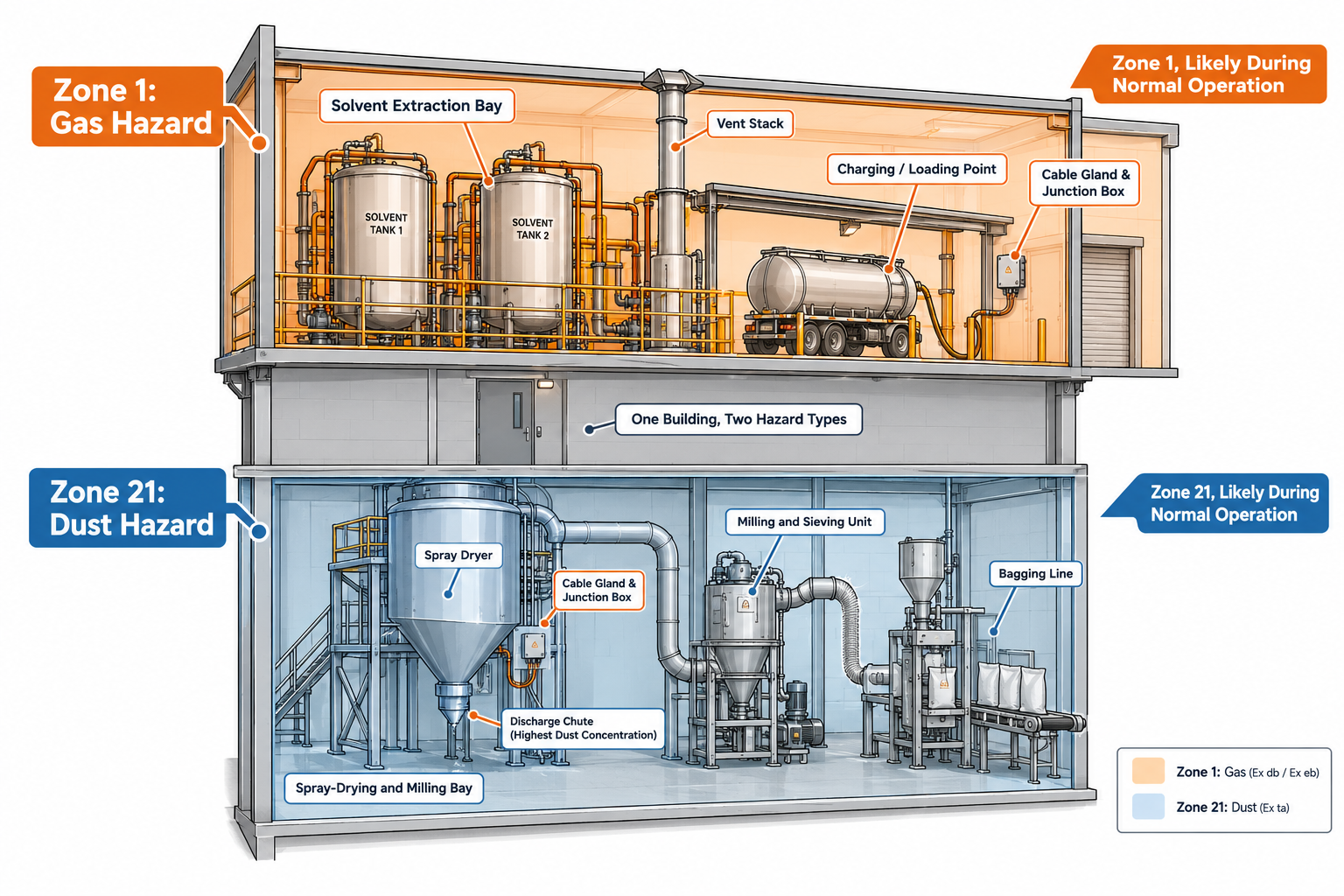
Chemical and pharmaceutical facilities routinely run a solvent-based or liquid process next to a dry powder process, sometimes in the same building. A few conditions specific to this industry are what make Zone 1/2 and Zone 21/22 a live specification issue on one site rather than a theoretical distinction:
- Solvent-based reaction, extraction, or storage areas generating flammable vapour under normal operation Zone 1 territory
- Powder milling, sieving, and pneumatic conveying lines generating a combustible dust cloud during every charging or discharge cycle Zone 21 territory
- Bag-filling and drum-filling stations where settled dust layers can become airborne if disturbed, typically classified Zone 22
- Multi-product plants where one building houses both a wet process and a dry process on adjoining lines, sharing electrical infrastructure and cable routing
A Blended-Hazard Site in Practice
A pharmaceutical intermediate plant runs solvent extraction in one process bay, classified Zone 1, and spray-drying of the extracted powder in the adjoining bay, classified Zone 21. If the cable gland specification was written once for the building based on the solvent process, the spray-dryer’s junction boxes may end up fitted with glands carrying a valid Ex d gas certificate but no Ex ta dust rating a certificate that’s real, current, and doesn’t cover the hazard actually present at that location. The fix isn’t a stricter single specification; it’s mapping gas zones and dust zones separately across the site, the same way washdown exposure gets mapped zone by zone on a marine installation.
Where This Shows Up in Process Expansion Projects?
The gap surfaces most often when a plant adds a new process line to an existing building rather than at initial construction, when the full hazardous area study is usually done properly. A facility originally built for liquid-phase chemical production, classified Zone 1/2 throughout, later adds a drying or granulation step to produce a powder intermediate on-site. The building’s electrical infrastructure including its cable glands was specified against the original gas-only hazard study. Unless the hazardous area classification is formally re-assessed for the new process, the new dust-generating equipment goes in without anyone confirming its glands carry Ex ta certification, because the paperwork trail still shows the building as “classified” without distinguishing which classification actually applies to the new equipment.
DCAB vs A2F: Matching Exgrip's Product Ranges to Zone Type
Zone type and gland range are a separate decision from certification Exgrip’s DCAB and A2F ranges both carry the certifications above, but differ in armour handling and compression type, which is what determines fit against a given cable construction and installation location.
DCAB Armoured, Double Compression
DCAB is Exgrip’s armoured double compression range, built for steel wire armoured (SWA) cable where the armour itself needs to be clamped and earthed at the gland, common on both gas-zone process cabling and dust-zone conveyor and dryer motor feeds. Available in IP66, IP67, and IP68 variants.
A2F Unarmoured, Single Compression
A2F is Exgrip’s unarmoured single compression range, suited to unarmoured or braided cable where only the outer sheath needs sealing rather than a separate armour clamp typically instrumentation and control cabling in both gas and dust classified areas. Available in IP66 and IP68 variants.
| Range | Armour | Compression Type | IP Rating Range | Typical Zone Fit |
|---|---|---|---|---|
| DCAB | Armoured (SWA) | Double compression | IP66 / IP67 / IP68 | Process power and motor feeds, Zone 1/2 and Zone 21/22 |
| A2F | Unarmoured | Single compression | IP66 / IP68 | Instrumentation and control cabling, Zone 1/2 and Zone 21/22 |
Material and Ingress Rating for Chemical Plant Conditions
Certification and zone type answer whether a gland is rated for the hazard; material and ingress rating answer whether it survives the chemical environment around that hazard. The two decisions are independent a gland can carry any combination of gas or dust certification alongside any of Exgrip’s three material options, so the material choice comes down to what the site’s process chemistry actually does to metal over years of service, not the zone classification itself.
| Material | Typical Chemical Plant Use | Key Property |
|---|---|---|
| Brass (standard) | General process areas with low to moderate chemical exposure | Cost-effective, reliable in non-aggressive environments |
| Nickel-plated brass | Areas with moderate solvent or vapour exposure, or general humidity | Enhanced corrosion resistance over standard brass |
| 316 stainless steel | Aggressive chemical exposure, coastal chemical sites, sour service | Chromium-nickel-molybdenum resistance to chloride and chemical attack |
A few points that matter specifically for chemical plant conditions beyond the material choice itself:
- IP66 or IP68 ingress protection is typically sufficient for enclosed process areas washdown-grade IP69K, covered in Exgrip’s offshore platform guide, is rarely a chemical plant requirement unless the site runs scheduled high-pressure cleandown
- Coastal or high-humidity chemical sites add the same chloride-resistance considerations covered in Exgrip’s marine and offshore material guide
- Dust-classified areas add an abrasion consideration alongside corrosion repeated exposure to fine powder during conveying and discharge can wear a seal interface over time independent of any chemical attack, which is a reason to confirm seal material and maintenance interval alongside the Ex ta certification itself, not instead of it
Certification: Ex db/Ex eb for Gas vs Ex ta for Dust
Gas and dust hazards are certified under different protection concepts even within the same framework. Ex db and Ex eb (flameproof enclosure and increased safety) are the concepts that apply to Zone 1/2 gas atmospheres. Ex ta is the equivalent concept for Zone 20/21/22 dust atmospheres a separate test regime confirming the enclosure prevents dust ingress to a level that stops an internal ignition source reaching a combustible dust cloud outside it. A gland certified Ex db for gas doesn’t automatically carry Ex ta for dust; the two need to be confirmed separately against the zone the equipment is actually going into.
ATEX
ATEX certification, issued by an EU Notified Body such as SIRA, TÜV Rheinland, Intertek, or Bureau Veritas, applies to international EPC projects with European-origin FEED specifications. ATEX marking distinguishes gas and dust equipment explicitly a typical gas marking reads II 2G Ex db IIB T6 Gb, while the dust-equivalent marking follows the same structure with a D for dust group and the Ex ta concept, such as II 2D Ex ta IIIC T135°C Db. The letter after the group number (G or D) is what tells a reviewer which hazard the certificate actually covers.
IECEx
IECEx is the international mutual-recognition scheme, accepted across more than 50 countries without re-testing per jurisdiction relevant on multi-country chemical plant projects sourcing equipment once for installations in different regions. IECEx certificates follow the same gas/dust concept split as ATEX, issued in the format IECEx XXX YY.NNNN.
PESO
PESO approval, issued by India’s Petroleum and Explosives Safety Organisation, is statutory for petroleum-classified facilities in India and commonly required across the broader chemical and process sector as well, covering both gas and dust classified areas depending on the installation.
IS 2148
IS 2148 is the Bureau of Indian Standards flameproof enclosure specification, aligned with IEC 60079-1, and is the qualification Indian PSU and large chemical-sector buyers typically require from vendors alongside or instead of an imported ATEX certificate verify project-by-project whether an ATEX mark satisfies the applicable BIS notification, since equivalence isn’t automatic.
| Certification | Issuing Body | Required For | Applicable Standard |
|---|---|---|---|
| ATEX | EU Notified Body (SIRA, TÜV Rheinland, Intertek, Bureau Veritas) | International EPC projects with EU-origin FEED | IEC 60079-1, ATEX Directive 2014/34/EU |
| IECEx | IECEx-accredited body | Multi-country chemical plant and process projects | IEC 60079 series |
| PESO | PESO India | Petroleum-classified and broader process facilities in India | Petroleum Act 1934, Petroleum Rules 2002 |
| IS 2148 | BIS / recognised test house | Indian PSU and large chemical-sector vendor qualification | IS 2148, aligned with IEC 60079-1 |
Why Exgrip for Chemical Plant Installations?
Exgrip manufactures its DCAB and A2F ranges from the Jamnagar facility in brass, nickel-plated brass, and 316 stainless steel, with ATEX, IECEx, PESO, and IS 2148 certification covering both gas and dust protection concepts on the same product lines. A chemical plant project specifying across a solvent-handling Zone 1 bay and a powder-handling Zone 21 bay can source both zone types’ requirements from one certified manufacturer rather than reconciling separate vendors’ documentation for gas and dust equipment.
For the full certified range built for chemical and pharmaceutical conditions, see Exgrip’s Chemical Plants Industry page, which covers material selection and certification detail across solvent handling, powder processing, and general process areas.
Conclusion & Call-to-Action
Zone 1/2 and Zone 21/22 answer two different questions about the same site, and a chemical plant specification that only asks the gas question is leaving the dust side of the building unaddressed. The fix isn’t a single blanket hazardous-area line item it’s mapping gas zones and dust zones separately, then confirming each gland carries the protection concept that actually matches its zone, not just a hazardous-area certificate in general.
Exgrip’s technical team can help project engineers work through this zone-by-zone mapping as part of standard chemical plant project support, covering both Ex db/Ex eb gas certification and Ex ta dust certification on the same product ranges.
📩 Talk to our technical team today at Exgrip.com
📞 Or call us directly for quick assistance!
Contact Us:
📞 Phone: +91 9537118899
🌐 Website: www.exgrip.com
📩 Request a Quote: Contact Page
FAQs
What's the difference between Zone 1/2 and Zone 21/22?
Zone 1 and Zone 2 classify flammable gas or vapour hazards. Zone 21 and Zone 22 classify combustible dust hazards. They’re numbered on separate scales and certified against separate test standards, so a gland rated for one doesn’t automatically cover the other.
Can one chemical plant have both gas and dust classified areas?
Yes, and it’s common. Solvent handling, extraction, and storage areas are typically gas-classified (Zone 1/2), while powder milling, drying, and bagging areas are typically dust-classified (Zone 21/22), sometimes in adjoining process bays on the same site.
What does Ex ta certification mean?
Ex ta is the protection concept for Zone 20/21/22 dust hazardous areas, confirming an enclosure prevents dust ingress to a level that stops an internal ignition source reaching combustible dust outside it. It’s separate from Ex db and Ex eb, which apply to gas hazards.
Does a gas-certified cable gland also cover dust hazards?
Not automatically. Ex db or Ex eb gas certification and Ex ta dust certification are tested and marked separately. A gland installed in a Zone 21 or Zone 22 area needs Ex ta certification confirmed specifically, not assumed from its gas rating.
Is IS 2148 required in addition to ATEX for Indian chemical plant projects?
Often, yes. Indian PSU and large chemical-sector buyers frequently require IS 2148 alongside or instead of an imported ATEX certificate. Whether an ATEX mark satisfies the applicable BIS notification depends on the specific project this should be verified case by case rather than assumed.
Do chemical plants need IP69K-rated cable glands like offshore platforms do?
Rarely. IP69K addresses high-pressure washdown cleaning, which is standard on offshore platforms but uncommon in enclosed chemical process areas. IP66 or IP68 is typically sufficient unless the specific site runs scheduled high-pressure cleandown cycles.