
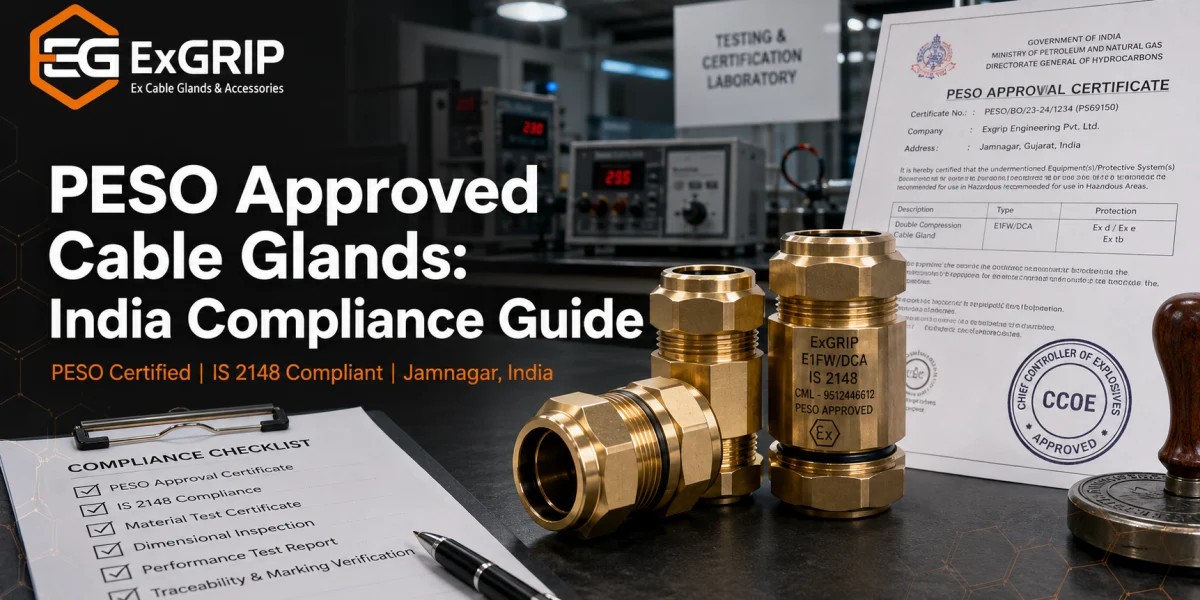
A cable gland arriving at an Indian petroleum refinery, LPG terminal, or gas distribution station with ATEX certification and nothing else does not clear goods receipt. PESO approval is a separate, mandatory requirement under Indian law, and a component without it cannot be installed in a PESO-regulated facility regardless of what international certification it carries. Procurement engineers who assume ATEX covers India find this out at the worst possible point in a project during pre-commissioning inspection, when the gap shows up as a rejected shipment and a schedule delay.
This guide explains what PESO is, the difference between PESO approval, PESO licenses, and PESO certificates, how the approval process works for electrical equipment like cable glands, which facilities are legally required to use PESO approved components, and how PESO relates to ATEX, IECEx, and IS 2148.
What Is PESO? Full Form, Meaning, and Regulatory Authority
PESO stands for the Petroleum and Explosives Safety Organisation. It operates under India’s Ministry of Commerce and Industry and is the statutory body responsible for regulating the manufacture, storage, transport, and use of explosives and petroleum products in India, including the electrical equipment installed in facilities that handle them. PESO was formerly known as CCOE the Chief Controller of Explosives and the two names are still used interchangeably in older documentation, vendor lists, and industry conversation. If a specification or a colleague refers to “CCOE approval,” they mean the same body and the same regulatory function as PESO.
PESO’s authority for electrical equipment derives from the Petroleum Act 1934 and the Petroleum Rules 2002. Any electrical apparatus installed in a location classified as hazardous under petroleum regulation pump seal housings, storage tank vicinity, LPG bottling areas, gas compression stations falls within PESO’s regulatory scope. This is distinct from the international Ex protection framework (ATEX, IECEx) covered under IEC 60079. India requires both layers of compliance simultaneously for equipment in petroleum-classified areas.
PESO Approval vs PESO License vs PESO Certificate: What's the Difference
These three terms are often used loosely but refer to distinct regulatory instruments, and procurement engineers frequently confuse them when reading vendor documentation.
| Term | What It Actually Means | Who Holds It |
|---|---|---|
| PESO Approval | Confirmation that a specific product design (e.g. a cable gland model) has passed PESO-recognised testing and is approved for use in petroleum-classified areas | Manufacturer, per product design/model |
| PESO License | Statutory authorisation to store, handle, or deal in petroleum products at a specific site or facility | Facility operator (refinery, depot, terminal) |
| PESO Certificate | The physical or digital document issued confirming either an approval or a license, carrying a reference number and validity period | Manufacturer (product approval) or facility operator (site license) |
For a cable gland buyer, the relevant document is the manufacturer’s PESO approval certificate for the specific gland model being purchased not a general company registration and not a facility license, which belongs to the site operator, not the equipment supplier.
The PESO Approval Process for Electrical Equipment
Getting a cable gland PESO approved is not a self-declaration. The manufacturer submits the product design to a PESO-recognised test house for evaluation against the applicable Indian standard IS 2148 for flameproof enclosures, or the relevant IS standard for the specific protection concept. The test house evaluates flame path dimensions, ingress protection, mechanical strength, and material compliance. Once testing is complete and the design passes, PESO issues an approval certificate referencing the specific product model, the standard it complies with, and a validity period, typically five years before renewal is required.
This differs from ATEX certification in one practical respect that matters to buyers: a PESO approval certificate is tied to a specific product design and manufacturing location. If a manufacturer changes the gland’s construction, material, or manufacturing site, the existing PESO certificate does not automatically extend to the modified product a fresh approval or an amendment is required. This is why procurement teams should always request the PESO certificate for the exact model and size being ordered, not a generic company-level compliance statement.
Which Facilities Require PESO Approved Cable Glands?
The Petroleum Rules 2002 define PESO-regulated facilities broadly, and the list is longer than most procurement teams initially assume.
- Oil refineries: Every process unit handling crude oil, intermediate products, or finished petroleum products, including Jamnagar, Vadodara, Panipat, and Mathura refinery complexes
- LPG bottling and storage plants: Filling stations, storage bullets, and distribution depots LPG facilities are among the most tightly regulated PESO categories because of the pressurised, highly flammable nature of the product
- Petroleum storage depots: Terminal facilities storing diesel, petrol, and other refined products before onward distribution
- City gas distribution (CGD) infrastructure: Pressure reduction stations and CNG compression facilities operating under PESO’s petroleum gas regulations
- Petroleum pipeline pumping stations: Intermediate pumping installations along cross-country pipeline routes
A facility does not need to be an oil refinery to fall under PESO’s scope. A city gas distribution pressure reduction station in a residential area of a Tier 2 Indian city is just as much a PESO-regulated facility as a Jamnagar refinery process unit the regulation applies to the hazard classification of the equipment’s location, not the scale of the site.
PESO vs ATEX vs IECEx vs IS 2148: Which Certifications Do You Actually Need
This is the question that causes the most procurement confusion, and the answer depends on where the equipment is installed, not on which certification “sounds more international.”
| Certification | Governing Framework | Mandatory in India? | Issued By |
|---|---|---|---|
| ATEX | EU Directive 2014/34/EU | Not mandatory alone voluntary/supplementary | EU Notified Body (SIRA, TÜV, Intertek) |
| IECEx | IEC 60079 mutual recognition scheme | Not mandatory alone voluntary/supplementary | IECEx-accredited certification body |
| PESO Approval | Petroleum Act 1934, Petroleum Rules 2002 | Yes statutory requirement | PESO / CCOE, India |
| IS 2148 | Bureau of Indian Standards | Referenced by PESO approval and PSU vendor specs | BIS-recognised test house |
Is ATEX certification enough for installation in India? No. ATEX confirms a product meets EU requirements for hazardous area equipment; it says nothing about compliance with Indian petroleum law. A gland can be ATEX certified and still be legally barred from a PESO-regulated Indian facility until it separately obtains PESO approval. The two certifications answer different regulatory questions and neither substitutes for the other. Exgrip’s guide to flameproof cable glands for hazardous areas in India covers the ATEX and IECEx side of this in more depth this guide focuses specifically on the PESO layer that sits on top of it for Indian installations.
PESO approval and IS 2148 are closely linked rather than competing: IS 2148 is the technical standard a flameproof cable gland is tested against, and PESO approval is the regulatory confirmation that the testing was completed and passed by a recognised body. A gland can reference IS 2148 compliance in its documentation without yet holding a current PESO approval certificate buyers should ask for the PESO certificate specifically, not just an IS 2148 test report.
Cable Gland Types and Sizing for PESO Approved Installations
PESO approval applies to a specific gland design, and the design category matters for what’s permitted in a given installation. Double compression cable glands provide independent sealing of the cable outer sheath and independent clamping of the armour wire this is the design mandated for SWA armoured cable terminations in Zone 1 areas. Single compression glands, which apply one combined action to both, are not accepted for PESO approved Zone 1 installations on armoured cable.
| Gland Type | Cable Compatibility | PESO Approved Zone 1 Use |
|---|---|---|
| Double Compression | SWA / AWA armoured cable | Yes, when individually PESO approved |
| Single Compression | Unarmoured cable | Not applicable for armoured Zone 1 entries |
Gland size selection follows the same principle covered in Exgrip’s flameproof cable gland guide: size is determined by the cable’s actual outer diameter, not the conductor cross-section, and should always be cross-checked against the manufacturer’s cable gland size chart. A PESO approved gland ordered in the wrong size does not become non-compliant on paper, but it will fail to seal correctly on site, which defeats the purpose of specifying an approved product in the first place. For a full size chart across M16 through M75 with armour grip ranges, use Exgrip’s cable gland selection tool, which is available as a downloadable PDF reference as well as an interactive lookup.
How to Verify a Cable Gland's PESO Approval Before You Order
PESO approval documentation should be requested and reviewed before a purchase order is raised, not after the shipment arrives. Four checks catch the majority of documentation problems procurement teams encounter.
Check the certificate references the exact model and size ordered. A PESO certificate for one gland model does not cover a different model from the same manufacturer, even within the same product family. Confirm the model number on the certificate matches the model number on the purchase order line by line.
Confirm the certificate is within its validity period. PESO approvals typically run for five years before renewal. A certificate issued in 2019 without evidence of renewal is not current, and installing equipment against an expired approval creates the same compliance gap as having no approval at all.
Verify the CCOE or PESO reference number independently. A legitimate certificate carries a specific reference number issued by PESO. If a supplier cannot provide this number or the documentation looks like a generic template rather than an issued certificate, treat it as a red flag rather than proceeding on trust.
Request the manufacturing location stated on the certificate. PESO approval is tied to where the product is manufactured. If a supplier has moved production between facilities, the original approval may not extend to output from the new site without an amendment.
Conclusion & Call-to-Action
India’s petroleum and gas infrastructure is expanding faster than its regulatory oversight is loosening. City gas distribution networks are extending into new districts, LPG bottling capacity is growing, and PSU-led refinery expansions continue across Gujarat and the eastern pipeline corridor. Every one of those projects adds new PESO-regulated installation points, and PESO documentation scrutiny at commissioning stage has, if anything, tightened over the past several years as more EPC contractors have been caught out by incomplete certification packs.
Exgrip manufactures double compression cable glands in Jamnagar, Gujarat, with current PESO approval and IS 2148 compliance documentation supplied as standard with every order not as a follow-up request after dispatch. The range is also ATEX certified for projects that require both layers of compliance simultaneously, which is the reality for most Indian EPC and PSU-tendered work today.
📩 Talk to our technical team today at Exgrip.com
📞 Or call us directly for quick assistance!
Contact Us:
📞 Phone: +91 9537118899
🌐 Website: www.exgrip.com
📩 Request a Quote: Contact Page
FAQs
What is the full form of PESO?
PESO stands for Petroleum and Explosives Safety Organisation. It operates under India’s Ministry of Commerce and Industry and regulates electrical equipment used in petroleum and explosives-classified hazardous areas across the country.
Is PESO the same as CCOE?
Yes, in practice. CCOE (Chief Controller of Explosives) was the organisation’s former name. PESO is the current name for the same regulatory body, and both terms appear interchangeably in older vendor documentation and industry conversation.
Is ATEX certification sufficient for cable gland installation in Indian refineries?
No. ATEX confirms compliance with EU hazardous area requirements but has no statutory standing under Indian petroleum law. Equipment installed in PESO-regulated Indian facilities requires separate, current PESO approval regardless of any ATEX or IECEx certification the product also holds.
How long does a PESO approval certificate remain valid?
PESO approvals are typically valid for five years from the date of issue, after which the manufacturer must apply for renewal. Always check the issue and expiry dates on the certificate rather than assuming approval status based on the product’s ATEX or IECEx certification dates, which run on separate cycles.
Does PESO approval cover all sizes and variants of a cable gland range?
Not automatically. PESO approval is generally tied to specific product models and constructions tested by the recognised test house. Request the certificate for the exact model and size being ordered rather than assuming a company-wide approval covers every variant in the catalogue.
What facilities in India legally require PESO approved cable glands?
Oil refineries, LPG bottling and storage plants, petroleum storage depots, city gas distribution pressure reduction stations, CNG compression facilities, and pipeline pumping stations are all classified as PESO-regulated under the Petroleum Rules 2002, and electrical equipment installed in their hazardous areas requires PESO approval.
Does Exgrip supply PESO approved cable glands with full documentation?
Yes. Exgrip’s double compression cable gland range, manufactured in Jamnagar, carries current PESO approval, IS 2148 compliance, and ATEX certification, with documentation supplied at the time of order rather than requiring a follow-up request.