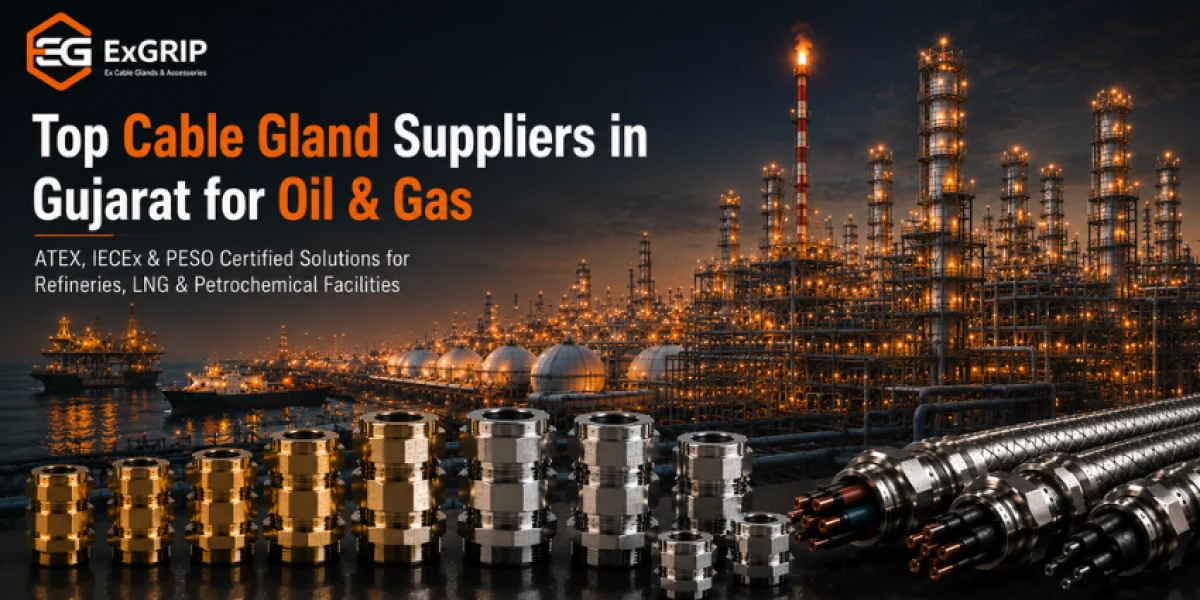
Gujarat India is home to one of the world’s most concentrated oil and gas processing corridors stretching from the Jamnagar refinery belt in the west to the petrochemical hubs of Dahej, Hazira, Bharuch, and Vadodara in the east. For EPC contractors, procurement engineers, and project managers working on oil and gas projects across this corridor, selecting the right cable gland supplier in Gujarat is a critical decision that directly impacts both installation safety and regulatory compliance. A cable gland is far more than a mechanical fitting in a hazardous refinery environment, it is a certified safety component that prevents the propagation of flame, gas, and explosive atmosphere into electrical enclosures.
Exgrip, headquartered in Udhyognagar, Jamnagar, Gujarat, is one of India’s leading manufacturers of ATEX certified, IECEx certified, and PESO approved explosion proof cable glands for oil and gas applications. With a complete product range covering double compression cable glands, single compression cable glands, and barrier glands available in brass, nickel-plated brass, and stainless steel Exgrip serves refineries, petrochemical plants, LNG terminals, and upstream oil and gas projects across Gujarat India and internationally. This guide covers everything procurement and engineering teams need to know when evaluating cable gland suppliers in Gujarat for oil and gas projects.
Why Gujarat is a Strategic Hub for Oil & Gas Cable Gland Supply?
Gujarat’s industrial geography makes it uniquely positioned as both a major consumer and manufacturer of cable glands for the oil and gas sector. The state hosts some of India’s largest and most complex energy infrastructure, creating consistent, large-volume demand for certified cable glands across project and maintenance phases.
Gujarat's Oil & Gas Industrial Corridor
Gujarat’s position as the largest refining state in India means that cable gland suppliers based in Gujarat particularly those located in Jamnagar, the brass manufacturing capital of India have a natural supply chain, logistics, and cost advantage for serving these industries.
The key refinery and petrochemical zones where cable gland demand is highest include:- Jamnagar: Home to the world’s largest single-location oil refining complex. Both public sector and private sector refineries in Jamnagar require ATEX and IECEx certified cable glands for Zone 1 and Zone 2 hazardous area installations throughout the refinery, terminal, and utility areas.
- Dahej: A major LNG import terminal and SEZ housing numerous petrochemical and specialty chemical projects. Dahej installations require cable glands rated for both gas hazardous areas and aggressive chemical environments.
- Hazira (Surat): A large integrated petrochemical complex with LNG, fertiliser, and chemical manufacturing plants all requiring extensive explosion proof cable gland installations.
- Bharuch and Ankleshwar: India’s largest GIDC chemical zone with hundreds of chemical and pharmaceutical manufacturing units requiring certified cable glands for hazardous process areas.
- Vadodara: Home to major petrochemical and polymer plants including GAIL and IPCL facilities requiring ATEX and IECEx certified cable glands for ongoing projects and maintenance.
Hazardous Area Requirements for Oil & Gas Cable Glands
Oil and gas facilities are classified as hazardous areas where flammable gases, vapours, or dusts may be present. Electrical equipment including cable glands installed in these areas must be rated and certified for the relevant zone classification. Using an uncertified or incorrectly rated cable gland in a hazardous area is not only a compliance failure; it is a serious safety risk that can result in equipment shutdown, legal liability, and in the worst case, ignition of an explosive atmosphere.
Hazardous Area Zone Classifications
| Zone | Atmosphere | Definition | Recommended Exgrip Model | Protection Type |
|---|---|---|---|---|
| Zone 1 | Gas / Vapour | Explosive atmosphere likely to occur in normal operation | E1FW (Double Compression) | Ex db IIC |
| Zone 2 | Gas / Vapour | Explosive atmosphere not likely in normal operation but may occur rarely | A2F (Single Compression) | Ex eb IIC |
| Zone 21 | Dust | Explosive dust atmosphere likely in normal operation | E1FW (Double Compression) | Ex tb IIIC |
| Zone 22 | Dust | Explosive dust atmosphere not likely in normal operation | A2F (Single Compression) | Ex tb IIIC |
Required Certifications for Oil & Gas Cable Glands in India
For cable glands used on oil and gas projects in India and Gujarat specifically, the following certifications are typically required or specified by project standards:
- ATEX Certification: Mandatory for projects with European-based clients or standards. Covers Ex db (flameproof), Ex eb (increased safety), and Ex ta (dust protection) protection modes.
- IECEx Certification: The international equivalent of ATEX, accepted in over 50 countries. Widely specified on international EPC projects in Indian refineries and petrochemical plants.
- PESO Approval: Required by the Petroleum and Explosives Safety Organisation (PESO) for electrical equipment installed in petroleum handling and storage facilities in India. PESO approval is mandatory for onshore oil and gas facilities governed by Indian petroleum regulations.
- IP66 / IP67 / IP68 Ratings: Dust-tight and water-resistant ratings required for outdoor refinery environments, cable trenches, and underground duct entries.
All Exgrip cable glands carry ATEX, IECEx, and PESO certifications and are rated IP66, IP67, and IP68 meeting the full certification requirements of Indian and international oil and gas project specifications. Visit the Technical page for full certification documentation and Ex marking details.
Cable Gland Types for Oil & Gas Applications
The selection of cable gland type for an oil and gas application depends on the cable construction (armoured or unarmoured), the hazardous area zone, and the environmental conditions at the installation point. Below is an overview of the main cable gland types used in Gujarat’s oil and gas industry.
Double Compression Cable Glands (Armoured Cables)
The double compression cable gland is the most commonly specified cable gland type for oil and gas projects. It is designed for use with steel wire armoured (SWA) and aluminium wire armoured (AWA) cables the standard cable constructions used for power distribution, instrumentation, and control wiring in refineries and petrochemical plants.
A double compression cable gland provides two independent mechanical seals: an inner compression that grips and bonds the cable armour layer, and an outer compression that seals the cable outer sheath. This dual-seal construction delivers the high IP rating and robust mechanical retention required for safety-critical oil and gas installations. Exgrip’s double compression range includes the E1FW, DCA, DCAB, DCU, and DCUB models, all rated Ex db for Zone 1 and Zone 2 hazardous area use.
Single Compression Cable Glands (Unarmoured Cables)
Single compression cable glands are used for unarmoured cables in oil and gas facilities typically for flexible instrument cables, control cables entering local control panels, and intrinsically safe field instrument wiring. Exgrip’s A2F, SCU, SCA, and SCUB models cover the full range of single compression applications, rated Ex eb for Zone 2 and selected Zone 1 installations.
Barrier Cable Glands
Barrier cable glands are used where cables pass through the wall of a flameproof (Ex d) enclosure. They prevent internal enclosure explosions from propagating back along the cable route. Exgrip’s DCAB, DCUB, and SCAB models are the barrier variants in the range and are essential for flameproof enclosure terminations in Zone 1 refinery installations.
Cable Gland Size Chart for Oil & Gas Applications
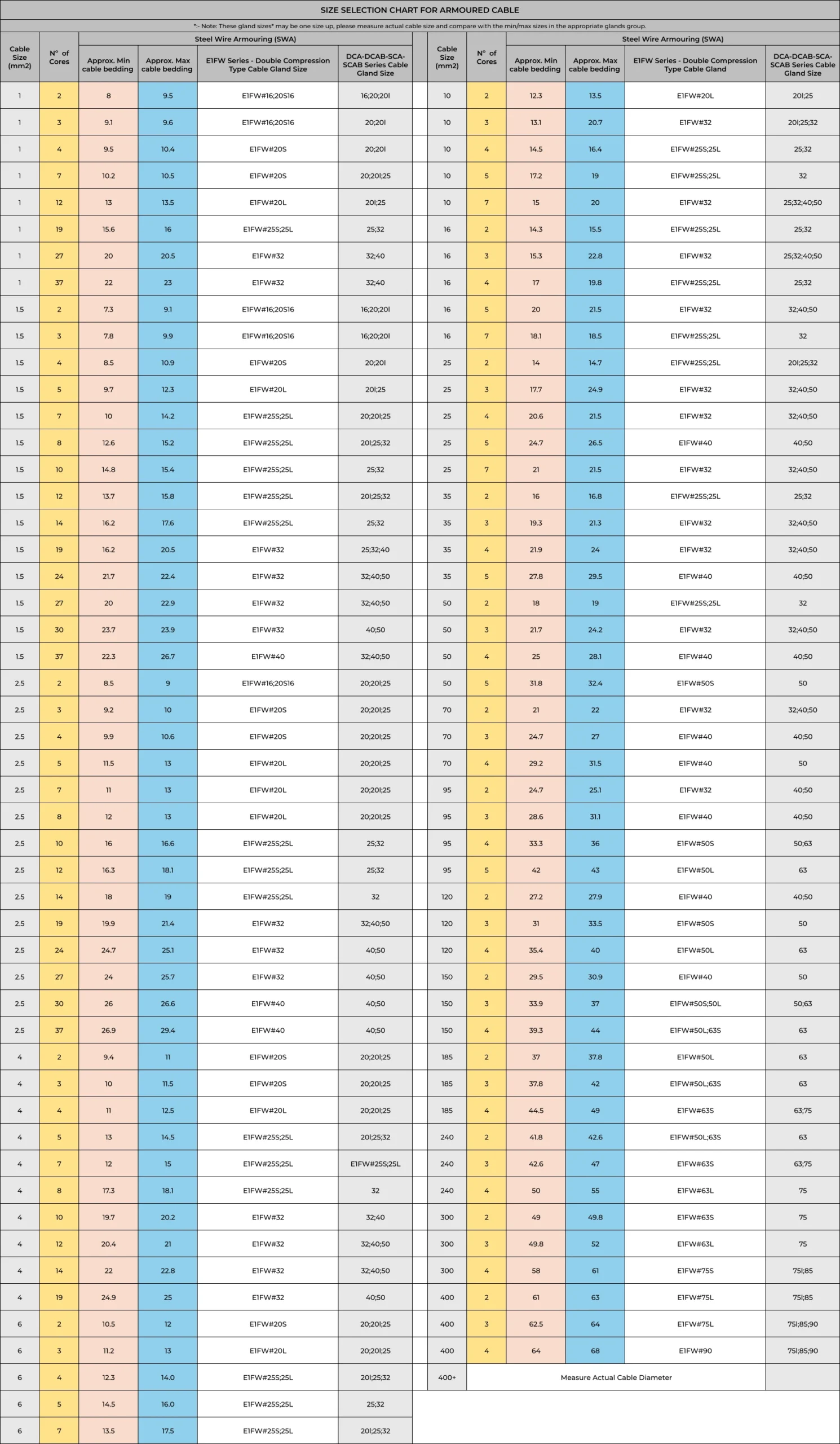
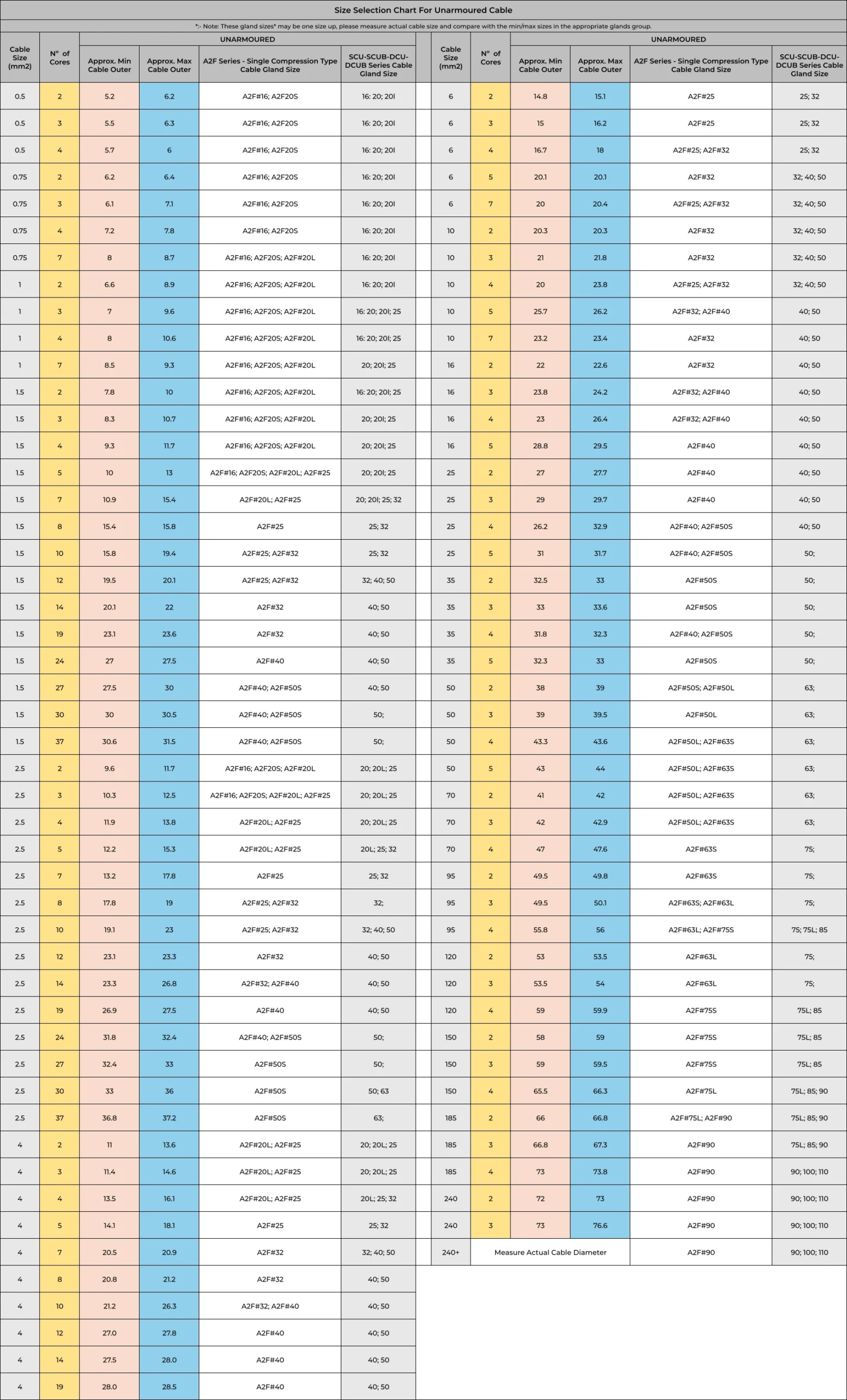
Selecting the right gland is just as important as choosing the right cable. That’s where the cable gland size chart and cable gland selection chart come in. These charts act as quick references to match the outer diameter of a cable with the correct gland size.
Cable Gland Size Chart for Armoured Cable :
Cable Gland Size Chart for Unarmoured Cable :
Material Selection: Brass vs Stainless Steel for Oil & Gas
Cable gland material selection for oil and gas projects in Gujarat depends on the specific installation environment within the facility. Three primary materials are used in refinery and petrochemical applications:
| Material | Best For | Advantages | Limitations |
|---|---|---|---|
| Brass | General refinery installations, process areas, MCC rooms, substations | Cost-effective, excellent machinability, good corrosion resistance, widely available from Jamnagar | Not suitable for highly acidic or chloride-rich environments |
| Nickel-Plated Brass | Outdoor installations, coastal and offshore-adjacent facilities, corrosive process areas | Enhanced corrosion resistance over standard brass, same mechanical properties | Higher cost than standard brass |
| Stainless Steel (SS316) | Highly corrosive environments, offshore platforms, LNG terminals, acid handling areas | Superior corrosion resistance, high mechanical strength, suitable for extreme chemical environments | Higher cost, heavier than brass |
For most onshore refinery and petrochemical installations in Gujarat’s industrial zones, brass cable glands are the standard specification. Nickel-plated brass is preferred for coastal and outdoor installations near the Jamnagar and Hazira coastlines. Stainless steel is typically reserved for LNG cold box areas, offshore-standard projects, and areas with aggressive chemical exposure.
Supplier Evaluation Checklist for EPC Contractors and Procurement Teams
When evaluating cable gland suppliers for an oil and gas project in Gujarat, procurement engineers and EPC contractors should use a structured assessment framework. The following checklist covers the critical criteria:
Certification and Compliance
- Does the supplier hold current ATEX certification (not expired)?
- Does the supplier hold current IECEx certification for the relevant product range?
- Does the supplier hold PESO approval for Indian petroleum installations?
- Are IP test reports (IP66 / IP67 / IP68) available for the specific models specified?
- Can the supplier provide full traceability documentation for materials and certifications?
Product Range and Technical Capability
- Does the supplier offer both single compression and double compression cable glands?
- Is the full range of metric, PG, and NPT thread entries available?
- Are barrier glands (Ex d termination types) available in the range?
- Does the supplier provide technical support for gland size selection and zone suitability?
- Are dimensional drawings and Ex marking documentation readily available?
Supply and Logistics
- What is the standard lead time for project quantities?
- Can the supplier fulfil urgent site requirements from stock?
- Is the supplier’s manufacturing location in Gujarat minimising lead time and logistics cost for Gujarat-based projects?
- Does the supplier have experience with large-volume EPC project supply?
Quality and Manufacturing Standards
- Is the manufacturing facility ISO certified?
- Does the supplier manufacture in-house or source from third parties?
- Is brass sourced from traceable suppliers in the Jamnagar brass manufacturing ecosystem?
- What quality inspection process is applied before dispatch?
Why Exgrip is a Trusted Cable Gland Supplier for Gujarat's Oil & Gas Industry
Exgrip’s manufacturing facility in Udhyognagar, Jamnagar puts it at the heart of India’s brass component manufacturing ecosystem. This location advantage, combined with the full suite of ATEX, IECEx, and PESO certifications, makes Exgrip a naturally strong fit for cable gland supply to Gujarat’s oil and gas sector.
- Complete certified range: ATEX, IECEx, and PESO certified cable glands covering Zone 1, Zone 2, Zone 21, and Zone 22 hazardous area requirements.
- Full documentation package: Ex certificates, IP test reports, dimensional drawings, and material certifications available for every product in the range.
- Gujarat-based supply: Manufactured in Jamnagar with direct logistics access to Dahej, Hazira, Bharuch, Vadodara, and all major Gujarat industrial zones.
- Project quantities: Exgrip supplies cable glands for large EPC project packages as well as smaller MRO and maintenance quantities.
- Technical support: Engineering support for gland selection, zone suitability, and material specification available directly from Jamnagar.
For full product specifications and to explore Exgrip’s cable gland range for oil and gas applications, visit the Oil & Gas Industry page or the Products page.
Conclusion & Call-to-Action
Selecting the right cable gland supplier is critical for ensuring safety, compliance, and long-term reliability in oil and gas projects. From refineries and LNG terminals to petrochemical plants and pipeline infrastructure, certified cable glands play a vital role in protecting electrical systems operating in hazardous environments across Gujarat.
Exgrip is a trusted Gujarat-based cable gland manufacturer offering ATEX, IECEx, and PESO-certified solutions for demanding oil and gas applications. With a comprehensive range of brass, stainless steel, single compression, double compression, and barrier cable glands, Exgrip helps EPC contractors, procurement teams, and plant operators meet project requirements with confidence, quality, and technical expertise.
📩 Talk to our technical team today at Exgrip.com
📞 Or call us directly for quick assistance!
Contact Us:
📞 Phone: +91 9537118899
🌐 Website: www.exgrip.com
📩 Request a Quote: Contact Page
FAQs
What certifications are required for cable glands used in oil and gas projects in Gujarat?
Cable glands for oil and gas projects in Gujarat typically require ATEX certification, IECEx certification, and PESO approval for Indian petroleum installations. Additionally, IP66, IP67, or IP68 ingress protection ratings are required for outdoor and wet environment installations. Specific certification requirements are defined by the project hazardous area classification and client or EPC contractor specification.
Which cable gland models does Exgrip recommend for Zone 1 oil and gas installations?
For Zone 1 gas hazardous areas, Exgrip recommends the E1FW double compression cable gland for armoured cables (Ex db IIC rated) and the DCAB or DCUB barrier glands for flameproof enclosure terminations. For Zone 2, the A2F single compression gland (Ex eb IIC rated) is the standard recommendation for unarmoured cables. Full zone suitability information is available on the Technical page.
Does Exgrip supply cable glands for large EPC oil and gas projects?
Yes. Exgrip supplies cable glands for EPC project packages of all sizes from small instrument loop installations to large project supply packages covering complete refinery units or petrochemical plant expansions. Exgrip’s Jamnagar manufacturing location enables project-specific lead times and logistics to all major Gujarat oil and gas industrial zones including Jamnagar, Dahej, Hazira, Bharuch, and Vadodara.
Why should I source cable glands from a Gujarat-based manufacturer for oil and gas projects?
Sourcing cable glands from a Gujarat-based manufacturer like Exgrip provides several advantages for oil and gas projects in the state: shorter lead times, lower logistics costs, easier site coordination, and access to technical support without significant transit delays. Jamnagar’s position as India’s brass capital also means that Gujarat-based manufacturers like Exgrip have direct access to high-quality brass raw material and machining expertise, supporting consistent product quality and competitive pricing.
What thread types are available on Exgrip cable glands for oil and gas projects?
Exgrip cable glands are available in metric thread (M), PG thread, and NPT thread entries covering the full range of thread types specified on Indian and international oil and gas projects. Thread type selection should match the thread entry of the electrical enclosure, junction box, or instrument being terminated. Contact Exgrip’s technical team for assistance with thread type selection for your project specification.