
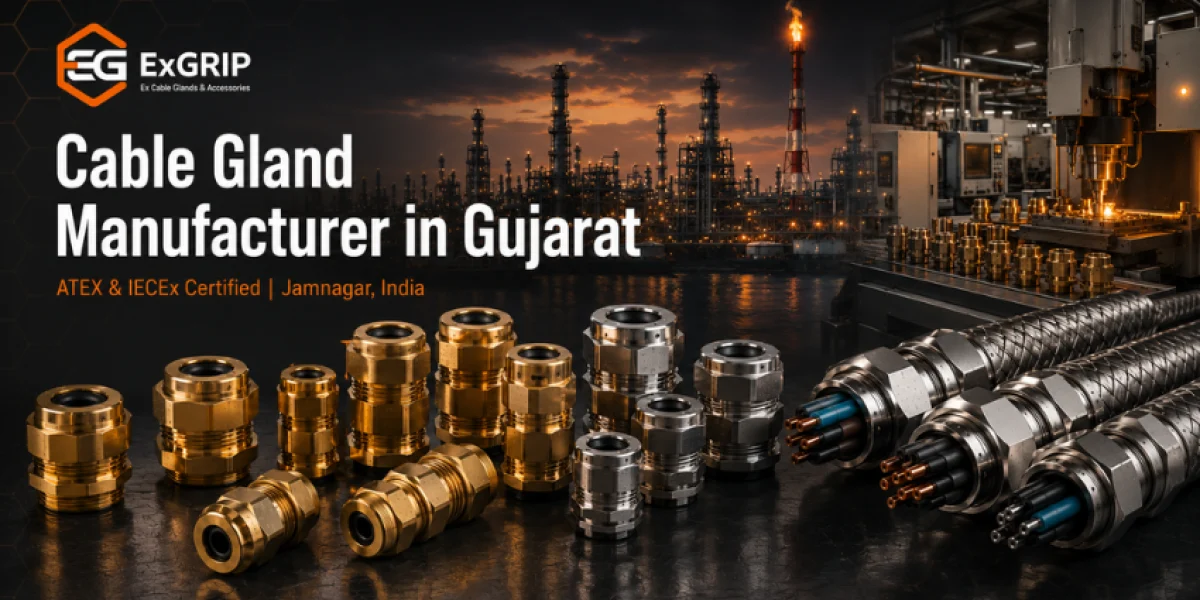
Gujarat has established itself as one of the most important industrial states in the country, home to world-scale oil and gas refineries, vast petrochemical and chemical processing corridors, offshore terminals, pharmaceutical manufacturing zones, and a rapidly expanding renewable energy sector. Across all of these industries, every electrical cable entering a junction box, control panel, or enclosure requires a certified cable gland a precision mechanical fitting that seals the entry point, retains the cable, and in hazardous environments, prevents the propagation of flame, explosive gas, and ignition risk. Exgrip, headquartered in Udhyognagar, Jamnagar, Gujarat, is one of India’s foremost cable gland manufacturers producing a comprehensive range of ATEX certified and IECEx certified cable glands for the most demanding industrial applications across Gujarat, India, and international export markets.
ATEX and IECEx certification are not optional standards for cable glands used in hazardous locations they are mandatory safety requirements that define whether a cable gland is legally and technically fit for installation in an explosive atmosphere. Gujarat’s industrial geography spans environments that directly require these certifications: the Jamnagar refinery belt, the LNG terminals at Dahej and Hazira, the chemical and pharmaceutical corridors of Ankleshwar, Bharuch, and Vadodara, and the offshore infrastructure along the Saurashtra coast. Exgrip’s brass cable gland manufacturing operations in Jamnagar at the heart of India’s brass capital allow the company to deliver certified, precision-engineered cable glands with the supply chain efficiency, quality consistency, and technical depth that industrial buyers across Gujarat and beyond require.
What is ATEX Certification for Cable Glands?
ATEX is the European Union’s framework of directives governing equipment and protective systems intended for use in potentially explosive atmospheres. The name derives from the French term “ATmosphères EXplosibles.” For cable glands, ATEX certification confirms that the product has been independently tested, assessed, and certified by a notified body to meet the relevant IEC and EN standards for explosion protection in classified hazardous areas.
What Does ATEX Full Form Mean in Practice?
Understanding the ATEX full form Atmosphères Explosibles helps clarify what the certification actually covers. ATEX-certified cable glands are designed and tested to prevent a cable entry point from becoming a source of ignition in environments where flammable gases, vapours, mists, or combustible dusts may be present. For buyers in Gujarat’s oil and gas, chemical, and pharmaceutical sectors, specifying ATEX certified cable glands is both a regulatory requirement and a fundamental project safety measure.
ATEX Protection Modes on Exgrip Cable Glands
Exgrip cable glands carry ATEX certification across three key protection modes:
- Ex db (Flameproof / Explosion-proof): The cable gland is designed to contain any internal ignition and prevent it from propagating to the surrounding explosive atmosphere. Used for Zone 1 flameproof enclosure terminations the most stringent hazardous area requirement. Applicable Exgrip models: E1FW, DCAB, DCUB.
- Ex eb (Increased Safety): Additional measures are applied to prevent the likelihood of excessive temperatures and the occurrence of arcs or sparks. Used for Zone 2 and selected Zone 1 installations. Applicable Exgrip models: A2F, SCU, SCA, DCA, DCU.
- Ex ta (Dust Ignition Protection): The cable gland is designed to prevent the ignition of surrounding combustible dust clouds. Used in Zone 21 and Zone 22 dust hazardous areas. Applicable across the Exgrip ATEX certified range.
What is IECEx Certification and Why Does It Matter?
IECEx is the International Electrotechnical Commission’s international certification scheme for equipment used in explosive atmospheres. While ATEX is the European Union’s framework, IECEx is the globally recognised equivalent accepted in over 50 countries worldwide, including India, Australia, the Middle East, Southeast Asia, and Africa. For Indian manufacturers supplying cable glands for international EPC projects, IECEx certification is the key that opens global market access.
Exgrip’s cable glands carry both ATEX and IECEx certification meaning every product in the certified range meets both European and international explosive atmosphere standards simultaneously. This dual certification is particularly valuable for Gujarat-based buyers and project teams working on projects with multinational ownership, international EPC contractors, or export-oriented installations where a single certification scheme may not be sufficient.
ATEX vs IECEx: Key Differences
| Criteria | ATEX | IECEx |
|---|---|---|
| Governing body | European Union (EU Directives) | International Electrotechnical Commission (IEC) |
| Geographical acceptance | Mandatory in EU; accepted globally | Accepted in 50+ countries worldwide |
| Applicable standards | EN/IEC 60079 series | IEC 60079 series |
| Certificate issuer | EU notified body | IECEx certified body |
| Marking on product | Ex marking with CE mark + notified body number | IECEx marking with certificate number |
| Preferred for | EU projects, European EPC specifications | International projects, Middle East, Asia-Pacific, India exports |
For technical details on ATEX and IECEx markings, protection modes, and EPL (Equipment Protection Level) classifications used on Exgrip products, visit the Technical page.
Hazardous Area Zone Classifications and Cable Gland Selection
Selecting the correct ATEX or IECEx certified cable gland for a hazardous area installation requires understanding the zone classification of the installation location. Zones define the frequency and duration with which an explosive atmosphere is expected to be present and directly determine which protection mode (Ex db, Ex eb, Ex ta) is required.
| Zone | Atmosphere | Frequency of Explosive Atmosphere | Required Protection | Recommended Exgrip Model |
|---|---|---|---|---|
| Zone 1 | Gas / Vapour | Likely during normal operation | Ex db IIC (flameproof) | E1FW, DCAB, DCUB |
| Zone 2 | Gas / Vapour | Not likely in normal operation; may occur rarely | Ex eb IIC (increased safety) | A2F, DCA, DCU |
| Zone 21 | Combustible Dust | Likely during normal operation | Ex tb IIIC (dust protection) | E1FW, DCAB |
| Zone 22 | Combustible Dust | Not likely in normal operation | Ex tb IIIC (dust protection) | A2F, DCA |
Cable Gland Types: Single Compression, Double Compression, and Barrier
For any hazardous area project in Gujarat’s industrial zones, understanding the three principal cable gland types is essential for correct specification and safe installation.
Single Compression Cable Glands
Single compression cable glands are designed for unarmoured cables. A single compression seal grips the cable outer sheath, providing environmental sealing and cable retention at the enclosure entry point. These glands are widely used for flexible instrument cables, control cables, and intrinsically safe field wiring in Zone 2 and safe area installations. Exgrip’s single compression range includes the A2F, SCU, SCA, A2FPF, A2FPM, and A2FCNF models.
Double Compression Cable Glands
A double compression cable gland provides two independent compression points an inner compression that mechanically bonds to the cable armour layer (SWA or AWA), and an outer compression that seals against the cable outer sheath. This dual-seal design delivers the mechanical retention, armour continuity, and high IP rating required for power and control cables in oil and gas, chemical, and offshore installations. Exgrip’s double compression cable gland range includes the E1FW, DCA, DCU, DCAB, and DCUB models, all ATEX and IECEx certified for Zone 1 and Zone 2 hazardous areas.
Barrier Cable Glands
Barrier cable glands are used where cables terminate into flameproof (Ex d) enclosures. They incorporate a compound-filled or mechanical barrier within the gland body that prevents the internal explosion of a flameproof enclosure from propagating back along the cable route. Barrier glands are mandatory for armoured cable entries into Zone 1 flameproof enclosures, JBs, and motor terminal boxes. Exgrip’s barrier range includes the DCAB (double compression, armoured, barrier) and SCAB (single compression, armoured, barrier) models.
Ingress Protection Ratings: IP66, IP67, and IP68 Explained
IP (Ingress Protection) ratings define how effectively a cable gland seals against the entry of dust and water. For industrial installations in Gujarat’s refinery, chemical, and offshore environments, the correct IP rating is as important as the hazardous area certification. All Exgrip cable glands are rated IP66, IP67, and IP68 simultaneously meeting the widest possible range of installation requirements.
- IP66: Dust-tight and protected against powerful water jets from any direction. Suitable for outdoor installations, washdown areas, and industrial enclosures exposed to rain and spray.
- IP67: Dust-tight and protected against temporary immersion in water up to 1 metre depth for 30 minutes. Required for cable trench installations and underground duct entries.
- IP68: Dust-tight and protected against continuous immersion in water beyond 1 metre depth. Mandatory for underwater, submerged, or permanently wet installations.
Cable Gland Material Selection: Brass, Nickel-Plated Brass, and Stainless Steel
The material of a cable gland determines its long-term performance in the specific installation environment. Exgrip manufactures certified cable glands in three materials each suited to different conditions across Gujarat’s diverse industrial landscape.
| Material | Corrosion Resistance | Mechanical Strength | Best Environments | Relative Cost |
|---|---|---|---|---|
| Brass | Good suitable for most industrial environments | High | Refineries, process plants, substations, MCC rooms, general indoor and outdoor industrial use | Standard |
| Nickel-Plated Brass | Very Good enhanced protection against humidity, salt, and mild chemicals | High | Coastal installations, outdoor panels in high-humidity zones, corrosive process areas, Jamnagar and Hazira coastal sites | Moderate |
| Stainless Steel (SS316) | Excellent resists strong acids, chlorides, and seawater | Very High | Offshore platforms, LNG terminals, acid handling areas, marine installations, pharmaceutical cleanrooms | Premium |
For most onshore oil and gas, chemical, and refinery installations across Gujarat, brass cable glands are the standard specification. Jamnagar’s position as India’s brass manufacturing capital gives Exgrip direct access to high-quality brass material and precision machining capability ensuring consistent dimensional accuracy and surface finish across the certified product range.
Common Cable Gland Installation Mistakes and How to Avoid Them
Even when the correct ATEX or IECEx certified cable gland is specified, incorrect installation can compromise the IP rating, invalidate the hazardous area certification, and create safety risks. The following are the most common installation mistakes observed on Gujarat project sites and the best practices to prevent them.
Using the Wrong Gland Size
Installing a cable gland that is too large for the cable OD is one of the most frequently observed errors. An oversized gland cannot compress sufficiently against the cable sheath to achieve IP66, IP67, or IP68 sealing. Always measure the actual cable OD not the nominal cable size and cross-reference against the gland size chart before installation. Use the Cable Gland Selection Tool to verify the correct size for your specific cable.
Incorrect Armour Termination on Double Compression Glands
For double compression cable glands on SWA or AWA armoured cables, the armour wires must be correctly prepared and seated within the armour clamp before the gland is tightened. Failing to fully seat the armour in the inner compression results in poor mechanical retention and loss of armour continuity a particular risk in vibrating environments such as motor terminal boxes and pump stations common in Gujarat’s refinery and process plants.
Over-tightening or Under-tightening
Both over-tightening and under-tightening a cable gland can compromise the seal. Over-tightening can crack the compression seal or distort the cable sheath, breaking the IP integrity. Under-tightening leaves the seal incomplete. Always follow the manufacturer’s torque specifications for the specific gland size and material.
Using Uncertified Glands in Hazardous Area
Substituting a non-certified cable gland in a Zone 1 or Zone 2 hazardous area even temporarily is a serious safety and compliance violation. In India, PESO regulations and international project specifications explicitly prohibit uncertified equipment in hazardous locations. Always verify ATEX and IECEx certificate validity before installation, particularly for project sites in Gujarat’s oil and gas and petrochemical zones.
Ignoring Thread Compatibility
Forcing a metric-thread cable gland into a PG or NPT threaded enclosure entry or vice versa damages the thread form, compromises the IP seal, and in hazardous areas can invalidate the Ex certification of both the gland and the enclosure. Always confirm the enclosure entry thread type (M, PG, or NPT) before selecting a cable gland.
Why Gujarat is India's Leading Hub for Cable Gland Manufacturing
Gujarat’s prominence as a cable gland manufacturing hub is inseparable from Jamnagar’s century-long identity as India’s brass capital. The city produces an estimated 40% of India’s total brass components output creating a tightly integrated local supply chain of brass bar stock, precision machining, surface finishing, and quality testing that directly enables cable gland manufacturing at scale and consistent quality.
Beyond raw material access, Jamnagar’s industrial ecosystem provides CNC machining expertise, tooling capability, and a skilled engineering workforce that meets the tight dimensional tolerances required for ATEX and IECEx certified cable gland production. Combined with Gujarat’s well-developed logistics infrastructure road, rail, and sea freight connections to all major industrial zones manufacturers based in Jamnagar can supply cable glands efficiently to Dahej, Hazira, Bharuch, Ankleshwar, Vadodara, and international export destinations.
Why Exgrip is a Trusted Certified Cable Gland Manufacturer in Gujarat
For procurement teams and engineering leads sourcing certified cable glands in Gujarat, Exgrip offers a combination of in-house manufacturing capability, internationally recognised certifications, and deep industry experience that makes it a reliable long-term supply partner for industrial projects of any scale.
- ATEX and IECEx Certified: Every cable gland in the Exgrip range carries current ATEX and IECEx certification issued by a recognised notified body. Ex db, Ex eb, and Ex ta protection modes are covered across the full product range from single compression and double compression cable glands to barrier glands and conduit entries.
- Complete Documentation on Request: Exgrip provides Ex certificates, IP test reports, dimensional drawings, material certifications, and RoHS/REACH declarations for all certified products supporting the documentation requirements of Indian and international EPC project specifications without delay.
- Manufactured In-House in Jamnagar: All Exgrip cable glands are produced at the company’s own manufacturing facility at Udhyognagar, Jamnagar, Gujarat. In-house production in India’s brass capital gives Exgrip direct control over material quality, dimensional accuracy, lead times, and product consistency from raw material to finished certified gland.
- Complete Product Range Under One Roof: Exgrip manufactures single compression, double compression, barrier glands, conduit entries, stopping plugs, reducers, adapters, and Y-adapters covering every cable entry requirement across a project from a single supply source. Metric, PG, and NPT thread entries are available across the range.
- Technical Support from Jamnagar: Exgrip’s technical team provides direct assistance with gland selection, zone suitability confirmation, cable gland size chart guidance, and compliance documentation available to project engineers and procurement teams working on Gujarat-based and national projects alike.
- Gujarat Supply Advantage: With manufacturing and dispatch from Jamnagar, Exgrip delivers efficient logistics to all major Gujarat industrial zones Dahej, Hazira, Bharuch, Ankleshwar, and Vadodara as well as national and international project sites, supporting project timelines with reliable lead times and flexible order quantities.
For full product specifications, certification documentation, and Exgrip’s complete ATEX and IECEx certified cable gland range, visit the Products page or contact the team directly at Contact Page.
Conclusion & Call-to-Action
As industrial infrastructure continues to expand, demand for reliable cable gland solutions remains strong. Jamnagar Gujarat has established itself as a global center for precision brass engineering and cable gland manufacturing. Whether the requirement involves brass cable gland products, double compression cable gland solutions, cable gland size selection, cable gland size charts, or armoured cable installations, manufacturers in Gujarat India provide dependable solutions for diverse industrial applications.
Choosing a reputable cable gland manufacturer ensures product quality, operational safety, regulatory compliance, and long-term system reliability across critical industries worldwide.
📩 Talk to our technical team today at Exgrip.com
📞 Or call us directly for quick assistance!
Contact Us:
📞 Phone: +91 9537118899
🌐 Website: www.exgrip.com
📩 Request a Quote: Contact Page
FAQs
What does ATEX full form mean and why is it relevant for cable glands?
ATEX stands for Atmosphères Explosibles French for explosive atmospheres. It refers to the European Union’s regulatory framework governing equipment used in environments where explosive gases, vapours, or dusts may be present. For cable glands, ATEX certification confirms the product has been independently tested and verified to prevent ignition in classified hazardous areas. In Gujarat’s oil and gas, chemical, and pharmaceutical industries, ATEX certified cable glands are a standard project requirement.
What is the difference between ATEX and IECEx certification for cable glands?
ATEX is the European Union’s hazardous area equipment certification framework, while IECEx is the international equivalent issued under the International Electrotechnical Commission’s certification scheme. Both certifications cover the same IEC 60079 series standards and explosion protection modes (Ex db, Ex eb, Ex ta). ATEX is mandatory for EU projects; IECEx is accepted in over 50 countries globally. Exgrip cable glands carry both ATEX and IECEx certification, making them suitable for Indian domestic projects and international export alike.
Which cable gland type should I use for armoured cables in a Zone 1 hazardous area?
For armoured cables (SWA or AWA) in Zone 1 hazardous areas, a double compression cable gland with Ex db (flameproof) certification is required. Exgrip’s E1FW model is the recommended Zone 1 double compression cable gland for armoured cable installations. For terminations directly into flameproof (Ex d) enclosures, the DCAB or DCUB barrier cable gland models are required.
How do I select the correct cable gland size for my cable?
Measure the outer diameter of the cable over its outer sheath using a calibrated vernier calliper. For armoured cables, also confirm the armour wire diameter. Match the measured OD to the appropriate gland size range in the Cable Gland Selection Chart.
Does Exgrip manufacture cable glands in Gujarat?
Yes. Exgrip manufactures all cable glands at its in-house production facility located at Udhyognagar, Jamnagar, Gujarat 361004, India. Jamnagar’s status as India’s brass capital gives Exgrip direct access to high-quality brass material and precision machining expertise. All ATEX and IECEx certified products are manufactured, inspected, and dispatched from the Jamnagar facility.
Are Exgrip cable glands suitable for chemical and pharmaceutical plants in Gujarat?
Yes. Exgrip supplies ATEX and IECEx certified cable glands for chemical and pharmaceutical plants across Gujarat’s industrial corridors including Ankleshwar, Bharuch, Dahej, and Vadodara. For chemically aggressive environments, nickel-plated brass and stainless steel cable gland options are available to provide enhanced corrosion resistance against acids, solvents, and process gases. Visit the Chemical Plants page for industry-specific product information.