
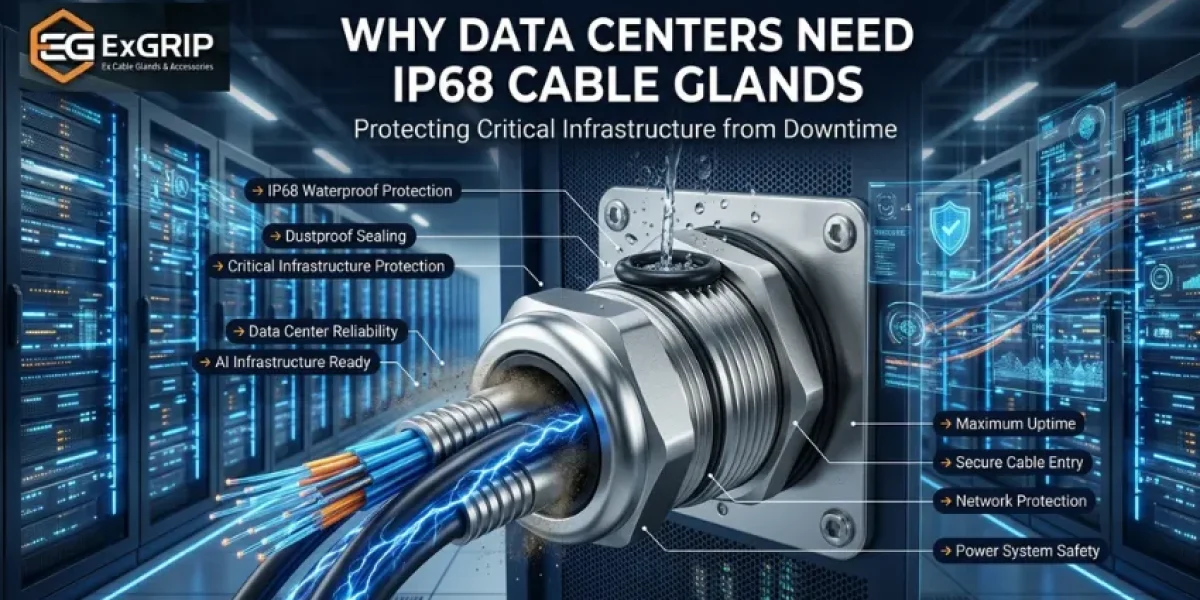
Modern data centers are the backbone of cloud computing, AI infrastructure, banking systems, telecom networks, healthcare platforms, and enterprise applications. As data center infrastructure continues to grow across India and globally, maintaining uninterrupted operations has become more important than ever.
While organizations invest heavily in servers, cooling systems, networking equipment, and power distribution infrastructure, one critical component is often overlooked: the cable entry system.
A poorly protected cable entry point can allow dust, moisture, and contaminants to enter electrical enclosures, causing equipment failures, network disruptions, and costly downtime.
This is where IP68 cable glands become essential. These industrial cable glands provide waterproof sealing, dust protection, strain relief, and secure cable retention for power cables, fiber optic cables, and network infrastructure.
Why Standard Cable Entry Systems Are Not Enough
Many facilities still use basic cable entry methods that focus only on routing cables into cabinets.
Common issues include:
- Dust entering network cabinets
- Moisture ingress
- Cable movement
- Seal deterioration
- Reduced equipment lifespan
- Maintenance issues
In mission-critical environments, even a small infrastructure failure can impact thousands of users.
Common Risks in Data Center Infrastructure
Dust Contamination
Dust can affect:
- Server performance
- Cooling systems
- Power distribution units
- Network switches
Even microscopic particles can reduce operational efficiency.
Water Ingress
Water can enter through:
Outdoor cabinets
Roof cable entries
Utility connections
Cooling system infrastructure
This may result in:
Electrical faults
Equipment damage
Corrosion
Service interruptions
Cable Movement
Heavy power cables and fiber optic bundles create mechanical stress.
Without proper cable retention:
Cables can loosen
Connections can fail
Seals may become compromised
How IP68 Cable Glands Solve These Problems
An IP68 cable gland creates a sealed connection between the cable and enclosure.
Benefits include:
Waterproof Protection
Prevents water ingress into critical infrastructure.
Dustproof Sealing
Provides complete protection against dust contamination.
Strain Relief
Reduces cable movement and mechanical stress.
Long-Term Reliability
Maintains sealing performance throughout the infrastructure lifecycle.
Data Center Application Comparison
| Area | Common Risk | Recommended Solution |
|---|---|---|
| Server Cabinets | Dust | IP68 Cable Gland |
| Outdoor Cabinets | Water Ingress | Stainless Steel Cable Gland |
| Generator Connections | Vibration | Double Compression Cable Gland |
| UPS Systems | Moisture | Waterproof Cable Gland |
| Fiber Infrastructure | Cable Stress | Industrial Cable Gland |
Why AI Data Centers Require Better Cable Protection
Modern AI data centers consume significantly more power than traditional facilities.
This means:
- Larger power cables
- More cable entries
- Increased heat generation
- Higher infrastructure density
As AI infrastructure expands across India, cable protection becomes increasingly important.
Even a minor cable entry failure can impact critical workloads.
Recommended Cable Gland Selection Process
Step 1: Identify Installation Area
Determine whether the application is:
- Indoor
- Outdoor
- High humidity
- Critical infrastructure
Step 2: Identify Cable Type
- Power Cable
- Fiber Optic Cable
- Communication Cable
- Control Cable
Step 3: Check Environmental Conditions
Consider:
- Dust exposure
- Water exposure
- Temperature changes
- Mechanical stress
Step 4: Select Correct Gland Material
Environment
Recommended Material
Indoor
Brass Cable Gland
Outdoor
Stainless Steel Cable Gland
Humid Areas
SS316 Cable Gland
Critical Systems
Double Compression Cable Gland
Step 5: Verify IP Rating
| Environment | Recommended Material |
|---|---|
| Indoor | Brass Cable Gland |
| Outdoor | Stainless Steel Cable Gland |
| Humid Areas | SS316 Cable Gland |
| Critical Systems | Double Compression Cable Gland |
For data centers:
- Minimum IP65
- Preferred IP66
- Recommended IP68
Installation & Maintenance
Proper installation is essential for maintaining IP68 performance.
Installation Tips
- Use the correct gland size
- Verify cable diameter
- Tighten according to specifications
- Check sealing rings
- Inspect enclosure entry points
Maintenance Tips
- Inspect seals periodically
- Check for cable movement
- Verify waterproof integrity
- Replace damaged glands immediately
- Maintain inspection records
- Inspect seals periodically
- Check for cable movement
- Verify waterproof integrity
- Replace damaged glands immediately
- Maintain inspection records
Why IP68 Matters for Critical Infrastructure
| Factor | Standard Cable Entry | IP68 Cable Gland |
|---|---|---|
| Dust Protection | Limited | Complete |
| Water Protection | Basic | Excellent |
| Cable Retention | Moderate | High |
| Infrastructure Reliability | Medium | High |
| Data Center Uptime | Risky | Improved |
Conclusion & Call-to-Action
Selecting the right cable gland, whether it’s a waterproof cable gland, brass cable gland, or using the correct cable gland accessories, is vital for industrial safety and system reliability.
At Exgrip, we provide a full range of cable glands, connectors, and accessories, certified with ATEX, IECEx, IP, RoHS, and REACH, suitable for any industrial or hazardous application.
📩 Talk to our technical team today at Exgrip.com
📞 Or call us directly for quick assistance!
Contact Us:
📞 Phone: +91 9537118899
🌐 Website: www.exgrip.com
📩 Request a Quote: Contact Page
FAQs
Why are IP68 cable glands used in data centers?
IP68 cable glands protect critical infrastructure from water ingress, dust contamination, and cable movement while improving long-term reliability.
Can IP68 cable glands be used indoors?
Yes. They are commonly used in server rooms, network cabinets, UPS systems, and critical infrastructure applications.
What is the best cable gland material for outdoor data center installations?
Stainless steel cable glands, particularly SS316, provide excellent corrosion resistance and durability.
How do cable glands improve data center uptime?
They prevent environmental contamination and infrastructure failures that could lead to downtime.
Are IP68 cable glands suitable for fiber optic cables?
Yes. They provide secure sealing and cable retention for fiber optic infrastructure.