
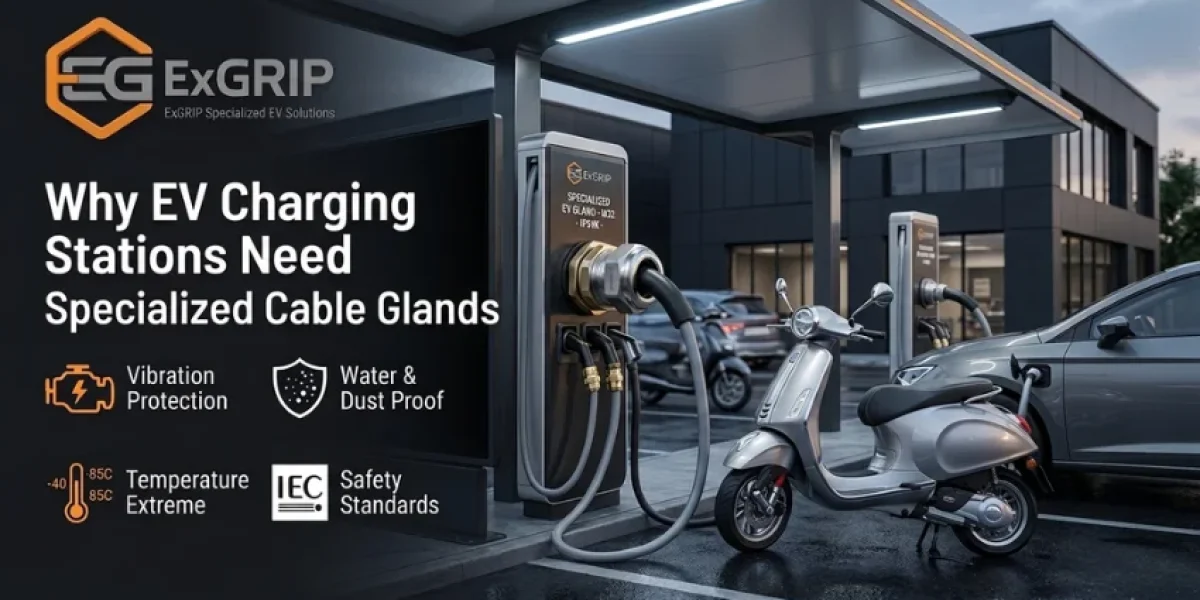
The global EV industry is growing rapidly, and with it, the demand for reliable EV charging infrastructure is increasing across commercial, industrial, and public spaces. From highway fast chargers and smart parking systems to residential charging units, modern charging stations must operate safely in harsh outdoor environments.
One small but critical component behind this reliability is the cable gland.
In many EV charging installations, electrical failures begin at the cable entry point. Water ingress, UV exposure, loose cable sealing, and incorrect cable gland sizing can gradually damage charging systems and reduce operational safety.
This is why modern charging systems increasingly use specialized cable glands designed specifically for outdoor electrical protection.
Why EV Charging Stations Need Better Cable Protection
Most EV Charging Installations Are Located In
EV charging stations are commonly installed in exposed environments where cables and enclosures require strong environmental protection.
Outdoor Areas
- Direct rain exposure
- Sunlight & UV radiation
- Humidity & moisture
- Changing weather conditions
Roads & Highways
- Continuous vibration
- Heavy traffic movement
- Dust & pollution
- Outdoor environmental stress
Parking Lots
- Public outdoor usage
- Water accumulation
- Dirt & contamination
- Frequent charging operations
These Environments Expose Charging Systems To
Environmental conditions directly affect EV charger reliability, enclosure safety, and electrical system performance.
Rainwater
- Water ingress risk
- Moisture penetration
- Electrical enclosure damage
- Corrosion possibility
Humidity
- Internal condensation
- Corrosion inside systems
- Reduced electrical reliability
- Connector degradation
Dust Exposure
- Dust accumulation
- Terminal contamination
- Reduced charging efficiency
- Electronics performance issues
Without Proper Sealing, Moisture Can Damage
Improper cable sealing allows water and contaminants to enter enclosures, leading to electrical failures and reduced charging reliability.
Charging Electronics
- Electrical short circuits
- Internal corrosion
- Charging interruptions
- Reduced equipment lifespan
Communication Systems
- Signal disruption
- Network instability
- Data communication errors
- Monitoring failures
Electrical Components
- Terminal damage
- Connector corrosion
- Power distribution issues
- System reliability problems
What Makes EV Charging Installations Different?
EV charging systems carry:
- high current loads
- continuous power supply
- outdoor operational stress
Compared to ordinary electrical panels, EV charging stations require stronger cable sealing and higher environmental protection.
Common Challenges in Outdoor EV Installations
| Installation Challenge | Impact |
|---|---|
| Water Exposure | Moisture ingress risk |
| UV Radiation | Seal cracking & aging |
| Cable Movement | Loose gland sealing |
| Dust & Pollution | Reduced IP protection |
| Heat Generation | Thermal stress |
| Corrosive Environment | Reduced gland lifespan |
Why Standard Cable Glands Often Fail in EV Charging Systems
Many charging stations still use standard cable glands not designed for demanding outdoor applications.
Over time, this can create serious sealing and maintenance issues.
Incorrect Cable Gland Size SelectionImproper sizing is one of the biggest reasons for cable gland failure.
If the gland size does not match the cable outer diameter:
- sealing pressure becomes uneven
- gaps form around the cable
- moisture enters the enclosure
This is why engineers regularly use:
- cable gland size chart
- gland size chart
- cable gland sizing chart
- cable gland selection chart
during installation planning.
Poor Waterproofing PerformanceOutdoor EV charging stations face:
- direct rainfall
- water splashes
- humidity changes
- condensation
Basic glands may lose sealing efficiency over time, especially in public outdoor installations.
Using properly rated IP68 cable glands helps maintain enclosure protection.
UV Damage and Material DegradationContinuous sunlight exposure can slowly damage low-quality gland materials.
Over time:
- seals become hard
- plastic components crack
- flexibility reduces
- waterproofing performance weakens
This is why nickel-plated brass and stainless steel cable glands are preferred in outdoor charging systems.
Continuous Cable StressCharging cables are heavier than ordinary industrial cables and experience frequent handling and movement.
Poor gland retention may lead to:
- cable loosening
- strain on terminals
- damaged sealing rings
- internal enclosure leakage
Importance of Correct Cable Gland Sizing in EV Charging Systems
Correct sizing is critical for both waterproofing and cable retention.
Large charging systems commonly use:
- armoured power cables
- multi-core outdoor cables
- high-capacity conductors
Installers frequently refer to:
- 4 core cable gland size chart
- armoured cable gland size chart
- electrical cable gland size chart PDF
- double compression cable gland size chart PDF
during EV infrastructure installation.
Practical Cable Gland Size Reference Table
| Cable Type | Common Application | Recommended Gland |
|---|---|---|
| 4 Core 25 sq mm Cable | Residential EV Charger | IP68 Brass Gland |
| 4 Core 70 sq mm Cable | Commercial Charging Unit | Double Compression Gland |
| 120 sq mm Power Cable | Fast Charging System | Heavy Duty Industrial Gland |
| 300 sq mm Armoured Cable | EV Charging Infrastructure | Double Compression Armoured Gland |
Why Double Compression Cable Glands Are Preferred
For outdoor charging systems, double compression cable glands provide better sealing compared to single compression designs.
- Better waterproofing
- Improved vibration resistance
- Secure cable clamping
- Higher ingress protection
- Better performance in harsh environments
This is especially important in:
- fast charging stations
- public charging infrastructure
- roadside EV installations
Recommended Materials for EV Charging Cable Glands
Choosing the right material improves durability and environmental resistance.
| Material | Best Application |
|---|---|
| Nickel-Plated Brass | Outdoor EV charging systems |
| Stainless Steel | Coastal & corrosive areas |
| Nylon | Indoor charging units |
| Aluminium | Lightweight enclosures |
For most outdoor charging systems, nickel-plated brass cable glands offer the best balance between:
- corrosion resistance
- strength
- long-term durability
Essential Features of Specialized EV Cable Glands
Modern EV charging stations require glands with:
- High IP protection
- UV resistance
- Corrosion resistance
- Secure cable sealing
- Vibration resistance
- Temperature stability
- Long operational life
These features help maintain safe and uninterrupted charging performance.
Cable Gland Accessories for Outdoor EV Installations
Accessories improve overall installation reliability and maintenance life.
Common Accessories- Weatherproof shrouds
- Earthing accessories
- Thread converters
- Sealing washers
- Corrosion-resistant locknuts
Using the right accessories helps improve:
- waterproof sealing
- outdoor durability
- vibration resistance
Why IP Ratings Matter in EV Charging Stations
Most outdoor EV charging systems use:
- IP66
- IP67
- IP68 cable glands
depending on environmental exposure and installation requirements.
However, even the best IP rating depends heavily on:
- correct installation
- accurate gland sizing
- proper tightening
- cable compatibility
Using the wrong gland size for cables can reduce protection performance significantly.
Downloadable Resources for Engineers & Installers
During installation and maintenance, engineers often use:
- Cable gland size chart PDF
- Electrical cable gland size chart PDF
- Armoured cable gland size chart PDF
- Double compression cable gland size chart PDF
These downloadable references help reduce installation errors and improve project planning efficiency.
Conclusion & Call-to-Action
Looking for the right IP68 cable gland, brass cable gland, or double compression cable gland for your EV charging installation? Exgrip offers certified industrial cable glands, accessories, and cable protection solutions for reliable outdoor performance and long-term electrical safety. Connect with our technical team today for expert support and cable gland selection guidance.
📩 Talk to our technical team today at Exgrip.com
📞 Or call us directly for quick assistance!
Contact Us:
📞 Phone: +91 9537118899
🌐 Website: www.exgrip.com
📩 Request a Quote: Contact Page
FAQs
What type of cable gland is commonly used in EV charging stations?
Most outdoor charging systems use double compression IP68 cable glands because they provide stronger sealing and better cable retention.
Why are IP68 cable glands preferred for EV infrastructure?
IP68 cable glands provide high protection against dust and water ingress, making them suitable for harsh outdoor environments.
Are stainless steel cable glands suitable for EV charging systems?
Yes. Stainless steel glands are highly suitable for coastal, corrosive, and heavy industrial environments.
Why are double compression glands preferred in outdoor installations?
They provide better waterproofing, stronger cable retention, and improved vibration resistance.
Why is proper gland sizing important for armoured EV cables?
Armoured cables require proper armor clamping and sealing. Using a correct armoured cable gland size chart helps maintain installation reliability.