Buying a cable gland for a hazardous area is not just a procurement decision it is a safety commitment. In explosive atmospheres, using a gland that is falsely claimed or improperly certified can lead to catastrophic failures, equipment loss, and serious safety incidents.
The question that engineers and procurement managers ask most often is simple: “How do I actually verify that this cable gland is genuinely ATEX certified?” Not just the supplier’s word. Not just a label. Real verification.
In this guide, we walk you through a clear, step-by-step process to verify ATEX certification on any cable gland from reading the physical marking on the gland body to cross-checking with official certification databases. Whether you are specifying glands for Zone 1, Zone 2, or any other classified hazardous area, this guide gives you the tools to verify with confidence.
What Does ATEX Certified Mean for a Cable Gland?
Before we go into verification steps, it is important to understand what ATEX certification actually means for a cable gland.
ATEX stands for Atmosphères Explosibles a European Union directive (2014/34/EU) that defines safety requirements for equipment used in explosive atmospheres. For a cable gland to carry the ATEX mark, it must be independently tested and approved by an officially recognised body, proving that the gland will not become a source of ignition in a hazardous area.
An ATEX certified cable gland must meet specific requirements including:
- Controlled surface temperatures that will not ignite surrounding gases or dusts
- Mechanical integrity to prevent sparks under normal or fault conditions
- Environmental sealing at IP66, IP67, or IP68 levels as required
- Compatibility with the relevant Ex protection concept such as Ex db (flameproof), Ex eb (increased safety), or Ex ta (dust ignition protection)
Simply put, ATEX certification means the cable gland has been tested, verified, and approved by a third-party authority not just self-declared by a manufacturer.
Why ATEX Verification Matters Before Every Purchase
In industries like oil and gas, petrochemical, pharmaceuticals, and mining, non-certified or counterfeit cable glands are a genuine risk. They look identical to certified products. The packaging may appear professional. The price may seem attractive. But once installed in a hazardous area, they could void your facility’s compliance status, invalidate your insurance, and most seriously put lives at risk.
Verifying ATEX certification before purchase protects you against:
- Regulatory non-compliance during safety audits and inspections
- Liability exposure if an incident occurs with uncertified equipment
- Installation rework costs if glands fail zone compatibility checks on site
- Supply chain risk from resellers who do not have direct manufacturer certification
This is why every responsible engineer regardless of experience level should know how to verify an ATEX certified cable gland independently.
Step by Step Guide to Verify ATEX Certification on a Cable Gland
Selecting the right gland is just as important as choosing the right cable. That’s where the cable gland size chart and cable gland selection chart come in. These charts act as quick references to match the outer diameter of a cable with the correct gland size.
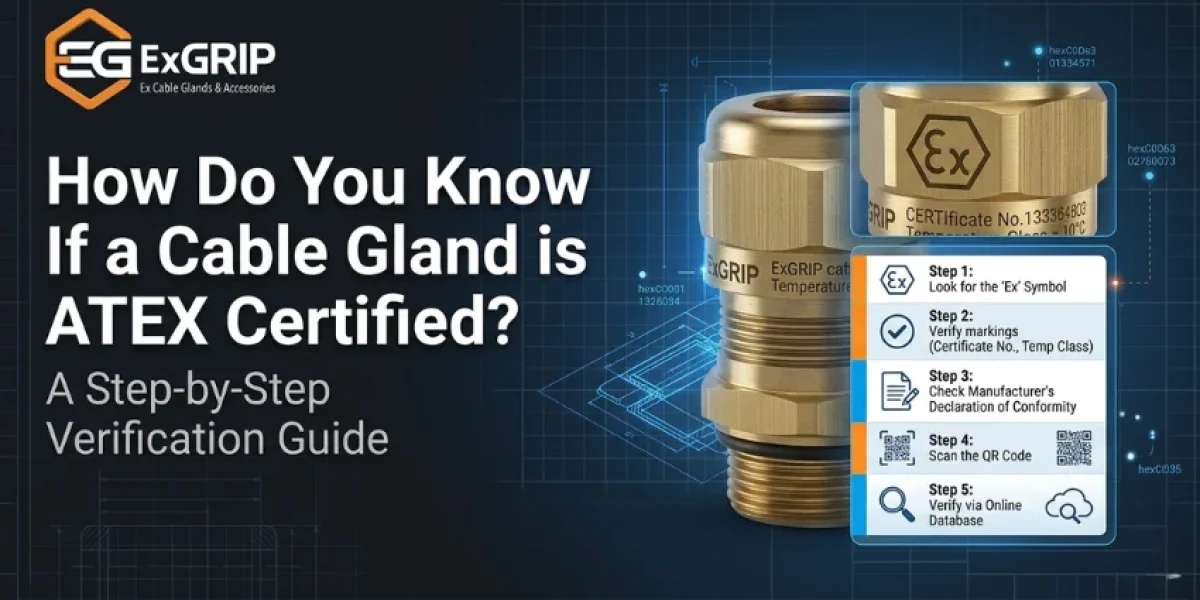
Locate the Ex Marking on the Cable Gland Body
The first and most immediate check is the physical Ex marking stamped or engraved on the cable gland body itself.
Every genuine ATEX certified cable gland must carry a clearly visible marking on its body. This marking is not on the packaging it is on the gland itself. If you cannot find it directly on the product, treat it as a serious red flag.
The Ex marking typically appears as:
- The Ex symbol (a hexagonal logo with “Ex” inside)
- The protection concept code (e.g., Ex db, Ex eb, Ex ta)
- The gas group (e.g., IIC, IIB, IIA)
- The temperature class (e.g., T6, T5, T4)
- The equipment protection level (e.g., Gb, Gc, Db)
For example, a marking that reads “Ex db IIC T6 Gb” tells you:
- Ex db Flameproof protection
- IIC Suitable for the most explosive gas group (hydrogen and acetylene environments)
- T6 Maximum surface temperature of 85°C
- Gb Equipment Protection Level for Zone 1
If the marking is unclear, incomplete, or missing do not proceed with installation.
Find the Notified Body Number
A genuine ATEX certificate is issued by a recognised Notified Body an independent testing organisation officially approved by a European Union member state.
On the cable gland, you will find a four-digit Notified Body number stamped alongside the Ex marking. This number identifies who issued the certificate.
Some of the most widely recognised Notified Bodies include:
| Notified Body | Country | Notified Body Number |
|---|---|---|
| ATEX – DEKRA EXAM | Germany | 0158 |
| SGS Fimko | Finland | 0598 |
| Bureau Veritas | France | 0081 |
| SIRA Certification Service | UK | 0518 |
| INERIS | France | 0080 |
You can verify any Notified Body number on the official European Commission NANDO database (New Approach Notified and Designated Organisations). If the number on your cable gland does not appear in that database, the certification is not legitimate.
Read and Decode the Full Ex Marking String
The complete Ex marking on an ATEX certified cable gland follows a defined structure. Once you understand the format, you can decode any gland’s certification at a glance.
Full Ex Marking Format:
II 2 G Ex db IIC T6 Gb
| Marking | Meaning |
|---|---|
| Ex | Explosion protected equipment |
| db | Protection method — flameproof enclosure |
| IIC | Gas group — suitable for hydrogen, acetylene (most stringent) |
| T6 | Temperature class — max surface temperature 85°C |
Locate and Verify the Certificate Number
Every ATEX certified cable gland comes with a unique certificate number issued by the Notified Body. This number is printed on the physical certificate document and should also be mentioned in the product datasheet or technical file provided by the manufacturer.
A typical ATEX certificate number looks like:
DEKRA 19ATEX0156 X
- DEKRA Notified Body name
- 19 Year of certification
- ATEX0156 Unique certificate reference
- X Indicates special conditions of use apply (if present)
Ask your supplier for the certificate number before purchase. A genuine manufacturer will provide this immediately without hesitation. If there is any reluctance or delay in sharing the certificate number that is a warning sign.
Cross-Check with the IECEx or ATEX Certificate Database
This is the most important verification step and one that most procurement teams skip entirely.
Both ATEX and IECEx certifications are recorded in publicly searchable databases. You can verify any certificate number in real time, for free.
For ATEX certificates: Visit: ec.europa.eu → search the ATEX equipment database
For IECEx certificates: Visit: iecex.com/iecex-system/iecex-od-search → search by manufacturer, certificate number, or product
On the IECEx database, you can:
- Confirm the certificate is active and not expired
- Verify the manufacturer’s name matches your supplier
- Download the original certificate document
- Check the scope of certification which gland models and sizes are covered
If your cable gland’s certificate number does not appear in either database, it is not a valid ATEX or IECEx certified cable gland.
Verify the Manufacturer's Technical Documentation
A certified manufacturer must provide a complete technical file with every ATEX certified cable gland. This documentation is a legal requirement under the ATEX directive and should be available on request.
The technical documentation must include:
- EU Declaration of Conformity – signed statement from the manufacturer confirming compliance
- Original ATEX or IECEx certificate – issued by the Notified Body
- Installation and maintenance instructions – specific to the certified product
- Technical datasheet – showing certified models, sizes, and clamping ranges
- Quality assurance documentation – (ISO or equivalent)
At ExGrip, all our ATEX and IECEx certified cable glands come with complete documentation as standard including the EU Declaration of Conformity, original certificates, and full installation guides. You can also refer to our Cable Gland Selection Chart to match the right certified gland to your cable size and application.
Match the Certified Gland to Your Hazardous Zone
Verifying the certificate is only half the job. You must also confirm that the certified cable gland type is appropriate for your specific hazardous zone classification.
Always cross-reference the ATEX category marked on the cable gland with the zone classification of your installation area. Using a Category 3G gland in a Zone 1 area, for example, is a non-compliant and dangerous installation.
If you need help identifying the right explosion proof cable gland for your zone, our technical team at ExGrip can assist with selection. You can also explore our full range of ATEX and IECEx certified cable glands designed for Zone 1, Zone 2, and dust hazardous areas.
ATEX vs IECEx What Is the Difference in Certification?
Many engineers ask whether an IECEx certified cable gland is the same as an ATEX certified one. They are related but not identical.
| Feature | ATEX | IECEx |
|---|---|---|
| Governing body | European Commission | International Electrotechnical Commission |
| Regional scope | Mandatory in European Union | Recognised globally (non-EU countries) |
| Certificate database | ATEX equipment database (EC) | IECEx certificate database (iecex.com) |
| Mutual recognition | Not automatic with IECEx | Many countries accept IECEx as equivalent |
| Marking | CE mark + Ex symbol | Ex symbol + IECEx certificate number |
For projects within Europe, ATEX certification is a legal requirement. For international projects in the Middle East, Asia, Australia, and Africa, IECEx certification is the accepted standard. ExGrip’s cable glands carry both certifications, making them suitable for global supply and international projects.
How ExGrip Ensures Genuine ATEX Certification
At ExGrip, we manufacture ATEX and IECEx certified cable glands from our facility in Jamnagar, India. Every gland in our hazardous area range carries:
- Full Ex marking stamped directly on the gland body
- Active ATEX and IECEx certificates verifiable in official databases
- EU Declaration of Conformity provided with every consignment
- Complete technical documentation available on request
- Protection concepts covering Ex db, Ex eb, and Ex ta
- IP ratings of IP66, IP67, and IP68 as standard
Our certified range covers armoured and unarmoured cable glands for Zone 1, Zone 2, Zone 21, and Zone 22 applications. Whether you need a single compression cable gland for an unarmoured cable or a double compression armoured cable gland for heavy-duty industrial use, every product in our Ex-certified range has been independently tested and approved.
You can explore our full certified product range here:
Certifications & Compliance
Using certified cable glands is essential for industrial safety and global compliance. Certifications give confidence that the product can withstand demanding environments.
Key Certifications to Look For:
-
ATEX & IECEx: Required for explosive or hazardous areas
-
IP66 / IP67 / IP68 Ratings: Guarantee dust-tight and waterproof performance
-
RoHS & REACH Compliance: Ensure environmentally safe and lead-free materials
-
CSA / UL Approvals: Necessary for North American installations
At Exgrip, all cable gland types, including brass cable gland, waterproof cable gland, and specialty adapters like 90° and YADP, are manufactured with these certifications, making them reliable for industries worldwide.
Conclusion & Call-to-Action
Verifying whether a cable gland is ATEX certified is not a complicated process but it requires a systematic approach. A genuine ATEX certified cable gland will always carry a clear Ex marking on the gland body, a Notified Body number, an active certificate verifiable in an official database, and complete technical documentation from the manufacturer.
📩 Talk to our technical team today at Exgrip.com
📞 Or call us directly for quick assistance!
Contact Us:
📞 Phone: +91 9537118899
🌐 Website: www.exgrip.com
📩 Request a Quote: Contact Page
FAQs
What is the simplest way to check if a cable gland is ATEX certified?
Look for the Ex marking stamped directly on the cable gland body not just on the packaging. The marking must include the Ex symbol, protection concept code (e.g., Ex db), gas group (e.g., IIC), temperature class (e.g., T6), and Equipment Protection Level (e.g., Gb).
Where can I verify an ATEX cable gland certificate online?
You can verify ATEX certificates on the European Commission’s official ATEX equipment database, and IECEx certificates on the IECEx Certificate of Conformity database at iecex.com. Both databases are free to access and allow searches by manufacturer name, certificate number, or product type.
What does the Notified Body number on a cable gland mean?
The Notified Body number is a four-digit code that identifies the independent testing authority that issued the ATEX certificate. For example, 0158 refers to DEKRA EXAM in Germany.
Can a cable gland be IECEx certified but not ATEX certified?
Yes. ATEX is a European Union directive, while IECEx is an international standard. A cable gland can hold one or both certifications. For installations within the EU, ATEX certification is a legal requirement.
Does an ATEX certified cable gland also guarantee IP66 or IP68 sealing?
Not automatically. ATEX certification covers explosion protection it is separate from the IP ingress protection rating. However, most industrial ATEX certified cable glands are also tested and rated for IP66, IP67, or IP68, as proper sealing is essential in hazardous environments.
Can I get an ATEX certified cable gland size chart in PDF format?
You can access the selection chart at cable gland selection charts or download our full product brochure as a PDF from the website.