
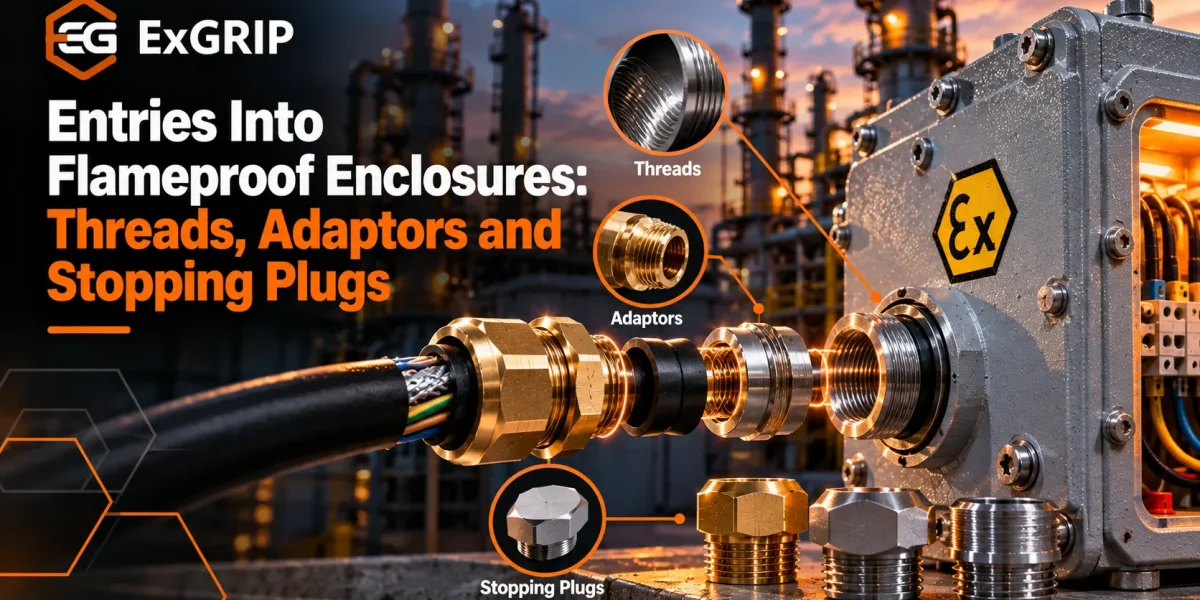
A flameproof enclosure is certified as a complete assembly, and the entries are part of that assembly. Fit the right gland the wrong way into the wrong entry and the certification is no longer valid, whatever the paperwork in the file says. Most of the time nothing visible happens, which is exactly why entry faults survive from commissioning right through to the first audit.
The rules around threads, adaptors and unused openings are short, specific and absolute. They are also the rules most often broken on site, usually with good intentions: a second adaptor to make a thread fit, a plastic plug because the metal one has not arrived, a hole drilled on site because the cable schedule changed. This guide sets out what is permitted at a flameproof entry, what is not, and the checks worth running before equipment is energised.
Key points
- Threaded parts at a flameproof entry must engage at least five full threads, because the threads form part of the flamepath.
- Only one certified thread adaptor is allowed per entry, and it must engage five full threads in its own right.
- Unused entries are closed with a certified metal stopping plug. Plastic plugs and improvised blanks are never acceptable.
- Clearance entries, site drilling and combining a blanking element with an adaptor are all prohibited.
The Entry Is Part of the Flamepath
Flameproof protection, Ex d, does not prevent an explosion inside the enclosure. It contains one. If a flammable mixture finds its way inside and ignites, the enclosure holds the pressure and cools the escaping gases below the ignition temperature of the surrounding atmosphere as they pass through the narrow gaps in the joints.
Those gaps are the flamepaths, and they are engineered. A machined flange joint, a spigot joint and a threaded entry are all flamepaths, each with a defined length and tolerance. The threads at a cable entry are not a convenient way to hold the gland on. They are doing the same job as the machined faces of the lid.
Once that is understood, the rules stop looking bureaucratic. Every one of them protects either the length of the flamepath or the gap across it.
The Five Full Thread Rule
Threaded parts entering a flameproof enclosure must engage at least five full threads. Not five turns, not five threads counted on the male part before it goes in, but five fully formed threads in engagement once the assembly is tight.
Older standards called for six, which gave a margin for thread undercut and run-out at the start of the thread form. That history is useful: it explains why five is a floor rather than a target, and why experienced inspectors look for more than the bare minimum when the entry allows it.
How Engagement Gets Lost
Nobody sets out to leave three threads engaged. It happens through a sequence of small, reasonable decisions.
- The wrong thread length is orderedA gland with a short entry thread will bottom out or tighten before five threads are in engagement.
- A washer stack builds upEach washer added under the entry consumes thread length that was meant for engagement.
- An adaptor is used to bridge a mismatchAn adaptor is permitted, but it introduces a second threaded joint that must itself meet the rule.
- The gland is backed off to orient itUnscrewing a fraction of a turn to point a cable in a better direction is common and quietly reduces engagement.
Alignment matters as much as depth. The entry must sit perpendicular to the enclosure face. A gland pulled over at an angle shortens the effective flamepath on one side of the thread while the other side still looks fully engaged, which is why a visual check from one angle can pass an entry that would fail a measurement.
Matching Thread Forms and Sizes
The thread form, pitch and tolerance class of the entry and the device have to match, because the two together form the flamepath. Metric, NPT and PG are not interchangeable, and a near fit is worse than an obvious mismatch because it will assemble.
Metric entries are the default on IEC certified equipment and are specified by diameter and pitch, for example M20 x 1.5. NPT threads are tapered and common on equipment of North American origin, which still appears regularly on Indian refinery and petrochemical projects supplied through international EPCs. PG threads survive on older European equipment.
Swipe to see the full table
| Thread | Where you meet it | Notes for Ex d entries |
|---|---|---|
| Metric | IEC certified equipment, most current projects | Parallel. Specify diameter and pitch together, as M20 x 1.5 |
| NPT | Equipment of North American origin | Tapered. Never mix with a parallel entry of similar size |
| PG | Older European equipment | Being replaced by metric. Needs a certified adaptor to interface |
Where a project inherits mixed equipment, the cleanest answer is to standardise the entries at design stage and order glands to suit, rather than resolving it on site with whatever is in the container. Our note on reading a cable gland size chart covers how entry thread sits alongside size and material in that decision.
Thread Adaptors: One Per Entry
When the equipment entry thread and the gland thread differ, a flameproof thread adaptor is the correct solution. The conditions attached to it are strict.
One adaptor only
A maximum of one adaptor per entry. Stacking two to bridge a larger mismatch is not permitted, however neat it looks.
Component certified
The adaptor must be a certified Ex component in its own right, with its markings available for inspection.
Five threads, twice
The adaptor must engage five full threads in the enclosure, and the gland must engage five full threads in the adaptor.
Never with a blank
A blanking element must not be fitted to an adaptor. Close an unused entry at the enclosure itself.
Direction matters too. A reducer brings a larger entry down to a smaller gland thread; an enlarger does the reverse. Both change the load path and the flamepath, so both are certified items rather than machine shop parts.
Angle adaptors solve a different problem. Where a cable has to leave an enclosure in a fixed direction, or where there is no room for the cable to bend after the gland, a 90 degree adaptor keeps the bend radius sensible without stressing the entry. A dual entry adaptor lets two cables enter through a single certified opening where the enclosure has run out of entries, which is a far better answer than drilling another hole.
Swipe to see the full table
| Fitting | Code | Use | Rating |
|---|---|---|---|
| Reducers and Adapters | RED & ADP | Bridging a thread size or form mismatch at the entry | Ex db / Ex eb / Ex ta |
| 90 Degree Adapter | 90°ADP | Turning the cable at the entry where space is tight | Ex db / Ex eb / Ex ta |
| Dual Entry Y Adapter | YADP | Two cables through one certified entry | Ex db / Ex eb / Ex ta |
Closing Unused Entries
An open entry on Ex equipment is one of the few findings that takes the equipment out of service immediately. The enclosure is no longer an enclosure.
Unused openings are closed with a certified flameproof metal stopping plug of the correct thread size, engaging at least five full threads, with its certification details visible for inspection. A plug is not a consumable to be grabbed from a general stores bin.
Hex head plug
Code PLG. Tightened with a spanner, which makes torque easy to apply and the fitting easy to inspect. Rated IP66, IP67 and IP68.
Dome and Allen key plug
Code PLD. A lower profile where clearance around the enclosure is limited, with the same protection levels.
Not acceptable
Plastic plugs, tape, sealant, bolts, and anything without a certificate. None of these maintain a flamepath.
Both Exgrip plug types are PESO certified alongside their Ex db, Ex eb and Ex ta markings, which matters on Indian sites where the PESO approval is checked separately from the international certificates. You can see the full range on our explosion proof fittings page.
What Is Never Permitted
Clearance entries
A plain drilled hole with a nut is not a flameproof entry. There is no flamepath in a clearance hole.
Site drilling or tapping
Entries are made by the enclosure manufacturer or its approved agent. A new hole changes a certified design.
More entries than certified
Exceeding the number or size of entries in the original design weakens the enclosure that has to contain the explosion.
Two adaptors in series
One certified adaptor per entry is the limit, regardless of how large the mismatch is.
Plastic stoppers
They cannot maintain a flamepath and they fail at the temperatures a flameproof enclosure can reach.
Blanks on adaptors
A blanking element combined with a thread adaptor is specifically excluded.
Entry Checklist Before Energising
- Count the entries against the certificateNumber and size as originally certified, with no additions.
- Confirm every thread form and sizeEntry and device matched for form, diameter and pitch, with no near fits.
- Check engagement on every entryAt least five full threads, with the device square to the face.
- Account for each adaptorOne per entry, component certified, markings legible.
- Close every unused openingCertified metal stopping plug of the correct size, properly tightened.
- Record what is fittedPart numbers and certificate references against each entry, so the first periodic inspection starts from a known baseline.
That last step is the one most often skipped and the one that pays back the most. An inspector who can see what was originally fitted spends the visit checking condition. An inspector who cannot spends it reconstructing history.
For the faults that appear after commissioning rather than during it, our guide to cable gland failure scenarios covers the sealing and clamping side of the same problem.
Conclusion & Call-to-Action
Flameproof entries fail compliance for ordinary reasons: a thread that does not match, an adaptor too many, an opening closed with the wrong thing. None of them require a deep reading of the standards to avoid. They require the entry schedule to be right before the equipment reaches site, and five minutes of checking before it is energised.
Get the entries right and the enclosure does its job for its full service life. Get them wrong and the certification on the file is describing something that no longer exists.
Send us your entry schedule
List the enclosure entry threads, the cable types and the number of spare entries, and our team will come back with the gland, adaptor and stopping plug part numbers for each one, certified Ex db, Ex eb and Ex ta and available PESO certified for Indian sites.
📩 Talk to our technical team at Exgrip.com
📞 Phone: +91 9537118899
🌐 Website: www.exgrip.com
📩 Request a Quote: Contact Page
FAQs
How many threads must engage on a flameproof cable entry?
At least five full threads must be in engagement once the device is tight. Older standards required six, which is why experienced installers treat five as a minimum rather than a target. The threads form part of the flamepath, so engagement is a safety dimension rather than a mechanical preference.
Can I use two thread adaptors to fit a gland?
No. A maximum of one certified thread adaptor is permitted per entry. Both joints must meet the five full thread rule, so the adaptor engages five threads in the enclosure and the gland engages five threads in the adaptor. If one adaptor cannot bridge the mismatch, the gland or the entry is wrong.
What can be used to close an unused entry on Ex d equipment?
A certified flameproof metal stopping plug of the correct thread size, engaging at least five full threads, with its certification markings visible. Plastic plugs, bolts, tape and sealant are not acceptable. An open unused entry is a finding that removes equipment from service immediately.
Can a hole be drilled on site for an extra cable entry?
No. Entries are drilled and tapped by the enclosure manufacturer or its approved agent, because a new hole changes a certified design and can weaken the enclosure that has to contain an explosion. Where an extra cable is needed, a certified dual entry adapter through an existing opening is the correct route.
Are metric, NPT and PG threads interchangeable?
No. The thread form, pitch and tolerance of the entry and the device must match, because together they form the flamepath. NPT is tapered while metric and PG are parallel. A near fit is the dangerous case, because it assembles and looks correct. Use a certified adaptor instead.
Does a stopping plug need PESO approval in India?
For hazardous area use on Indian sites, the fittings are checked for PESO approval alongside their Ex markings. Exgrip hex head and dome type stopping plugs are PESO certified and carry Ex db, Ex eb and Ex ta markings with IP66, IP67 and IP68 protection.