
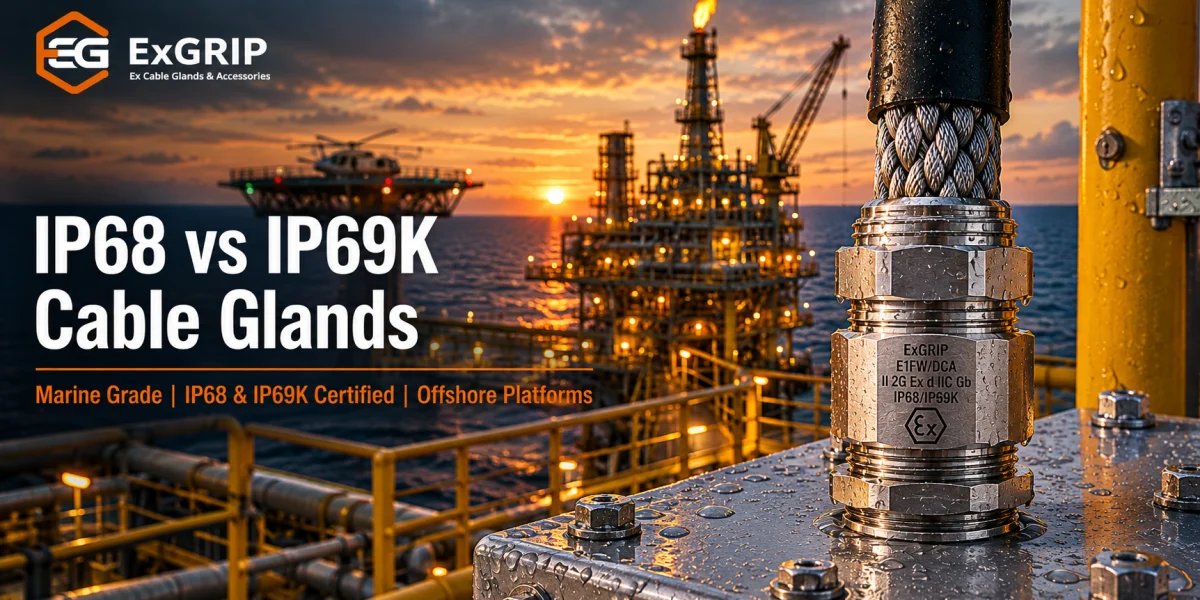
A cable gland rated IP68 passed its immersion test, holds its certificate, and still fails within a year of service on an offshore platform not from submersion, but from the twice-weekly high-pressure freshwater washdown used to strip salt buildup off deck equipment. IP68 was never tested against that specific stress. IP69K was, and most offshore platform specifications don’t distinguish between the two until a gland has already failed.
Offshore platform electrical installations face a narrower, more specific set of conditions than general marine exposure routine high-pressure, high-temperature washdown being the one IP68 alone doesn’t answer for. This guide breaks down what IP68 and IP69K actually test, where IP67 fits below both, where each rating matters on a platform and where it doesn’t, the thread-size and material choices that go alongside the rating decision, and how it all fits with the certification requirements that already apply to offshore hazardous area installations.
IP68 vs IP69K: What Actually Changes Between Them
IP68 and IP69K are frequently treated as a simple ladder IP69K assumed to be “IP68 plus more” but they test for genuinely different failure modes. Knowing which test each rating actually runs is what determines whether a platform specification needs one, both, or a mix across zones.
What IP68 Testing Actually Certifies?
IP68 testing covers dust ingress (the “6” full protection against dust) and continuous or prolonged immersion in static or slow-moving water (the “8”), typically at a manufacturer-specified depth for a specified duration, commonly around 1 metre for extended periods in cable gland testing. It answers a single question: what happens if this enclosure ends up underwater. It says nothing about pressure, temperature, or directional jet impact, because none of those are part of the IP68 test method.
What IP69K Testing Actually Certifies?
IP69K testing is a different exercise entirely. It subjects the enclosure to high-pressure (80–100 bar), high-temperature (up to 80°C) water jets from multiple angles at close range 10 to 15 cm for a fixed cycle, simulating steam-jet or high-pressure washdown cleaning. That’s the exact process used to strip salt and grime off offshore deck equipment on a routine cleaning schedule. IP69K does not certify depth immersion at all; a gland can be fully IP69K-rated and still not carry a formal immersion depth rating, which is why platforms that face both submersion risk and washdown need both ratings specified, not one in place of the other.
| Test Condition | IP68 | IP69K |
|---|---|---|
| Dust ingress | Fully protected | Fully protected |
| Static/prolonged immersion | Protected, per depth/duration spec | Not the primary test IP69K doesn’t certify depth immersion |
| High-pressure water jet (80–100 bar) | Not tested | Protected |
| High-temperature jet (up to 80°C) | Not tested | Protected |
| Close-range directional spray (10–15 cm) | Not tested | Protected, from multiple angles |
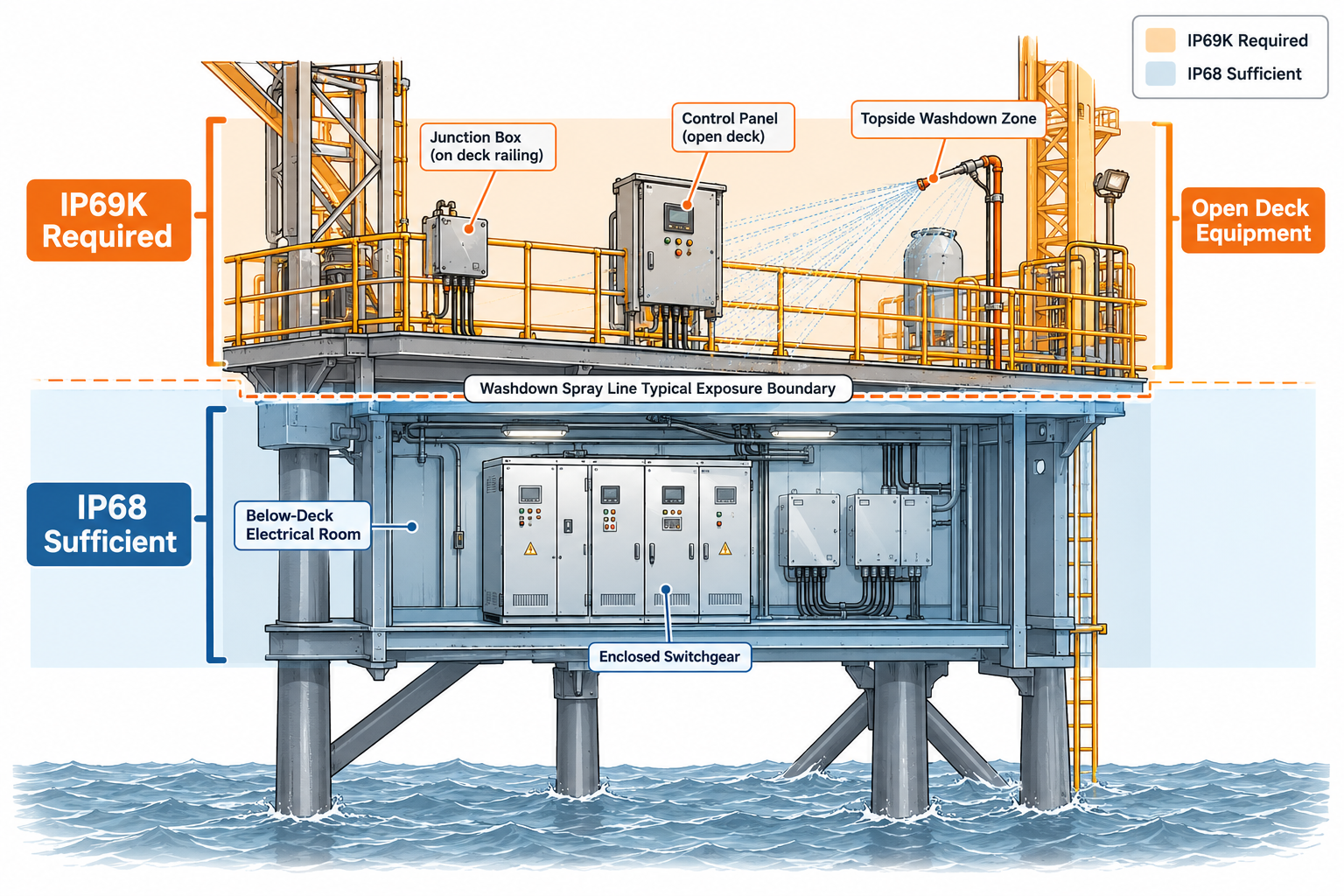
| Typical offshore use case | Below-deck, enclosed, non-washdown areas | Open deck, washdown zones, topside equipment |
Where the Line Falls on a Real Platform?
The practical distinction: IP68 answers “what happens if this gets submerged,” and IP69K answers “what happens when this gets blasted with hot, high-pressure water at close range.” A platform installation can need one, both, or neither depending on where the gland actually sits treating IP69K as an automatic upgrade over IP68 misunderstands what the second rating is actually certifying. A gland can be IP68-rated without being IP69K-rated, IP69K-rated without a formal depth-immersion rating, or both offshore projects that face genuine submersion risk in a washdown-exposed zone need to confirm both ratings are certified together, not assume one implies the other.
Where IP67 Fits Below Both Ratings?
IP67 shows up on some general-purpose cable gland datasheets and is sometimes confused with IP68 during early-stage specification, so it’s worth placing on the same ladder. IP67 certifies protection against temporary immersion typically up to 1 metre for up to 30 minutes rather than the continuous or prolonged immersion IP68 covers. On an offshore platform, that difference matters: IP67 fits equipment in occasionally wet but not submerged locations, while IP68 and IP69K are the two ratings that actually apply to the sustained water exposure and washdown conditions platform equipment sees.
| Rating | Immersion Test | Duration/Pressure | Suited To |
|---|---|---|---|
| IP67 | Temporary immersion | Up to 1 m, up to 30 minutes | Occasionally wet, non-submerged, non-washdown areas |
| IP68 | Continuous/prolonged immersion | Manufacturer-specified depth and duration | Below-deck, enclosed, or submersion-risk locations |
| IP69K | High-pressure, high-temperature jet spray | 80–100 bar, up to 80°C, close range | Open-deck, topside, routine washdown zones |
IP67-rated glands are rarely the right specification for offshore platform work once a project is past the general-purpose stage most offshore process, wellhead, and utility platforms have enough sustained water and washdown exposure that IP68 or IP69K (or both, by zone) is the realistic minimum.
Why Offshore Platforms Specifically Raise This Question?
Routine washdown is a standard maintenance practice on offshore installations, not an occasional event. Salt deposits accelerate corrosion and interfere with equipment operation, so platforms typically run scheduled freshwater or high-pressure washdown cycles on exposed deck equipment sometimes multiple times per week depending on the platform’s location and weather exposure. That’s a materially different exposure pattern than an onshore installation sees, and it’s the specific reason offshore platform specifications increasingly separate IP68 and IP69K as distinct line items rather than assuming one covers the other.
A few conditions specific to offshore platforms are what push this from a theoretical distinction to a practical specification issue:
- Scheduled high-pressure freshwater washdown on exposed deck equipment, often multiple times per week
- Salt-laden sea spray reaching equipment well above the waterline in rough weather, independent of scheduled washdown
- Equipment relocation during retrofit or brownfield projects, moving gear into zones it wasn’t originally specified for
- Mixed procurement across project phases, where topside and below-deck equipment are sourced and specified separately and the zone boundary gets lost between them
The gap shows up most often in retrofit and refurbishment projects. A junction box originally specified for general marine exposure (IP68) in an enclosed area gets relocated to an open-deck position during a platform upgrade, without the ingress specification being revisited to match its new washdown exposure. The gland still carries a valid IP68 certificate it was simply never tested against the condition it’s now facing, and the failure that eventually shows up reads as a product defect when it’s actually a specification gap from the relocation.
A Typical Retrofit Failure Pattern
A platform’s control panel junction box is originally installed in an enclosed below-deck utility room and specified IP68, correctly, for that location. A later deck reconfiguration moves the utility room’s function to an open-air platform extension to free up below-deck space the junction box goes with it, mounted on the new open-deck structure, now sitting directly on the washdown crew’s weekly cleaning route. Nobody revisits the ingress specification during the move, because the gland’s certificate is still valid and the relocation is logged as a mechanical change, not an electrical specification change. Within a few washdown cycles, water finds its way past a seal that was never tested against 80-100 bar directional spray, and the resulting fault gets diagnosed as a component defect rather than what it actually is: a specification that stopped matching its environment the moment the equipment moved.
Where IP68 Is Still Sufficient on an Offshore Installation?
Not every gland on a platform needs IP69K. Specifying it across an entire installation by default adds cost without addressing a stress certain locations never actually experience. Locations where IP68 typically remains the correct specification include:
- Below-deck electrical rooms and enclosed switchgear areas, sheltered from direct spray paths
- Instrumentation and control panels mounted inside weatherproof enclosures away from washdown lines
- Cable entries on equipment positioned behind structural barriers or bulkheads relative to the washdown route
- General marine humidity and occasional splash zones that don’t sit on a scheduled washdown path
These conditions are exactly what IP68 was tested for continuous exposure to humidity and occasional splash, not directional high-pressure jets. The specification decision comes down to mapping the physical washdown route on a platform, not defaulting every gland on the structure to the higher rating.
SS316L and the Washdown Environment
Material and ingress rating are independent specifications, and washdown conditions put a specific demand on material that general saltwater exposure doesn’t: repeated thermal cycling from hot-water washdown followed by cooling, combined with the same chloride exposure covered in Exgrip’s existing marine corrosion-resistance content. SS316L’s composition addresses both mechanisms:
- Molybdenum content (typically 2–3%) that standard 304-grade stainless lacks, specifically improving resistance to chloride pitting and crevice corrosion
- Chromium-nickel matrix that maintains a stable passive oxide layer even after repeated thermal cycling at a gland’s seal and joint interfaces
- Low carbon content (“L” grade) that reduces the risk of carbide precipitation at welds and threaded joints exposed to repeated heating
- Proven multi-year service life in washdown-cycled marine and offshore installations, where standard 304-grade parts show pitting and joint degradation considerably earlier
This is a narrower, washdown-specific angle on material selection than a general marine corrosion discussion for the broader material comparison across marine and coastal applications generally, see Exgrip’s guide on Marine & Offshore Cable Glands Selection Guide for Corrosion-Resistant Installations.
Certification for Offshore Hazardous Zones
Offshore platforms handling petroleum or gas are frequently classified hazardous areas, which means the ingress rating conversation sits alongside, not instead of, hazardous area certification. None of the three frameworks below change based on IP68 or IP69K rating a gland can carry any combination of hazardous area certification and either ingress rating, since they certify different things entirely.
ATEX for European-Origin FEED Specifications
ATEX certification (Ex db, Ex eb, Ex ta protection concepts) applies where a project’s front-end engineering design originates from a European framework, common on multi-national offshore EPC contracts.
IECEx for Multi-Country Offshore Projects
IECEx is the international mutual-recognition scheme, used where a platform project spans multiple jurisdictions and a single certification needs to be accepted across all of them without re-testing per country.
PESO for Indian Petroleum and Gas Jurisdiction
PESO approval applies where the installation falls under Indian Petroleum and Explosives Safety Organisation jurisdiction the standard requirement for offshore platforms operating in Indian waters or supplied to Indian PSU operators.
For the complete breakdown of what each hazardous area certification framework actually requires including IS 2148 for Indian PSU vendor qualification see Exgrip’s guide on PESO Approved Cable Glands: India Compliance Guide. If the installation falls within a classified Zone 1 or Zone 2 area, which most offshore process and wellhead platforms do, Flameproof Cable Glands for Hazardous Areas in India covers Ex d selection criteria specifically.
Why Exgrip for Offshore Platform Installations?
Product Ranges: E1FW and DCAB in SS316L
Exgrip manufactures its E1FW and DCAB double compression ranges in SS316L stainless steel from the Jamnagar facility, with IP68 and IP69K variants available on the same product lines allowing a single platform project to specify by zone (washdown-exposed topside equipment versus enclosed below-deck installations) without switching suppliers or product families between them.
Thread Sizing for Offshore Spec Sheets
Offshore junction box and enclosure entries most commonly specify M20 or M25 metric threads, and Exgrip’s E1FW and DCAB ranges are available across the standard metric thread sizes offshore spec sheets call for, in both IP68 and IP69K variants. Getting the thread size wrong at the specification stage is a separate, avoidable failure mode from getting the ingress rating wrong confirming both against the actual enclosure entry and the zone’s washdown exposure at the same time avoids a second round of respecification later in the project.
One Certified Source for Zone and Washdown Requirements
The same ranges carry ATEX, IECEx, and PESO certification, so a project specifying both hazardous area compliance and washdown-rated ingress protection can source the full combination material, thread size, ingress rating, and hazardous area certification from one certified manufacturer rather than reconciling documentation across two or more vendors.
For the full certified range built for marine and offshore conditions, see Exgrip’s Marine & Offshore Industry page, which covers material selection across ship electrical panels, control systems, coastal facilities, and deck equipment.
Conclusion & Call-to-Action
IP68 and IP69K answer two different questions, and an offshore platform specification that only asks one of them is leaving a real failure mode unaddressed. The fix isn’t defaulting every gland to the higher rating it’s mapping washdown exposure zone by zone and specifying accordingly, the same way material selection already gets mapped to corrosion risk and thread size gets matched to the actual enclosure entry.
Exgrip’s technical team can help project engineers work through this zone mapping as part of standard offshore project support, alongside the hazardous area certification review most platform installations already require.
📩 Talk to our technical team today at Exgrip.com
📞 Or call us directly for quick assistance!
Contact Us:
📞 Phone: +91 9537118899
🌐 Website: www.exgrip.com
📩 Request a Quote: Contact Page
FAQs
Is IP69K always better than IP68 for offshore cable glands?
Not better, just different. IP69K certifies resistance to high-pressure, high-temperature washdown spray, which IP68 doesn’t test for, but IP68 already covers static and prolonged immersion adequately in non-washdown areas. The right choice depends on whether the installation location faces routine washdown.
What does IP69K testing actually involve?
IP69K subjects the enclosure to water jets at 80–100 bar pressure and up to 80°C temperature, sprayed from multiple close-range angles (10–15 cm), simulating steam-jet or high-pressure washdown cleaning. It’s a fundamentally different stress test than IP68’s immersion testing.
How does IP67 differ from IP68 and IP69K?
IP67 certifies only temporary immersion typically up to 1 metre for up to 30 minutes rather than the continuous or prolonged immersion IP68 covers, and it isn’t tested against washdown-style jet spray at all. On offshore platforms, IP67 fits occasionally wet locations that never see sustained submersion or washdown; IP68 and IP69K are the two ratings that actually apply to platform deck and below-deck conditions.
Do all glands on an offshore platform need IP69K?
No. Below-deck electrical rooms and enclosed switchgear areas away from washdown spray paths typically see conditions IP68 already covers. IP69K matters specifically for open-deck and topside equipment exposed to routine washdown cycles.
Does IP69K rating affect hazardous area certification?
No. Ingress rating and hazardous area certification (ATEX, IECEx, PESO) are independent specifications. A gland can carry any combination of hazardous area certification alongside either IP68 or IP69K, since they certify different things.
Are Exgrip's offshore cable glands ATEX, IECEx, and PESO certified?
Yes. Exgrip’s E1FW and DCAB double compression ranges carry ATEX, IECEx, and PESO certification, available in both IP68 and IP69K variants, so hazardous area compliance and washdown-rated ingress protection can be sourced from a single certified manufacturer.