
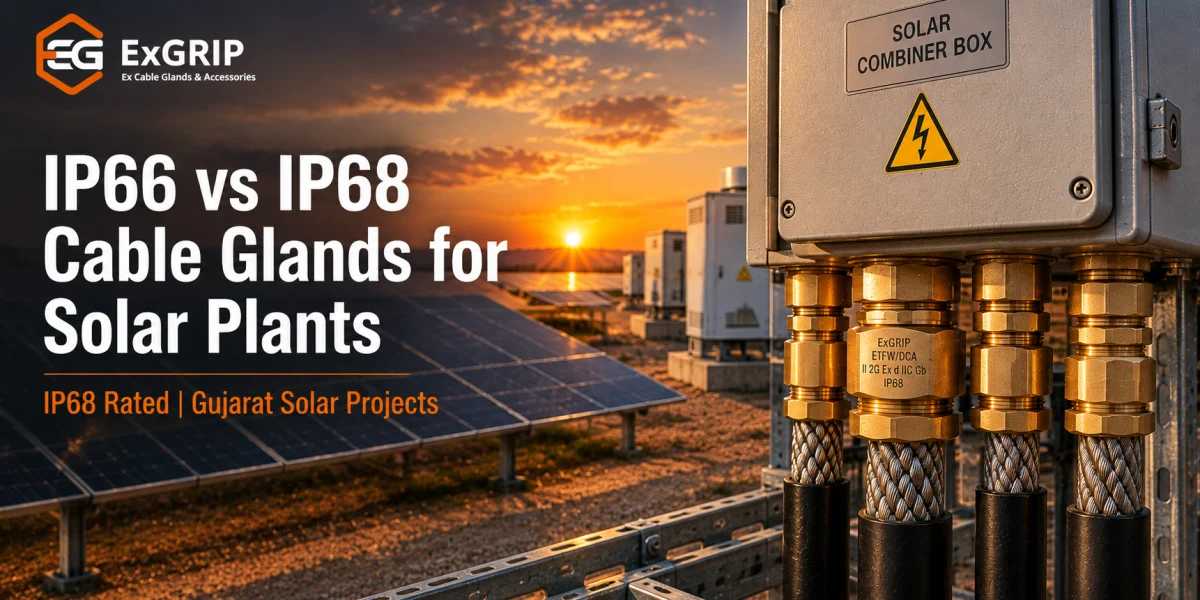
An inverter tripping offline three weeks after commissioning, with moisture found inside the gland entry point, is one of the more expensive lessons a solar EPC contractor can learn on a live project. The cable gland tested fine on paper IP66 rated, dust-tight, rated against powerful water jets and it still let condensation build up inside an inverter enclosure that never sees direct spray in the first place. The failure wasn’t the rating. It was specifying the wrong rating for what that installation actually experiences.
Every solar power plant procurement list runs into this question sooner or later: does a rooftop array need the same cable gland rating as a ground-mounted utility-scale site, or an inverter room? The honest answer is no, and treating IP66 and IP68 as a simple “better safe than sorry, always go higher” decision either overspends on rooftop installations or, worse, under-protects the installations that actually need IP68.
IP66 vs IP68 : What the Numbers Actually Mean for a Solar Site
Both ratings guarantee full dust protection the first digit, 6, is identical across IP66 and IP68 and means the gland is completely sealed against dust ingress. The difference sits entirely in the second digit. IP66 protects against powerful water jets from any direction, which covers wind-driven rain, monsoon downpours, and pressure washing during maintenance. IP68 goes further: it’s rated for continuous or prolonged immersion beyond one metre, a condition a properly installed solar gland should realistically never face, since these installations are not submerged equipment.
| Test Condition | IP66 | IP68 |
|---|---|---|
| Dust ingress | Fully protected | Fully protected |
| Powerful water jets (any direction) | Protected | Protected |
| Temporary immersion (up to 1m) | Not rated | Protected |
| Continuous/prolonged immersion | Not rated | Protected, per manufacturer depth/duration spec |
| Typical solar use case | Rooftop arrays, inverter rooms, dry enclosures | Ground-mount junction points, flood-prone sites, coastal humidity |
The practical takeaway: IP68 isn’t “IP66 plus extra margin.” It’s a specific answer to a specific exposure condition sustained or repeated contact with standing water that most solar installations don’t actually have, even in a heavy Gujarat monsoon.
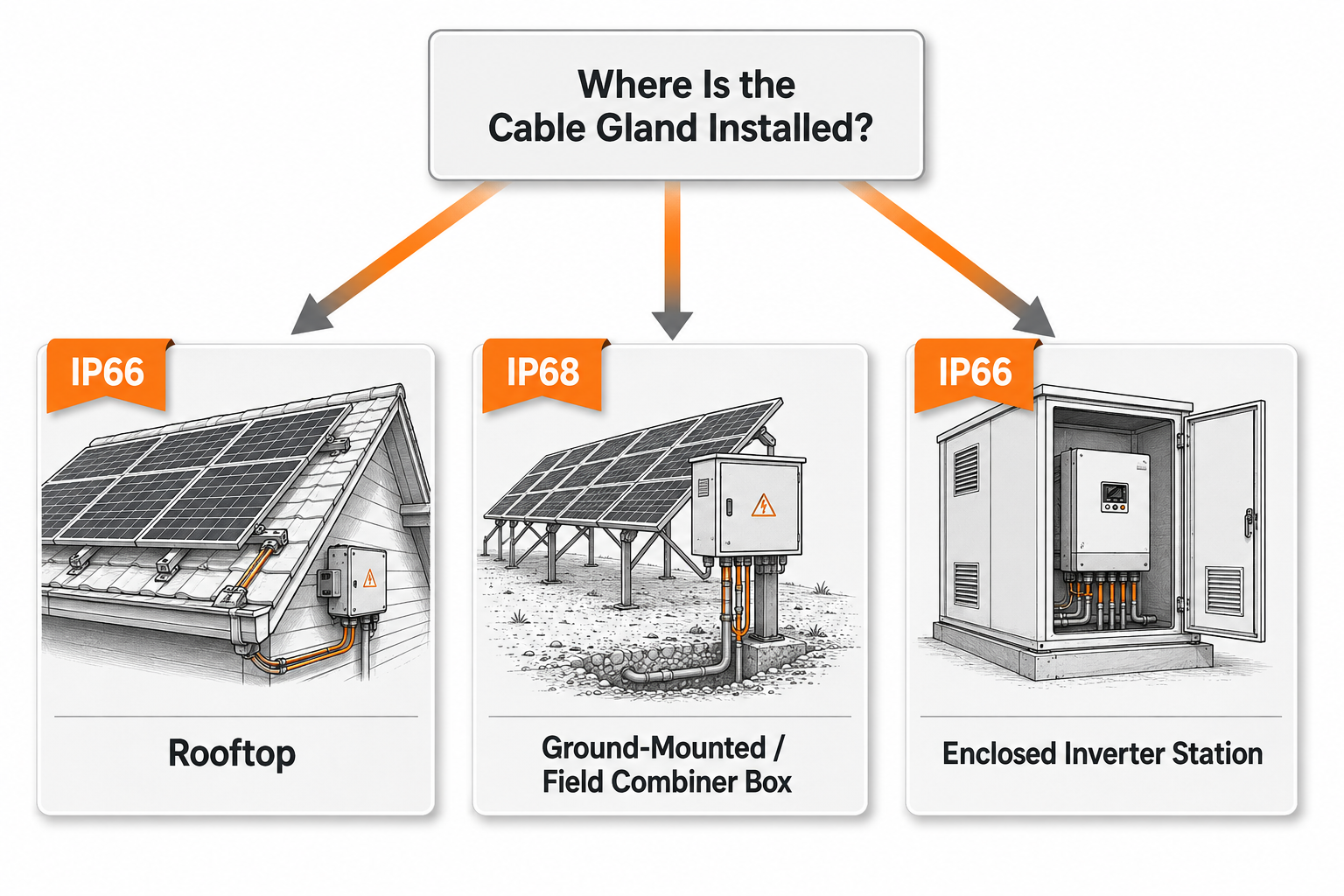
Rooftop Solar Installations: Where IP66 Is Often Sufficient
Rooftop arrays sit above ground level, drain quickly, and rarely accumulate standing water around the junction boxes and cable entry points, even during heavy rain. For rooftop cable gland selection, IP66 typically covers the actual exposure conditions wind-driven rain, splash, and dust without paying for immersion protection the installation will never need. Over-specifying every rooftop gland to IP68 as a default adds cost across potentially thousands of termination points on a commercial rooftop project without a corresponding reduction in failure risk.
The exception worth flagging: rooftop installations with poor drainage design, or panels mounted low enough that pooling water can realistically reach the junction box during extreme rainfall, should be treated as ground-mount-equivalent for gland selection purposes rather than defaulting to the rooftop standard.
Ground-Mounted and Utility-Scale Solar: Why IP68 Is the Default
Ground-mounted string combiner boxes and junction points typically sit 300-600mm above grade on their mounting structure high enough to avoid routine puddling, but well within reach of standing water on sites with clay-heavy soil or inadequate drainage grading, where monsoon runoff can pool for days rather than draining within hours. Three site conditions push the exposure risk from “occasional splash” into genuine standing-water territory:
- Clay or low-permeability soil: common across parts of Gujarat’s solar belt, where water can take 24-48 hours longer to drain than it would on sandy or well-graded ground, extending the window during which a low-mounted junction box sits in contact with water.
- Poor site grading at handover: EPC contractors under schedule pressure sometimes finish grading after panel installation rather than before, leaving low points that weren’t visible on the original site survey.
- Row-end and perimeter positions: combiner boxes at the low end of a sloped array field collect runoff from every row above them, seeing more sustained water contact than boxes positioned mid-field.
Enclosed Inverter Stations: A Different Ingress Problem
Centralized inverter stations on utility-scale sites the walk-in or prefab enclosures housing the main inverters, not the field-mounted combiner boxes covered above face a failure mechanism that has nothing to do with external water contact. A sealed enclosure heats up during the day and cools overnight, and if the internal air temperature drops below its dew point during that cycle, moisture condenses directly onto the coolest internal surfaces, including cable gland entry points, regardless of how well-sealed the enclosure is against outside weather.
An IP68 gland doesn’t solve this, because the moisture source is inside the enclosure, not outside it no ingress rating stops condensation that’s already formed on the inside of the seal. For enclosed inverter stations, IP66 is usually adequate for the gland itself, and the specification questions that actually matter are enclosure ventilation, breather vents, and desiccant plugs sized to the enclosure’s internal air volume. Field-mounted combiner boxes remain a separate case as covered above, those sit outdoors at grade and follow the same IP68 logic as other ground-mounted equipment, not this indoor condensation scenario.
UV Resistance and Dust The Half of the Spec Sheet IP Rating Doesn't Cover
An IP68 rating is measured once, at the factory, on a new gland. It says nothing about what happens to that same gland’s seal after ten years of direct sun on an outdoor solar site with a 15-25 year design life. The specific failure mechanism is UV-driven degradation of the elastomer sealing gasket, and different gasket materials age very differently under sustained sunlight:
| Gasket Material | UV Degradation Pattern | Typical Outdoor Service Life |
|---|---|---|
| Standard nitrile (NBR) | Surface cracking and hardening (chalking) under sustained UV, seal loses compression set | Shorter better suited to indoor/shaded use |
| EPDM | Strong UV and ozone resistance, minimal cracking over extended outdoor exposure | Longer standard choice for outdoor solar gaskets |
| Silicone | Excellent UV stability, wider temperature tolerance, but softer and more susceptible to mechanical wear | Longer used where temperature swing is the bigger factor |
A gasket that chalks and cracks under UV doesn’t fail the way a burst pipe fails it loses compression set gradually, so the gland can pass a visual inspection while its actual ingress protection has already dropped below its rated IP number. That’s a materially different failure mode from the water-ingress scenarios covered earlier in this guide, which is why gasket material selection deserves its own line item on a solar procurement datasheet rather than being assumed to come bundled with the IP rating.
Dust behaves differently again. IP testing verifies that dust can’t get in it doesn’t address dust settling and compacting on external threads and gland bodies over years of unattended outdoor operation, which is a real maintenance factor on dry, low-rainfall ground-mount sites across Gujarat’s solar belt. Compacted dust on external threads can make future maintenance disassembly harder and, in marginal cases, abrade external seals during periodic re-torquing a mechanical wear issue distinct from the ingress question the IP number answers.
Why Exgrip for Solar EPC Projects
Exgrip manufactures its A2F (unarmoured, industrial-grade) and E1FW (armoured, flameproof-rated) cable gland ranges in both IP66 and IP68 variants, in brass and nickel-plated brass, from the Jamnagar facility allowing a single EPC project to specify different ratings by installation zone (rooftop, ground-mount, inverter room) without switching suppliers between them. Double compression glands from the E1FW/DCA range are also available for armoured cable terminations on utility-scale ground-mount sites where cable protection matters as much as ingress rating.
On the compliance side, Exgrip’s cable gland range is RoHS compliant, restricting hazardous substances like lead, cadmium, and mercury in the materials used, and REACH compliant under EU chemical safety regulation both of which commonly appear on procurement checklists for solar EPC projects with international financing or export-linked components. Hazardous-area certification (ATEX, IECEx, PESO) isn’t a requirement for standard solar generation sites, since these installations aren’t classified explosive atmospheres. If your project includes battery energy storage in a classified zone, that’s covered separately in our guide on Cable Gland Selection for Battery Energy Storage Systems (BESS) rather than in this comparison.
Conclusion & Call-to-Action
The IP66-versus-IP68 decision for a solar project isn’t a single site-wide specification it’s a zone-by-zone assessment that pays for itself twice over: once in avoiding the failure of an under-specified gland in a genuinely wet location, and again in avoiding the wasted cost of over-specifying thousands of rooftop terminations to a rating they’ll never need.
Documenting the rating by installation zone at the specification stage, rather than defaulting to one blanket choice across the project, is a small amount of engineering time that avoids both outcomes. Exgrip’s technical team can help EPC contractors map installation zones to the correct IP rating and material combination as part of standard project support.
📩 Talk to our technical team today at Exgrip.com
📞 Or call us directly for quick assistance!
Contact Us:
📞 Phone: +91 9537118899
🌐 Website: www.exgrip.com
📩 Request a Quote: Contact Page
FAQs
Is IP68 always better than IP66 for solar cable glands?
Not necessarily better, just different. IP68 adds immersion protection that most rooftop and inverter room installations never need, while IP66 already covers dust and powerful water jet exposure. The right choice depends on whether the installation location can realistically face standing water.
Do rooftop solar installations need IP68 cable glands?
Usually not. Rooftop arrays drain quickly and rarely accumulate standing water at junction points, so IP66 typically covers the actual exposure conditions. Poor-drainage rooftop designs are the main exception worth treating as IP68-equivalent.
What IP rating is recommended for ground-mounted or utility-scale solar plants?
IP68 is the safer default for ground-mounted and utility-scale installations, since combiner boxes and junction points sit closer to grade and are more exposed to monsoon flooding and standing water than rooftop equivalents.
Does a cable gland's IP rating cover UV resistance?
No. IP testing certifies dust and water ingress resistance only, not how the seal material holds up after years of UV exposure. For outdoor solar installations with a 15-25 year service life, gasket material UV resistance needs separate consideration alongside the IP number.
Do solar cable glands need ATEX or PESO certification?
No, not for standard solar generation sites, since these are not classified explosive atmospheres. ATEX, IECEx, and PESO certification become relevant only if the project includes battery storage or another application in a classified hazardous zone.
Are Exgrip's solar cable glands RoHS and REACH compliant?
Yes. Exgrip’s cable gland range is both RoHS compliant, restricting hazardous substances in materials, and REACH compliant under EU chemical safety regulation both commonly required on solar EPC procurement checklists with international financing.
What's the difference between glands for enclosed inverter stations versus outdoor combiner boxes?
Enclosed inverter stations face condensation from internal day-night temperature cycling rather than direct water exposure, so IP66 is usually adequate there, with enclosure ventilation and desiccant use mattering more than gland rating alone. Outdoor field-mounted combiner boxes face direct water exposure at grade and follow the same IP68 logic as other ground-mounted equipment.