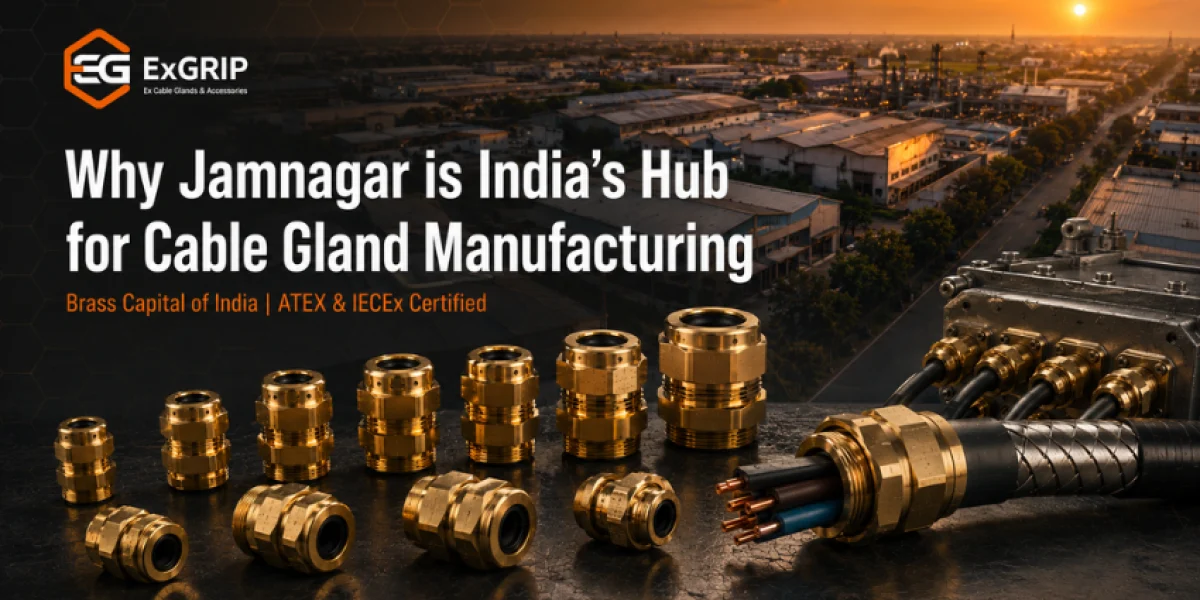
India’s cable gland industry has a clear heartbeat and it beats in Jamnagar, Gujarat. Known internationally as the brass capital of India, Jamnagar has evolved over decades into the country’s most concentrated hub for the design, precision machining, and export of industrial cable glands. Engineers and procurement managers across the oil and gas, solar, marine, and chemical sectors consistently source their brass cable gland requirements from Gujarat-based manufacturers, drawn by the region’s unmatched combination of raw material access, skilled engineering labour, and competitive pricing that no other Indian manufacturing cluster can replicate.
At the centre of this manufacturing ecosystem stands Exgrip a Jamnagar-based cable gland manufacturer producing a comprehensive range of single compression and double compression cable glands certified to ATEX, IECEx, and PESO standards. From small instrumentation cables through to large SWA armoured power cables in Zone 1 hazardous areas, Exgrip’s products serve critical industrial applications across India and export markets. Understanding why Jamnagar dominates India’s cable gland manufacturing landscape helps procurement teams make better-informed sourcing decisions and this guide explains exactly that.
Jamnagar: India's Brass Capital and the Foundation of Cable Gland Manufacturing
Jamnagar, situated on the northwestern coast of Gujarat, has carried the title of India’s brass capital for well over half a century. The city and its surrounding industrial zones particularly Udhyognagar and Shanker Tekri are home to thousands of brass machining units, ranging from small precision workshops to large integrated manufacturing facilities. This deep concentration of brass manufacturing expertise is the single most important factor behind Jamnagar’s dominance in cable gland production globally.
Brass is the material of choice for industrial cable glands because of its exceptional properties: excellent corrosion resistance, superior machinability, good tensile strength, non-sparking characteristics in hazardous environments, and inherent compatibility with a wide range of chemical environments. Jamnagar’s manufacturers have refined their brass machining processes over generations, achieving the dimensional tolerances and surface finishes that meet international standards including the precision required for ATEX-certified explosion-proof assemblies where thread engagement and sealing performance are safety-critical.
The Raw Material Advantage
Gujarat’s industrial infrastructure supports a continuous, cost-efficient supply of high-grade brass billets and rods to Jamnagar’s manufacturing base. The proximity of major ports including Kandla and Mundra enables both efficient import of copper and zinc (the primary constituents of brass) and rapid export of finished products to international markets. This logistics advantage translates directly into shorter lead times and competitive pricing for buyers sourcing cable glands from Jamnagar suppliers, particularly on large EPC projects where procurement cost and schedule both matter.
Skilled Workforce and Engineering Expertise
The depth of precision machining knowledge in Jamnagar is generational. Families have worked in brass machining for decades, and this knowledge base is continuously replenished through local technical institutes and apprenticeship programmes. For cable gland manufacturers like Exgrip, this means access to machinists, quality control technicians, and production engineers who understand the specific tolerances, thread forms, and sealing requirements that industrial cable gland standards demand including the exacting manufacturing and documentation requirements of IECEx and ATEX certification bodies.
Cable Gland Types Manufactured in Jamnagar
Jamnagar’s cable gland manufacturers produce a comprehensive range of gland types suited to both unarmoured and armoured cables across standard and hazardous area applications. The table below outlines the primary cable gland types available from Exgrip, all manufactured at their Udhyognagar, Jamnagar facility.
| Cable Gland Type | Exgrip Model Range | Cable Type | Typical Application |
|---|---|---|---|
| Single Compression (Unarmoured) | A2F, SCU, SCA | Unarmoured cables | General industrial, control panels, instrumentation |
| Double Compression (Armoured) | E1FW, DCA, DCU | SWA / AWA armoured cables | Outdoor power cables, Zone 1 & Zone 2 hazardous areas |
| Barrier Cable Glands | SCUB, SCAB, DCAB, DCUB | Unarmoured & armoured | Flameproof Ex db enclosures, Zone 1 critical applications |
| Conduit Entry | A2FPF, A2FPM, A2FCNF | Rigid & flexible conduit | Control systems, switchgear, panel wiring |
| Stopping Plugs | PLG, PLD | N/A blank entry | Sealing unused cable entries in Ex-rated enclosures |
| Accessories | Reducers, Adapters, YADP, 90° Adapters | Various | Adapting gland sizes, branching, directional cable routing |
All Exgrip cable gland models are available in brass (standard), nickel-plated brass (enhanced corrosion resistance), and stainless steel for the most aggressive chemical and marine environments. For a complete selection reference, engineers can use the Exgrip Cable Gland Selection Chart or the interactive Cable Gland Selection Tool to match gland model to cable type and installation environment.
Cable Gland Size Chart: Selecting the Right Gland for Your Application
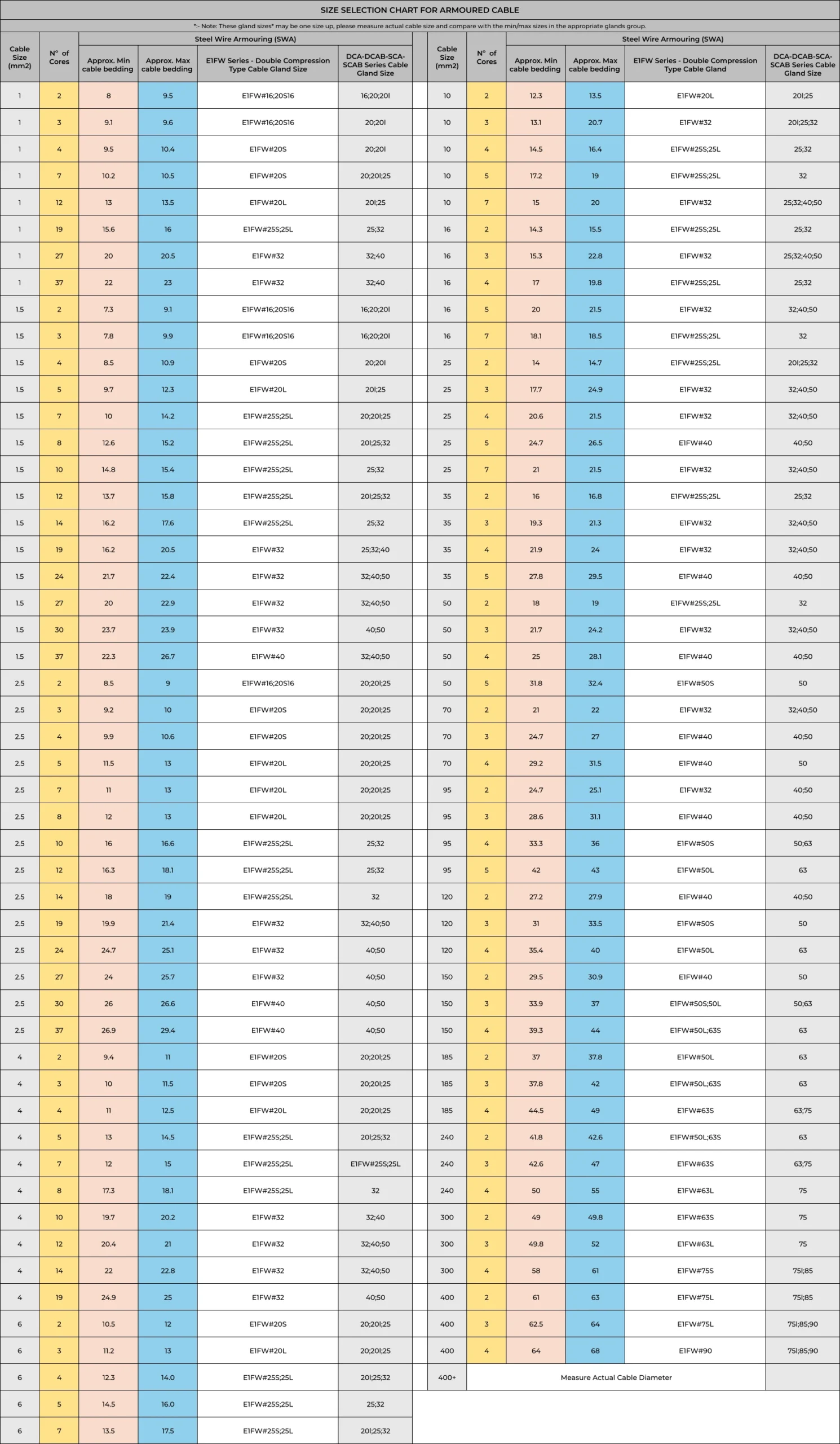
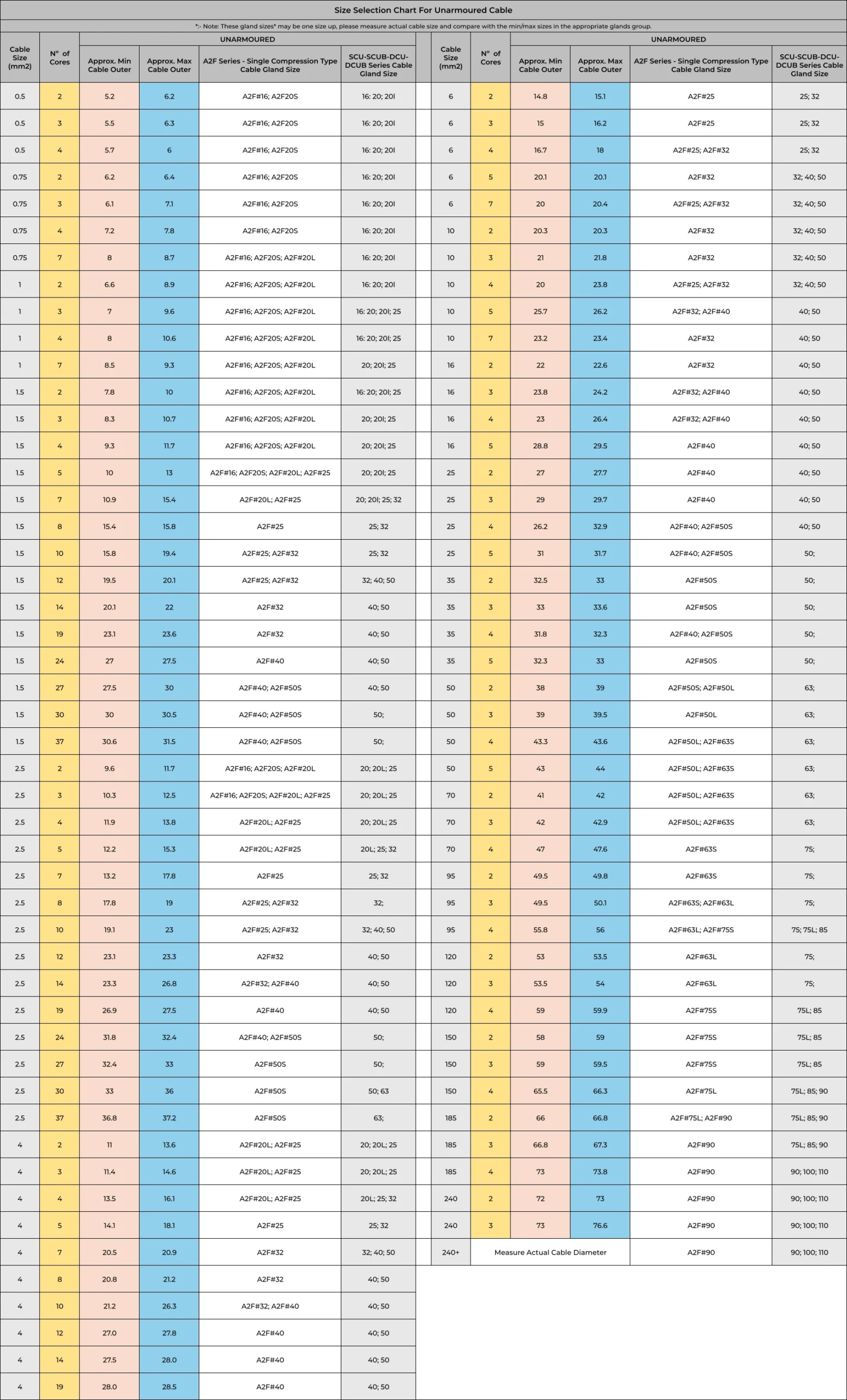
Correct cable gland size selection is critical for maintaining IP-rated ingress protection, cable retention performance, and the mechanical integrity of the cable entry point. The cable gland size must match the outer diameter of the cable being terminated an undersized gland will not seal, while an oversized gland will fail to grip the cable sheath effectively. The table below is a standard reference gland size chart for metric thread cable glands the most widely specified thread type in Indian industrial projects.
Cable Gland Size Chart for Armoured Cable :
Cable Gland Size Chart for Unarmoured Cable :
ATEX Certification, IECEx, and PESO: What Certified Means for Indian Buyers
The word certified carries significant technical and legal weight when specifying cable glands for hazardous area installations. In India’s oil refineries, petrochemical complexes, offshore platforms, and chemical processing plants, uncertified cable glands are not merely non-compliant they represent a direct safety liability and an insurance and regulatory exposure. Jamnagar-based manufacturers that have secured internationally recognised hazardous area certifications represent the top tier of India’s industrial cable gland supply chain.
ATEX Full Form and What It Covers
ATEX is derived from the French phrase ATmospheres EXplosibles literally, explosive atmospheres. ATEX certification is the European Union’s framework (Directive 2014/34/EU) for equipment intended for use in potentially explosive atmospheres and is recognised globally as a benchmark for hazardous area equipment safety. Cable glands certified under ATEX are independently tested and verified to maintain their flameproof, increased safety, or dust ignition-proof protection in Zone 1 and Zone 2 classified hazardous areas where flammable gases, vapours, or dusts may be present.
Exgrip holds ATEX certification across multiple protection concepts: Ex db (flameproof enclosure), Ex eb (increased safety), and Ex ta (dust ignition protection). This breadth of certification means a single Jamnagar-based supplier can address the complete range of hazardous area cable entry requirements across different enclosure types and zone classifications on a single industrial project.
IECEx Certification: The Global Standard
IECEx is the International Electrotechnical Commission’s certification scheme for equipment used in explosive atmospheres, accepted across more than 50 countries including Australia, the Middle East, Southeast Asia, and Africa. While ATEX applies specifically within the European Economic Area, IECEx carries broader international recognition. For Indian manufacturers like Exgrip, holding both ATEX certification and IECEx certification enables supply to both domestic and export markets from a single audited product range a significant commercial and compliance advantage when bidding on international EPC contracts.
PESO Approval for Indian Oil and Gas Projects
In India, the Petroleum and Explosives Safety Organisation (PESO) approval is a mandatory compliance requirement for electrical equipment including cable glands installed in petroleum storage, handling, and processing facilities. Any cable gland specified for Indian oil refineries, LPG facilities, or fuel handling terminals must carry valid PESO approval alongside its international hazardous area certifications. Exgrip’s cable gland range is PESO approved, making its products fully compliant for the entire spectrum of Indian industrial, petrochemical, and oil and gas installations. For project-specific information on certified cable glands for the oil and gas sector, visit the Exgrip Oil & Gas industry page.
Industries That Source Cable Glands from Jamnagar, Gujarat
The industries that rely on Jamnagar-manufactured cable glands are some of India’s most technically demanding sectors environments where cable entry integrity is directly linked to operational safety and regulatory compliance.
- Oil & Gas and Refining: Jamnagar hosts one of the world’s largest refining complexes, and the surrounding industrial ecosystem depends entirely on certified hazardous area equipment. Local supply from Jamnagar-based ATEX and PESO-approved manufacturers dramatically reduces logistics cost and lead time for this sector.
- Solar and Renewable Energy: Gujarat accounts for a major share of India’s installed solar generation capacity, particularly in the Kutch, Banaskantha, and Patan districts. IP68-rated cable glands for outdoor, UV-exposed DC cable entries on solar farms are a significant and growing product category for Jamnagar cable gland manufacturers.
- Marine and Offshore: The Saurashtra coast including Jamnagar port and surrounding shipyards requires marine-grade cable glands in stainless steel or nickel-plated brass with IP67 and IP68 ingress protection ratings for saltwater resistance and long-term reliability.
- Chemical and Pharmaceutical: The Ankleshwar, Dahej, and Vadodara chemical corridors specify cable glands with enhanced material grades stainless steel or nickel-plated brass for resistance to aggressive chemical environments, combined with ATEX certification for hazardous area compliance in process areas.
- Infrastructure, Metro Rail, and Data Centres: India’s expanding infrastructure programmes including metro rail networks, airport expansions, and the country’s growing AI data centre sector demand certified, IP-rated cable glands for high-density cable management in electrical rooms, distribution boards, and external plant installations.
Why Procurement Managers and Engineers Choose Jamnagar Suppliers
The decision to source cable glands from Jamnagar is driven by a combination of advantages that no other Indian manufacturing cluster can match simultaneously. For procurement teams evaluating their supply chain options, the following factors consistently place Gujarat-based manufacturers at the top of the shortlist.
- International certification at competitive Indian pricing: ATEX and IECEx certified cable glands from Jamnagar are priced significantly below equivalent European or North American alternatives without compromising on the certification scope or manufacturing quality that global projects demand.
- Material traceability and quality consistency: Leading Jamnagar manufacturers operate quality management systems with full material traceability, documented dimensional inspection records, and batch certification essential for large EPC projects where documentation packages and third-party inspection hold points are mandatory.
- Comprehensive range from a single source: Cable gland requirements on a large project typically span multiple sizes, thread types, compression configurations, and material grades. Manufacturers like Exgrip offer a complete range single compression, double compression, barrier glands, stopping plugs, and accessories enabling single-source procurement and simplified vendor management.
- Technical support for project-specific selection: Reputable Jamnagar manufacturers provide engineering support for project-specific gland selection, including hazardous area classification advice, cable outer diameter verification against manufacturer data, and documentation support for ATEX and PESO compliance submissions.
- Export capability and established global supply chains: Jamnagar’s proximity to Kandla and Mundra ports, combined with established export documentation expertise, means that internationally certified cable glands can reach project sites in the Middle East, Africa, Southeast Asia, and Europe within competitive lead times and with full certification traceability.
Conclusion & Call-to-Action
📩 Talk to our technical team today at Exgrip.com
📞 Or call us directly for quick assistance!
Contact Us:
📞 Phone: +91 9537118899
🌐 Website: www.exgrip.com
📩 Request a Quote: Contact Page
FAQs
Why is Jamnagar known as the brass capital of India?
What is a double compression cable gland and when is it used?
A double compression cable gland is designed specifically for armoured cables most commonly steel wire armoured (SWA) or aluminium wire armoured (AWA) cables. It features two compression points: one that mechanically clamps the cable armour for retention and earthing continuity, and one that seals the cable outer sheath for IP-rated ingress protection. Double compression glands are the standard specification for outdoor installations, direct buried cables, and hazardous area cable entries in Zone 1 and Zone 2 classified environments. Exgrip’s double compression range includes the E1FW, DCA, and DCU models.
What does ATEX full form mean and why does it matter?
ATEX stands for ATmosphères EXplosibles French for explosive atmospheres. It refers to European Union Directive 2014/34/EU, which sets mandatory safety standards for equipment used in potentially explosive atmospheres. ATEX-certified cable glands are independently tested and verified to prevent ignition of surrounding flammable gases, vapours, or combustible dusts. For cable entry into explosion-proof enclosures on oil platforms, refineries, or chemical plants, ATEX certification is a non-negotiable specification requirement. Exgrip holds ATEX certification under the Ex db, Ex eb, and Ex ta protection concepts.
What is the difference between ATEX certification and IECEx certification?
ATEX certification applies specifically within the European Economic Area and is governed by EU directives. IECEx is the International Electrotechnical Commission’s global certification scheme, accepted in over 50 countries including the Middle East, Australia, Southeast Asia, and Africa. While the underlying technical requirements are closely aligned, IECEx carries broader international recognition outside Europe. Exgrip holds both ATEX and IECEx certifications, making its cable glands compliant for both European and international export projects from a single audited product range.
Can Jamnagar cable gland manufacturers supply certified products for export projects?
Yes. Jamnagar-based manufacturers with ATEX and IECEx certification are established suppliers to international EPC projects across the Middle East, Africa, Southeast Asia, and Europe. Exgrip’s proximity to Kandla and Mundra export ports, combined with its internationally recognised certifications and export documentation capabilities, enables efficient supply to project sites outside India with full certification traceability including material test certificates, conformity declarations, and ATEX/IECEx certificate copies.