
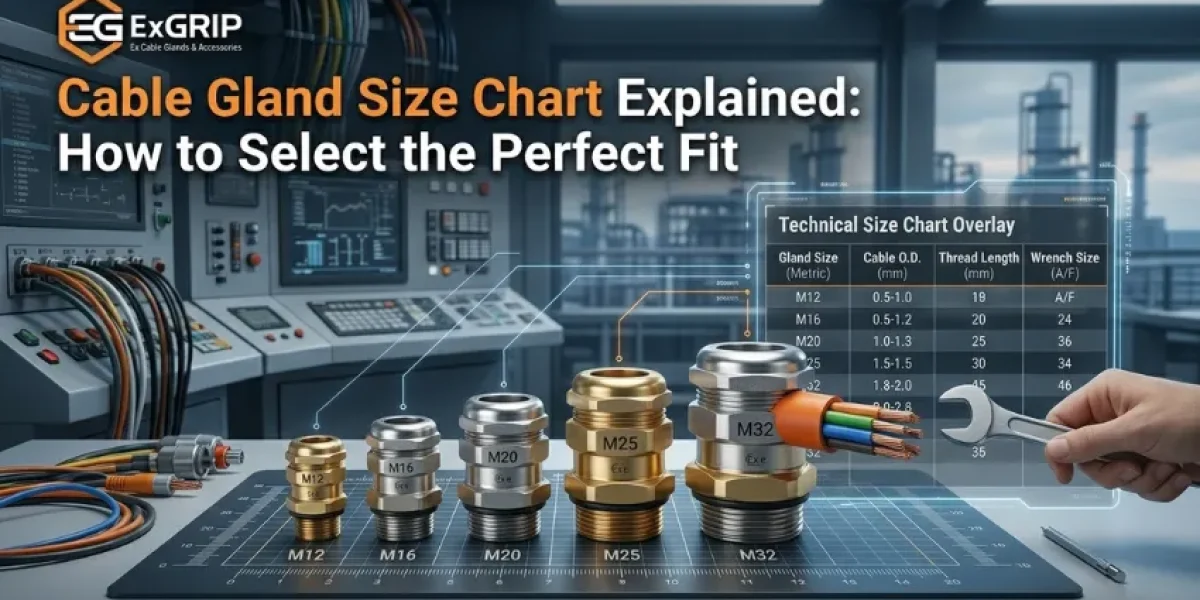
Selecting the correct cable gland size is one of the most critical steps in ensuring a safe, secure, and long-lasting cable installation. A wrong size not only compromises sealing but also increases the risk of equipment failure, moisture ingress, and safety hazards.
Many engineers and procurement professionals rely on a cable gland size chart, but without proper understanding, it often leads to incorrect selection. This guide simplifies the entire process by explaining how to use a cable gland selection chart, understand thread types, and match cable diameter with the right gland.
Whether you’re working with industrial panels, hazardous areas, or outdoor installations, this industrial cable gland size guide will help you make precise and reliable decisions.
What is a Cable Gland Size Chart?
A cable gland size chart is a reference table used to determine the correct gland size based on:
- Cable outer diameter
- Thread type (Metric, PG, NPT)
- Application requirement
It ensures:
- Proper sealing (IP66/IP68)
- Mechanical strength
- Electrical continuity
Without using a proper cable gland selection chart, installations may fail under environmental stress.
Types of Cable Gland Sizes
Metric Cable Gland Sizes
- Most commonly used worldwide
- Measured in millimeters (e.g., M20, M25, M32)
- Preferred for modern industrial systems
PG Cable Gland Sizes
- Based on German standards
- Example: PG7, PG9, PG11
- Still used in legacy systems
NPT Cable Gland Sizes
- Used mainly in US-based systems
- Thread measured in inches
- Common in oil & gas industries
Cable Gland Size Chart (Selection Table)
| Cable Diameter (mm) | Metric Size | PG Size | NPT Size |
|---|---|---|---|
| 3 – 6 mm | M12 | PG7 | 3/8″ |
| 6 – 12 mm | M16 | PG9 | 1/2″ |
| 10 – 14 mm | M20 | PG11 | 3/4″ |
| 13 – 18 mm | M25 | PG13.5 | 1″ |
| 18 – 25 mm | M32 | PG21 | 1 1/4″ |
How to Select Cable Gland Size (Step-by-Step)
Step 1: Measure Cable Diameter
Use a vernier caliper to get accurate measurement.
Step 2: Match with Size Chart
Use the cable diameter vs gland size table.
Step 3: Choose Thread Type
Metric → Standard projects
NPT → Oil & gas
PG → Old systems
Step 4: Check Application
Indoor / outdoor
Hazardous / safe area
IP requirement
Step 5: Verify Sealing Range
Always ensure cable falls within gland sealing range.
Accessories Used With Cable Glands
- Locknuts – secure mounting
- Earth tags – grounding
- Shrouds – environmental protection
- Sealing washers – improve IP rating
Connector Compatibility
Armored Cables
Require double compression glands
Unarmored Cables
Single compression is sufficient
IP Rating Consideration
IP66 → dust + water
IP68 → waterproof
Installation & Maintenance Guide
Installation Tips:
- Avoid over-tightening
- Ensure uniform compression
- Check sealing ring placement
Maintenance:
- Inspect annually
- Replace worn seals
- Check for loosening
Certifications & Compliance
- IP66 / IP68
- ATEX (for hazardous areas)
- IECEx (global certification)
- RoHS & CE
Technical Comparison Chart
| Feature | Metric | PG | NPT |
|---|---|---|---|
| Usage | Global | Europe (old) | USA |
| Accuracy | High | Medium | Medium |
| Standardization | Modern | Legacy | Regional |
Why Choose Exgrip?
Exgrip ensures precision-engineered cable gland solutions with:
- Accurate sizing standards
- Global compliance
- Bulk supply capability
- Strict QC processes
- Custom sizing support
Conclusion & Call-to-Action
Selecting the right cable gland, whether it’s a waterproof cable gland, brass cable gland, or using the correct cable gland accessories, is vital for industrial safety and system reliability.
At Exgrip, we provide a full range of cable glands, connectors, and accessories, certified with ATEX, IECEx, IP, RoHS, and REACH, suitable for any industrial or hazardous application.
📩 Talk to our technical team today at Exgrip.com
📞 Or call us directly for quick assistance!
Contact Us:
📞 Phone: +91 9537118899
🌐 Website: www.exgrip.com
📩 Request a Quote: Contact Page
FAQs
How do I choose the correct cable gland size?
Measure cable diameter and match it with a cable gland size chart.
What happens if I use wrong gland size?
It can lead to leakage, poor sealing, and equipment damage.
Which is better: metric or PG gland?
Metric is modern and widely used.
Can one gland fit multiple cable sizes?
Each gland has a specific sealing range.
What is the most common cable gland size?
M20 and M25 are widely used.