
Marine and offshore installations operate in one of the harshest environments on earth high salinity, humidity, vibration, temperature fluctuations, and explosive atmospheres. Selecting the correct cable gland size chart and corrosion-resistant cable gland is not just a design decision it is a safety-critical engineering requirement.
Improper gland sizing leads to water ingress, armor slip, premature corrosion, and non-compliance with hazardous area standards. For shipyards, offshore rigs, FPSOs, desalination plants, and coastal refineries, cable termination must withstand extreme environmental stress while maintaining IP and explosion-proof integrity.
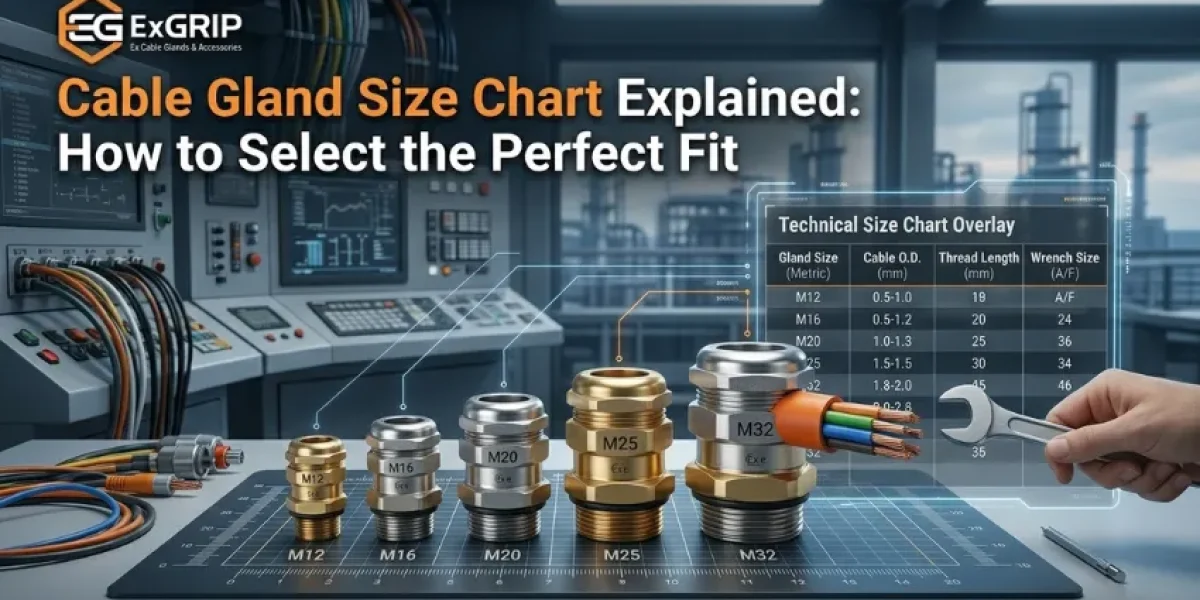
This guide explains how to interpret a cable gland size chart, how to select the right gland size for armoured and unarmoured cables, and what materials perform best in marine and offshore applications.
What is a Marine & Offshore Cable Gland?
A marine cable gland is a corrosion-resistant cable entry device designed to:
Secure and seal electrical cables
Maintain IP66 / IP67 / IP68 protection
Provide strain relief
Ensure armour earthing continuity
Prevent saltwater ingress
Comply with hazardous area standards
In offshore installations, glands are frequently made from:
Nickel-plated brass (marine grade)
SS316 / SS316L stainless steel
Duplex stainless steel (for extreme salinity)
Marine cable glands are commonly used in:
Offshore oil platforms
Ship engine rooms
Coastal substations
LNG terminals
Marine switchboards
Types of Marine Cable Glands
1. Single Compression Cable Glands
-
Used for unarmoured cables
-
Seals on outer sheath only
-
Suitable for general marine panels
2. Double Compression Cable Glands
-
Seals on inner bedding and outer sheath
-
Provides armour clamping
-
Ideal for armoured cables in offshore platforms
3. Explosion-Proof (Flameproof) Cable Glands
-
Designed for Zone 1 & Zone 2 hazardous areas
-
Prevent flame propagation
-
ATEX / IECEx compliant
4. Barrier Cable Glands
-
Resin-based compound sealing
-
Used for gas group IIC environments offshore
Cable Gland Size Chart (Marine & Offshore Applications)
Selecting correct gland size depends on:
-
Cable overall diameter (OD)
-
Armour type (SWA / AWA)
-
Core configuration
-
Installation environment
| Cable OD Range (mm) | Gland Size | Entry Thread | Typical Application |
|---|---|---|---|
| 6 – 12 mm | M20 | M20 x 1.5 | Control panels |
| 12 – 18 mm | M25 | M25 x 1.5 | Instrument cables |
| 18 – 25 mm | M32 | M32 x 1.5 | 4 Core 16–35 sq mm |
| 25 – 32 mm | M40 | M40 x 1.5 | 4 Core 70–120 sq mm |
| 32 – 44 mm | M50 | M50 x 1.5 | 3.5 Core 185 sq mm |
| 44 – 56 mm | M63 | M63 x 1.5 | 300 sq mm cables |
Example: 300 sq mm Cable Gland Size
For a 3.5 Core 300 sq mm armoured cable:
Typical OD: 48–52 mm
Recommended gland size: M63
Type: Double compression
Material: SS316 (Offshore grade)
IP Rating: IP68 preferred
Cable Size and Gland Size Selection Factors
When using a gland size chart, engineers must verify:
Cable Diameter Range
Never select gland based only on cable sq mm. Always confirm OD.
Armour Clamping Range
Double compression glands must match armour thickness.
Thread Type
-
Metric (M20, M25, M32, etc.)
-
NPT (US offshore systems)
-
PG (Older marine installations)
Material Compatibility
-
Salt spray resistance
-
Galvanic corrosion avoidance
-
Temperature range (-40°C to +120°C)
Technical Comparison Chart
| Parameter | Nickel Plated Brass | SS304 | SS316 |
|---|---|---|---|
| Corrosion Resistance | Moderate | Good | Excellent |
| Marine Suitability | Coastal | Light marine | Offshore platforms |
| Cost | Economical | Mid | Premium |
| Salt Spray Resistance | 48–96 hrs | 240 hrs | 500+ hrs |
Single vs Double Compression (Marine Use)
| Feature | Single Compression | Double Compression |
|---|---|---|
| Armour Support | No | Yes |
| Vibration Resistance | Medium | High |
| Offshore Use | Limited | Recommended |
| Hazardous Area | Rare | Common |
| Rating | Protection Level | Marine Use |
|---|---|---|
| IP66 | Dust tight + powerful water jets | Minimum |
| IP67 | Temporary immersion | Better |
| IP68 | Continuous immersion | Best for offshore |
Accessories Used With Marine Cable Glands
Lock NutsSecure gland to enclosure wall. Earth TagsEnsure proper earthing continuity for armoured cables.ShroudsProvide extra corrosion protection and insulation.Sealing WashersImprove ingress protection when installed in marine panels.
Connector Compatibility
-
Marine glands must match:
-
Armoured cables (SWA, AWA)
-
Unarmoured control cables
-
Flexible marine cables
-
Hazardous area certified enclosures
Typical ratings:
-
Temperature: -40°C to +120°C
-
IP68 / IP69K
-
Ex d / Ex e certified
Installation & Maintenance Guide
Step 1: Verify Cable OD
Measure accurately using vernier caliper.
Step 2: Select from Cable Gland Size Chart
Confirm clamping range overlaps cable OD.
Step 3: Prepare Cable
Remove outer sheath and armour correctly.
Step 4: Install Gland
Tighten using specified torque (as per manufacturer datasheet).
Step 5: Inspect Seal
Check O-ring seating and compression ring alignment.
Step 6: Periodic Inspection
-
Annual corrosion check
-
Torque verification
-
Seal integrity inspection
-
Certifications & Compliance
Using certified cable glands is essential for industrial safety and global compliance. Certifications give confidence that the product can withstand demanding environments.
Key Certifications to Look For:
-
ATEX & IECEx: Required for explosive or hazardous areas
-
IP66 / IP67 / IP68 Ratings: Guarantee dust-tight and waterproof performance
-
RoHS & REACH Compliance: Ensure environmentally safe and lead-free materials
-
CSA / UL Approvals: Necessary for North American installations
At Exgrip, all cable gland types, including brass cable gland, waterproof cable gland, and specialty adapters like 90° and YADP, are manufactured with these certifications, making them reliable for industries worldwide.
Global Reach with Brass Cable Gland Solutions
Exgrip provides a wide range of brass cable gland solutions, including:
-
90° Adapters – Right-angle entry to reduce cable stress
-
YADP (Dual Entry Adapters) – Allow two cables to pass through one entry point
-
Waterproof / Watertight Brass Cable Glands – Protect against moisture and dust ingress
Why Choose Exgrip Solutions?
-
Worldwide Delivery: Fast shipping across Asia, Europe, Middle East, USA, and beyond
-
Cost-Effective Options: Affordable without compromising safety
-
Wide Product Range: Standard glands, specialized connectors, and accessories
-
Trusted by Industries: Oil & gas, renewable energy, telecom, automation, and infrastructure
Exgrip combines global standards with local manufacturing efficiency, ensuring reliable cable gland solutions for any project.
Conclusion & Call-to-Action
Selecting the right cable gland, whether it’s a waterproof cable gland, brass cable gland, or using the correct cable gland accessories, is vital for industrial safety and system reliability.
At Exgrip, we provide a full range of cable glands, connectors, and accessories, certified with ATEX, IECEx, IP, RoHS, and REACH, suitable for any industrial or hazardous application.
📩 Talk to our technical team today at Exgrip.com
📞 Or call us directly for quick assistance!
Contact Us:
📞 Phone: +91 9537118899
🌐 Website: www.exgrip.com
📩 Request a Quote: Contact Page
FAQs
How do I choose the correct cable gland size for marine applications?
Always measure the cable overall diameter and select gland size whose clamping range overlaps that measurement. Never rely only on sq mm rating.
What gland size is used for 300 sq mm armoured cable?
Typically M63 double compression gland, but confirm OD before finalizing.
Which material is best for offshore cable glands?
SS316 or duplex stainless steel due to high salt corrosion resistance.
Is double compression mandatory for marine installations?
For armoured cables in offshore platforms, double compression is strongly recommended due to vibration and armour support.
What IP rating is required for offshore cable glands?
IP68 is preferred for continuous exposure to water and humidity.