
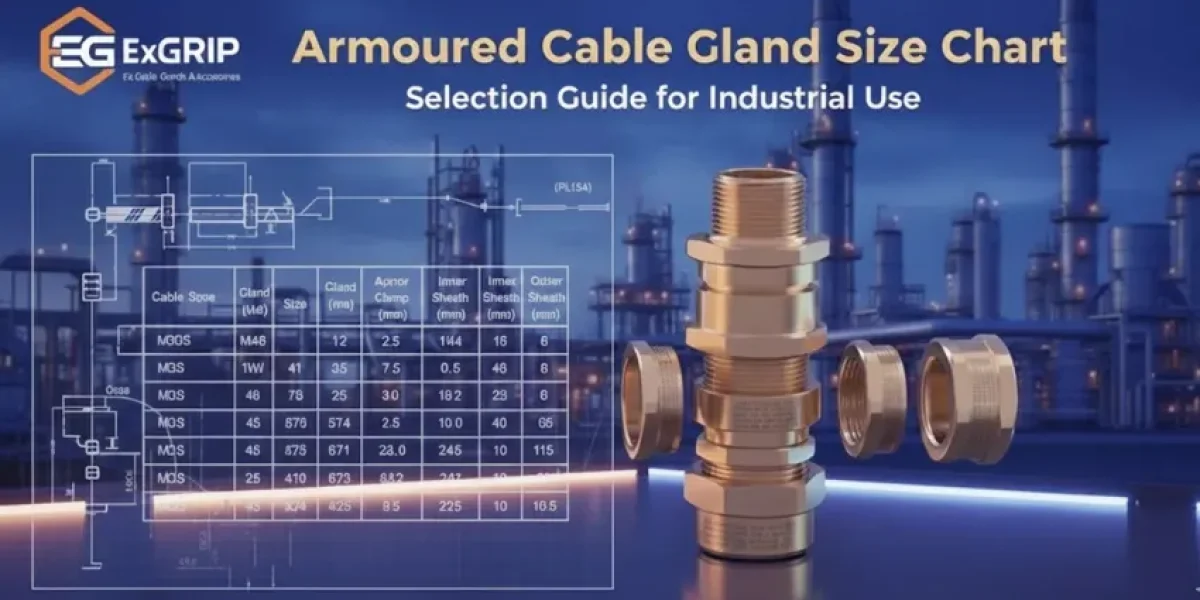
Choosing the right armoured cable gland size is essential for safe and reliable electrical installations. A properly selected gland protects the cable from mechanical damage, ensures sealing, maintains earth continuity, and increases the life of the connection—especially in industrial environments.
This guide provides a complete armoured cable gland size chart, selection rules, parts explanation, accessories, and PDF-ready details for engineers and technicians.
What Is an Armoured Cable Gland?
An armoured cable gland is a mechanical device used to terminate and secure SWA (Steel Wire Armoured) or AWA (Aluminium Wire Armoured) cables. These glands are designed to lock the cable in place, prevent pull-out, and protect the entry point from dust, moisture, or chemical exposure.
In industrial installations, they ensure proper grip on both the inner bedding and the armouring layer, which helps in grounding and providing strain relief. Compared to normal glands, armoured types are stronger, more durable, and capable of handling outdoor or vibration-heavy environments.
Benefits include:
-
Mechanical retention and strain relief
-
Earth continuity through armouring
-
Protection against moisture, dust, and chemicals
-
Vibration resistance for industrial equipment
-
Compatibility with cable gland accessories like shrouds, earth tags, and locknuts
This is why almost all industrial projects require the correct cable glands sizes for safe installation.
Cable Gland Parts Name
Understanding the cable gland parts name helps ensure proper installation. An armoured cable gland generally contains:
Main Components
-
Gland Body: The primary housing that fits into the equipment or panel entry.
-
Clamping / Armour Cone: Grips the armouring for mechanical and electrical continuity.
-
Compression Nut: Tightens the gland and applies pressure to the seal or cone.
-
Seal / Rubber Ring: Creates a secure environmental seal around the cable sheath.
-
Lock Nut: Used to secure the gland from the inside of the enclosure.
-
Earth Tag: Provides grounding to the armour for fault current protection.
-
Shroud: A PVC protective sleeve that prevents dust and water entry around the gland.
These parts work together to ensure proper termination—especially in outdoor installations where sealing matters the most.
Types of Armoured Cable Glands
Choosing the correct gland type is as important as selecting the right size. The two most-used types are:
These glands provide compression only at one point—generally the inner seal. They are suitable for indoor, moderately controlled environments.
They are commonly used where exposure to moisture, dust, or chemicals is minimal.
Best used for:
-
Indoor panels
-
Protected industrial sectors
-
Smaller SWA cables
These provide compression at two points:
-
On the inner sheath
-
On the outer sheath
This results in superior sealing and mechanical support. Because of their reliability, they are the preferred option for most industrial projects.
Advantages:
-
High ingress protection (IP67 / IP68)
-
Suitable for outdoor and heavy-duty industrial use
-
Commonly used with double compression cable gland size chart PDF references
Double compression glands are the industry standard for motors, pumps, control panels, and outdoor junction boxes.
How to Select the Correct Armoured Cable Gland Size
Selecting the correct gland is based on multiple factors not just thread size. Here’s the proper method:
The cable’s OD in mm must fall within the gland’s clamping range.
This is the most important step in sizing.
Armour thickness affects grip and compression performance.
Example:
-
3C, 4C, 3.5C
-
10 sq.mm, 25 sq.mm, 150 sq.mm
Bigger core sizes require larger glands.
Metric thread sizes must match your panel or equipment entry.
Outdoor, corrosive, marine, or industrial environments usually require double compression models.
Following these steps ensures accurate and safe gland selection every time.
Armoured Cable Gland Size Chart (In mm)
*(Includes natural keyword usage: gland chart, cable gland size chart in mm, armoured cable gland size chart) *
| Cable Size | Cores | Cable OD (mm) | Recommended Gland Size | Thread |
|---|---|---|---|---|
| 3C x 1.5 | 3 | 10–12 | M16 | Metric |
| 4C x 4 | 4 | 12–14 | M20 | Metric |
| 3.5C x 6 | 3.5 | 15–17 | M20 / M25 | Metric |
| 4C x 10 | 4 | 17–19 | M25 | Metric |
| 4C x 16 | 4 | 20–23 | M32 | Metric |
| 3.5C x 35 | 3.5 | 27–30 | M40 | Metric |
| 3.5C x 70 | 3.5 | 32–36 | M50 | Metric |
| 3.5C x 95 | 3.5 | 36–40 | M63 | Metric |
| 3.5C x 150 | 3.5 | 42–46 | M75 | Metric |
This gland chart helps you quickly match your cable OD to the correct gland.
Double Compression Cable Gland Size Chart
| Gland Size | OD Range (mm) | Thread | Suitable For |
|---|---|---|---|
| M20 | 10–14 | Metric | LV control cables |
| M25 | 14–20 | Metric | Armoured power cables |
| M32 | 20–26 | Metric | Industrial panels |
| M40 | 26–32 | Metric | Outdoor installations |
| M50 | 32–38 | Metric | Heavy duty equipment |
| M63 | 38–48 | Metric | Large power cables |
Cable Gland Accessories
To complete installation safely, the following cable gland accessories are used:
Important Accessories (Explained)
-
Shrouds: Prevent dust and moisture around the gland.
-
Earth Tags: Provide continuous grounding to the armour.
-
Lock Nuts: Secure the gland from inside the panel.
-
Serrated Washers: Improve grip and prevent loosening due to vibration.
-
Reducers & Adaptors: Adjust thread compatibility.
-
Stopping Plugs: Seal unused cable entries.
Including the right accessories ensures proper sealing and long-term reliability.
Downloadable Cable Gland Size Charts
To support field engineers, you can prepare downloadable references like:
Armoured cable gland size chart (offline reference)
These PDFs improve usability and SEO performance.
Conclusion & Call-to-Action
Selecting the right armoured cable gland size is essential for safe and efficient industrial installation. With the correct information about gland types, parts, accessories, and cable OD, choosing the right size becomes simple and reliable.
This guide gives you a complete gland chart, selection rules, and downloadable PDF-ready references to help technicians, engineers, and panel builders make accurate decisions.
📩 Talk to our technical team today at Exgrip.com
📞 Or call us directly for quick assistance!
Contact Us:
📞 Phone: +91 9537118899
🌐 Website: www.exgrip.com
📩 Request a Quote: Contact Page
FAQs
How do I know which gland size fits my cable?
Measure the cable OD in mm and match it with the gland’s clamping range listed in the size chart.
What is the purpose of using double compression cable glands?
They provide two sealing points, offering better protection in outdoor, industrial, or dusty environments.
Are armoured and non-armoured cable glands different?
Yes. Armoured glands are designed to grip the armour layer, while non-armoured glands rely only on the outer sheath for sealing.
Can I use M20 instead of M25 gland?
No, The gland size must match the cable OD and thread entry. Using the wrong size can cause leakage or pull-out.
What accessories are required for cable gland installation?
Shrouds, lock nuts, serrated washers, and earth tags are commonly used accessories.
Why are cable gland size charts provided in mm?
Because cable outer diameters are measured in millimetres, ensuring precise selection.
Which gland is best for outdoor installations?
Double compression glands are preferred for outdoor and industrial environments.
Can I download cable gland size charts in PDF format?
Yes, many manufacturers provide cable gland size chart PDF documents for easy site reference.