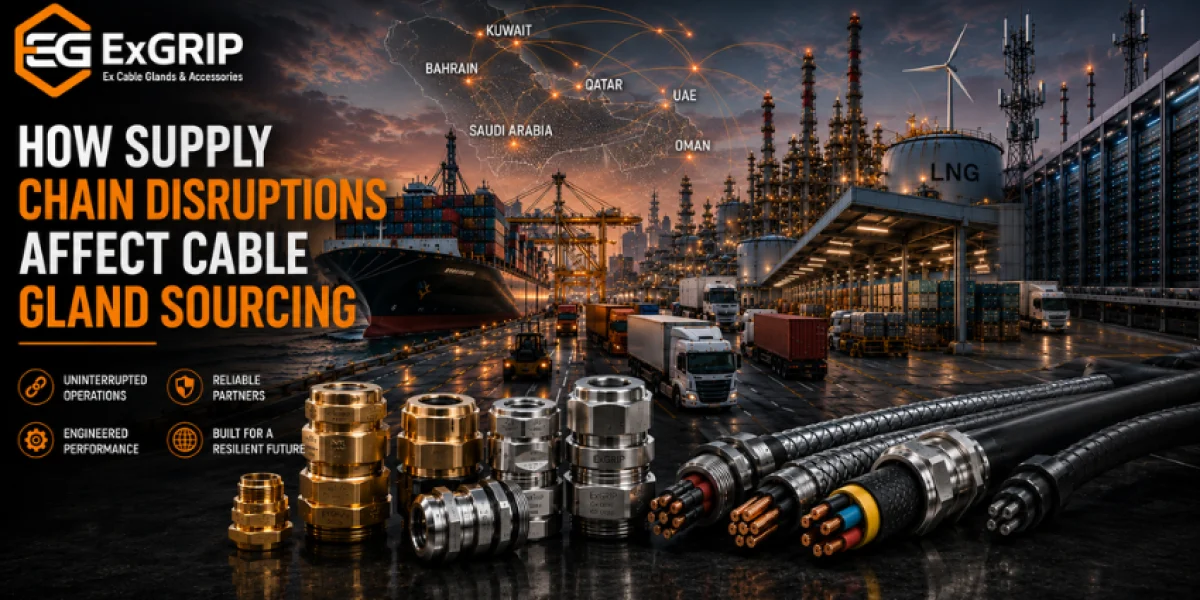
The global industrial sector has experienced significant supply chain disruption over the past few years. From shipping delays and raw material shortages to geopolitical tensions and fluctuating freight costs, procurement teams across GCC countries are facing increasing challenges when sourcing critical electrical components.
One such component is the cable gland a small yet essential product that plays a major role in maintaining cable integrity, equipment safety, ingress protection, and hazardous area compliance. Whether selecting the correct cable gland size or choosing among different cable gland types, project teams must ensure product availability without compromising technical requirements.
For industries such as oil & gas, petrochemicals, LNG facilities, power plants, renewable energy projects, data centers, telecom infrastructure, and industrial manufacturing, sourcing the right cable gland at the right time has become a strategic procurement priority.
As global markets continue to face uncertainty, effective supply chain management has become essential for maintaining project schedules and controlling procurement risks. This article explores how supply chain disruptions are reshaping cable gland sourcing strategies throughout GCC countries and what buyers can do to build more resilient procurement processes.
Understanding Supply Chain Management
Before discussing sourcing challenges, it is important to understand what is a supply chain and why it matters.
What Is a Supply Chain?
A supply chain is the complete network involved in producing and delivering products from raw material suppliers to end users.
A typical industrial supply chain includes:
| Supply Chain Stage | Description |
|---|---|
| Raw Materials | Brass, stainless steel, seals, accessories |
| Manufacturing | Production and quality control |
| Warehousing | Inventory storage |
| Transportation | Shipping and logistics |
| Distribution | Regional supply partners |
| End Users | Industrial projects and facilities |
In simple terms, if someone asks what is supply chain, it is the journey a product takes from production to final installation.
What Is Supply Chain Management?
Supply chain management refers to planning, coordinating, monitoring, and optimizing the flow of materials, products, information, and logistics throughout the supply chain.
Effective supply chain management helps companies:
- Reduce delays
- Improve inventory availability
- Lower procurement costs
- Manage supplier risks
- Ensure project continuity
- Improve customer satisfaction
For GCC infrastructure projects, supply chain management has become more important than ever.
What Is Supply Chain Disruption?
A supply chain disruption occurs when normal product movement is interrupted, causing delays, shortages, increased costs, or reduced availability.
Common causes include:
Global Events
- Geopolitical conflicts
- Trade restrictions
- Sanctions
- Economic instability
Logistics Challenges
- Port congestion
- Container shortages
- Shipping route disruptions
- Freight cost fluctuations
Manufacturing Issues
- Raw material shortages
- Factory shutdowns
- Labor shortages
- Quality control delays
Environmental Factors
- Natural disasters
- Extreme weather conditions
- Flooding
- Earthquakes
Understanding the GCC Market
For manufacturers, EPC contractors, procurement teams, and infrastructure developers, the GCC region represents one of the world’s most active markets for industrial, energy, and construction projects. Understanding the structure of the GCC is important when evaluating supply chains, export opportunities, and sourcing strategies for critical electrical components such as cable glands.
GCC Country Full Form
The full form of GCC is Gulf Cooperation Council.
The GCC is a regional intergovernmental organization established to promote economic, political, security, and trade cooperation among member states in the Arabian Gulf region. Over the years, the GCC has become a major hub for oil & gas investments, petrochemical developments, renewable energy projects, data centers, transportation infrastructure, and industrial manufacturing.
What Is GCC Countries?
The term GCC countries refers to the six member nations that form the Gulf Cooperation Council. These countries work together to strengthen regional economic growth, facilitate trade, encourage infrastructure development, and improve cooperation across various industries.
Today, GCC countries are among the largest investors in energy, industrial modernization, smart cities, and large-scale infrastructure projects, creating significant demand for high-quality electrical equipment and cable management solutions.
GCC Countries List
The six official GCC member countries are:
| GCC Member Country | Capital City |
|---|---|
| Saudi Arabia | Riyadh |
| United Arab Emirates (UAE) | Abu Dhabi |
| Qatar | Doha |
| Kuwait | Kuwait City |
| Oman | Muscat |
| Bahrain | Manama |
These countries collectively represent one of the most important industrial and energy markets in the Middle East.
What Are the 7 GCC Countries?
There are currently six official GCC member countries, not seven.
The officially recognized GCC countries are:
- Saudi Arabia
- United Arab Emirates (UAE)
- Qatar
- Kuwait
- Oman
- Bahrain
While other Middle Eastern nations are often associated with the Gulf region, they are not members of the Gulf Cooperation Council.
Why GCC Countries Matter for Industrial Procurement
GCC countries continue to invest heavily in:
- Oil & gas facilities
- Petrochemical complexes
- LNG terminals
- Renewable energy projects
- Data centers
- Smart city developments
- Transportation infrastructure
- Power generation facilities
- Industrial manufacturing plants
As a result, demand for reliable electrical components, including cable glands, hazardous area cable accessories, and cable management systems, remains strong across the region. For suppliers and procurement professionals, understanding the GCC market is essential for developing resilient sourcing strategies and ensuring uninterrupted project execution.
Common Cable Gland Types Used in GCC Industries
Selecting suitable cable gland types is essential for project performance.
| Cable Gland Types | Typical Applications |
|---|---|
| Brass Cable Glands | Industrial and infrastructure projects |
| Stainless Steel Cable Glands | Corrosive environments |
| Armoured Cable Glands | Heavy-duty power cables |
| Explosion-Proof Cable Glands | Hazardous areas |
| Hazardous Area Cable Glands | Oil & gas facilities |
| EMC Cable Glands | Data centers and telecom |
Different applications require different gland specifications, certifications, and sealing capabilities.
How Supply Chain Disruptions Affect Cable Gland Sourcing
1. Longer Lead Times
One of the biggest impacts of supply chain disruption is extended lead times.
Previously:
| Scenario | Typical Lead Time |
|---|---|
| Standard Cable Glands | 2–4 Weeks |
| Specialized Glands | 4–6 Weeks |
Now many projects experience:
| Scenario | Current Lead Time |
|---|---|
| Standard Cable Glands | 6–12 Weeks |
| Specialized Glands | 10–20 Weeks |
This affects project schedules and procurement planning.
2. Raw Material Price Volatility
Cable gland manufacturing depends heavily on:
- Brass
- Stainless steel
- Nickel plating materials
- Sealing compounds
Price fluctuations directly impact procurement budgets.
Particularly for:
- Brass cable glands
- Stainless steel cable glands
- Explosion-proof cable glands
Procurement teams must now account for greater pricing uncertainty.
3. Inventory Shortages
Large-scale GCC projects often require thousands of cable glands.
When suppliers experience stock shortages:
- Construction schedules slow down
- Installation teams become idle
- Project milestones shift
- Procurement costs increase
Inventory availability has become as important as product pricing.
4. Certification Delays
Hazardous area projects require certified products.
Examples include:
- ATEX-certified glands
- IECEx-certified glands
- Explosion-proof cable glands
- Hazardous area cable glands
Supply chain disruptions can delay certification renewals and product availability, creating compliance challenges.
5. Increased Freight Cost
Shipping costs have become a major procurement factor.
Challenges include:
- Container shortages
- Port congestion
- Route diversions
- Fuel cost increases
As a result, landed costs can rise significantly, especially for urgent project requirements.
How GCC Procurement Teams Are Changing Their Sourcing Strategies
Multi-Supplier Procurement Models
Organizations increasingly avoid depending on a single supplier.
Benefits include:
- Reduced risk
- Better inventory access
- Improved lead time flexibility
- Competitive pricing
Strategic Inventory Planning
Leading companies now maintain safety stock for:
- Critical cable gland sizes
- Hazardous area products
- Project-specific accessories
This reduces exposure to unexpected delays.
Early Procurement Involvement
Procurement teams are participating earlier in project planning.
Advantages include:
- Improved forecasting
- Better supplier coordination
- Reduced emergency purchases
- Lower logistics costs
Supplier Diversification
Companies increasingly source from multiple regions including:
| Region | Strategic Benefit |
|---|---|
| India | Manufacturing strength and export flexibility |
| Europe | Premium certifications |
| Middle East | Regional stock availability |
| Asia-Pacific | Competitive pricing |
This diversification improves resilience.
Why Indian Manufacturers Are Gaining Attention in GCC Markets
As procurement teams seek alternatives to traditional sourcing channels, India has become an increasingly attractive manufacturing hub.
Reasons include:
- Strong engineering capabilities
- Competitive production costs
- Export-focused manufacturing
- Faster customization
- Broad certification support
- Flexible production capacity
Companies such as Exgrip support GCC customers by supplying industrial cable gland solutions aligned with international quality requirements while maintaining supply chain flexibility.
Conclusion & Call-to-Action
Recent supply chain disruptions have fundamentally changed how industrial companies source cable glands across GCC countries. Challenges such as extended lead times, freight cost increases, raw material volatility, and inventory shortages are forcing procurement teams to rethink traditional sourcing approaches.
To remain competitive, organizations must strengthen their supply chain management practices, diversify supplier networks, maintain strategic inventory levels, and improve forecasting accuracy. Companies that proactively manage their supply chain risks will be better positioned to maintain operational continuity and meet project deadlines.
For critical sectors such as oil & gas, petrochemicals, power generation, data centers, telecom infrastructure, and industrial manufacturing, reliable cable gland sourcing is no longer just a purchasing function it has become a strategic business requirement.
As infrastructure investment continues across GCC countries, partnering with dependable manufacturers and export-focused suppliers can help organizations secure the right cable gland types and cable gland sizes while reducing exposure to future supply chain disruption challenges.
📩 Talk to our technical team today at Exgrip.com
📞 Or call us directly for quick assistance!
Contact Us:
📞 Phone: +91 9537118899
🌐 Website: www.exgrip.com
📩 Request a Quote: Contact Page
FAQs
What is a supply chain?
A supply chain is the network of suppliers, manufacturers, logistics providers, distributors, and customers involved in delivering products from raw materials to end users.
Why are cable glands important in GCC industries?
Cable glands help ensure safety, ingress protection, explosion protection, and reliable cable performance in demanding industrial environments.
What is the GCC country full form?
GCC stands for Gulf Cooperation Council.
What are the GCC countries?
The GCC countries are Saudi Arabia, UAE, Qatar, Kuwait, Oman, and Bahrain.
How can procurement teams reduce supply chain risks?
They can diversify suppliers, maintain inventory buffers, improve forecasting, and establish long-term supplier partnerships.