
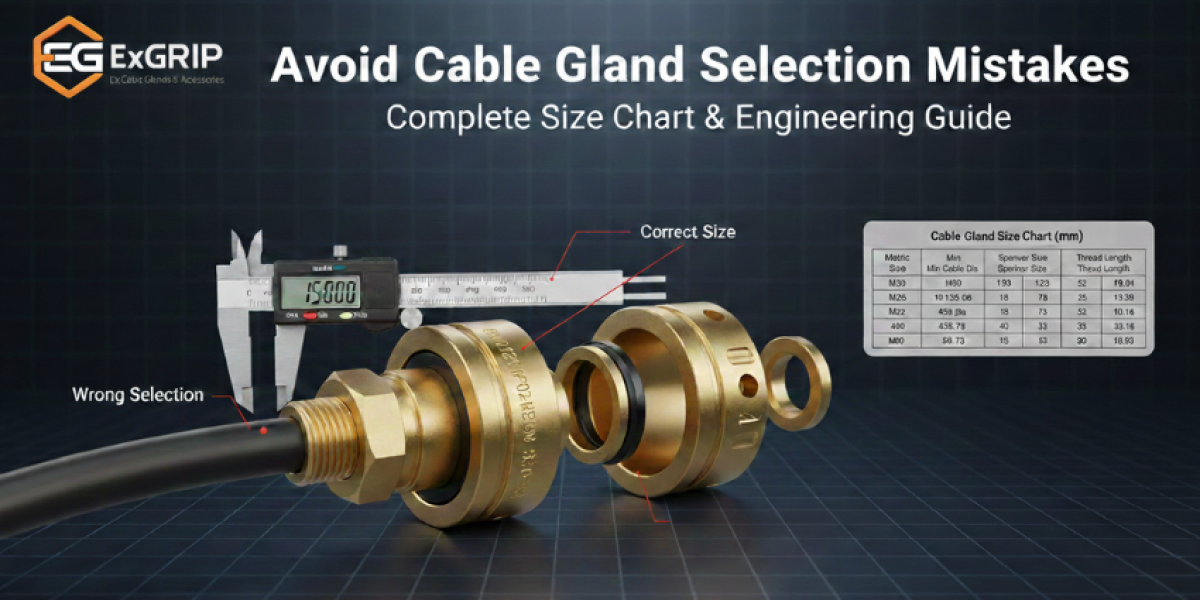
Electrical failures rarely happen because of the cable itself.
They happen because of wrong cable gland selection.
Choosing the incorrect cable gland size, ignoring the cable gland size chart in mm, or misunderstanding cable gland types can cause:
-
Water ingress
-
Flame propagation
-
Earthing failure
-
Loose termination
-
Inspection rejection
-
Costly shutdowns
This comprehensive guide explains every major selection mistake and provides complete cable gland charts, PDFs, and size references engineers need.
What is a Cable Gland?
A cable gland is a mechanical device used for:
-
Securing cables
-
Providing strain relief
-
Ensuring earthing continuity
-
Preventing dust and water ingress
-
Supporting safe cable glanding and termination
It connects the cable to equipment such as panels, junction boxes, and control systems.
Without proper cable and gland size matching, the entire electrical system becomes vulnerable.
Cable Gland Types (And Where Engineers Go Wrong)
Understanding cable gland type and size compatibility is critical.
Single Compression Cable Gland
Used mainly for:
-
Unarmoured cables
-
Light-duty industrial use
Common mistake: Using single compression cable gland for armoured cables.
Double Compression Cable Gland
Used for:
-
Armoured cables
-
Hazardous areas
-
Heavy-duty installations
The double compression cable gland grips both inner sheath and armour, ensuring secure retention.
Common mistake: Not checking double compression cable gland size chart before selection.
Armoured Cable Gland
Specifically designed for:
-
SWA (Steel Wire Armoured) cables
-
Industrial plants
-
Oil & gas projects
Ignoring armoured cable gland size chart pdf leads to loose armour clamping. Brass Cable Gland
A brass cable gland is widely preferred because of:
-
High corrosion resistance
-
Excellent conductivity
-
Mechanical durability
-
Long service life
Wrong material selection is one of the biggest installation failures.
Complete Cable Gland Size Chart in MM
Below is the most used cable gland size chart in mm reference.
| Gland Size | Cable OD Range (MM) | Typical Application |
|---|---|---|
| M20 | 6 – 12 mm | Control cables |
| M25 | 10 – 18 mm | Power cables |
| M32 | 15 – 22 mm | Industrial cables |
| M40 | 19 – 28 mm | Armoured cables |
| M50 | 27 – 35 mm | Heavy power cables |
| M63 | 34 – 44 mm | Large industrial cables |
This cable gland size chart should always be matched with actual cable OD.
Armoured Cable Gland Size Chart
| Cable Size | Recommended Gland |
|---|---|
| 25 sq mm | M32 |
| 70 sq mm | M40 |
| 150 sq mm cable gland size | M50 |
| 240 sq mm | M63 |
| 3.5 core 300 sq mm cable gland size | M75 |
Always confirm via armoured cable gland size chart pdf before procurement.
Double Compression Cable Gland Size Chart
| Cable OD (MM) | Gland Type |
|---|---|
| 12–18 mm | DC M25 |
| 18–25 mm | DC M32 |
| 25–32 mm | DC M40 |
| 32–38 mm | DC M50 |
Refer to official double compression cable gland size chart pdf for precision.
Electrical Cable Gland Size Chart PDF Guide
Engineers should always maintain:
-
electrical cable gland size chart pdf
-
cable gland size chart pdf
-
armoured cable gland size chart pdf
-
double compression cable gland size chart pdf
-
cable gland types pdf
These documents ensure:
Inspection approval
Accurate BOQ preparation
Reduced rework
Standard compliance
Installation & Maintenance
Proper installation and maintenance are key to getting the best performance from your cable glands. Whether it’s a waterproof cable gland, brass cable gland, or standard connector, following best practices ensures longevity and safety.
Installation Tips:
-
Follow the recommended torque values to avoid leaks or damage
-
Use appropriate cable gland accessories, such as O-rings or adapters, to maintain IP or watertight integrity
-
Protect the cable’s bend radius; use 90° adapters for sharp corners
-
Ensure grounding for metallic glands and connectors
Maintenance Tips:
-
Inspect seals and washers regularly for wear or damage
-
Retighten glands after thermal cycles or heavy use
-
Keep certification datasheets (ATEX, IECEx, IP) handy for audits
-
Replace worn-out glands promptly to avoid electrical hazards
Regular maintenance prolongs the life of your cable gland solutions and ensures safe, compliant operation.
Cable Glanding and Termination Mistakes
Common errors in cable glanding and termination:
-
Incorrect armour stripping
-
Wrong cable gland size
-
Improper earthing
-
Over-tightening
-
Ignoring IP rating
Correct cable gland chart referencing avoids all of these.
Installation & Maintenance Tips
Always measure outer diameter
Never assume based on sq mm alone
Use torque wrench for tightening
Check IP rating (IP65/IP66/IP68)
Verify earth continuity
Routine inspection prevents system failure.
Conclusion & Call-to-Action
Selecting the right cable gland, whether it’s a waterproof cable gland, brass cable gland, or using the correct cable gland accessories, is vital for industrial safety and system reliability.
At Exgrip, we provide a full range of cable glands, connectors, and accessories, certified with ATEX, IECEx, IP, RoHS, and REACH, suitable for any industrial or hazardous application.
📩 Talk to our technical team today at Exgrip.com
📞 Or call us directly for quick assistance!
Contact Us:
📞 Phone: +91 9537118899
🌐 Website: www.exgrip.com
📩 Request a Quote: Contact Page
FAQs
How to select correct cable gland size?
Measure cable outer diameter and refer to the cable gland size chart.
What is 150 sq mm cable gland size?
Typically M50, but confirm using official chart.
What is 3.5 core 300 sq mm cable gland size?
Usually M75 for armoured cables.
Difference between single and double compression cable gland?
Single grips outer sheath only; double grips both sheath and armour.
What is cable gland HSN code?
Generally falls under electrical fittings category for GST — confirm regionally.