
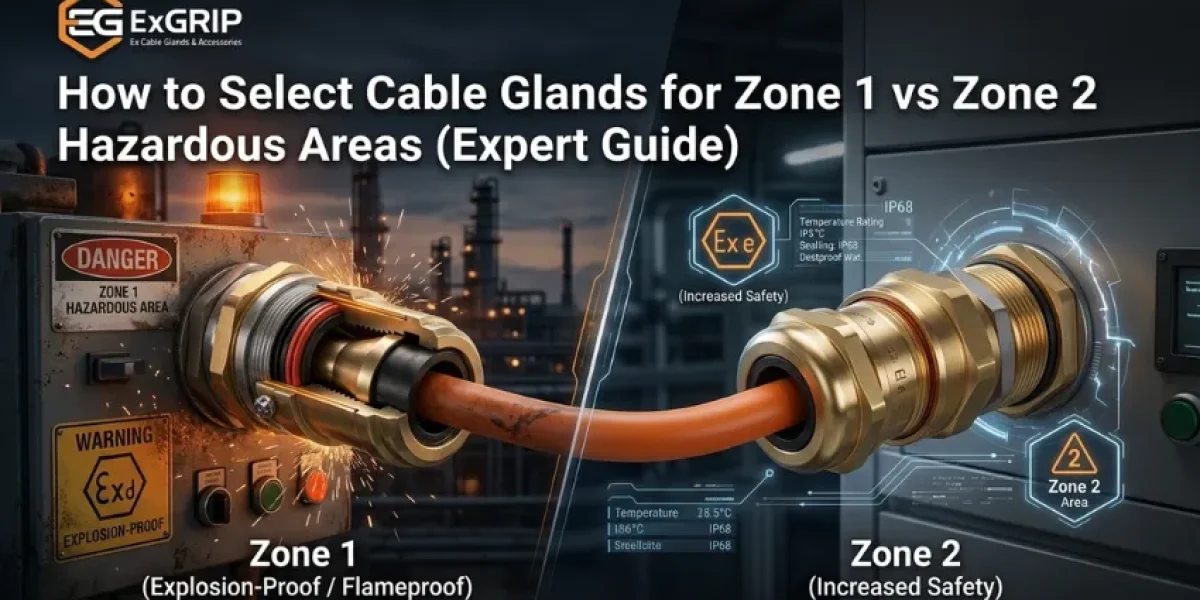
In hazardous industrial environments where flammable gases, vapors, or dust are present, electrical safety is non-negotiable. One small but critical component that plays a major role in explosion protection is the ATEX cable gland. Using the wrong gland or ignoring compliance standards can lead to serious safety risks, equipment failure, or legal penalties.
This blog explains the safety standards for ATEX cable glands, outlines a clear compliance checklist for engineers, and helps you understand how to select the right gland for hazardous-area installations.
What Is an ATEX Cable Gland?
An ATEX cable gland is a specially designed cable entry device used in potentially explosive atmospheres. It ensures safe cable termination by preventing the passage of flames, sparks, or hot gases from electrical equipment into the surrounding hazardous area.
These glands are certified under the ATEX Directive (2014/34/EU) and are commonly used in oil & gas plants, chemical industries, refineries, and other explosive environments.
Why Safety Standards Matter for ATEX Cable Glands
Safety standards exist to ensure that ATEX cable glands perform reliably under extreme conditions. A non-compliant gland may compromise explosion protection, leading to catastrophic consequences.
Following proper ATEX safety standards helps to:
-
Prevent ignition of explosive atmospheres
-
Maintain enclosure integrity
-
Ensure long-term reliability
-
Meet legal and regulatory requirements
-
Pass safety audits and inspections
Key ATEX Safety Standards and Certifications
When selecting or installing ATEX cable glands, engineers must verify compliance with recognized international standards.
-
ATEX Directive 2014/34/EU – Equipment for explosive atmospheres
-
IECEx Certification – International explosion protection scheme
-
EN 60079 Series – Electrical equipment for explosive gas atmospheres
-
IP66 / IP67 / IP68 Ratings – Environmental sealing standards
Always ensure the gland marking matches the hazardous zone classification.
Cable Gland Parts Name (ATEX-Specific)
Understanding cable gland parts name terminology is essential for correct assembly and compliance.
Typical ATEX cable gland parts include:
-
Gland body
-
Inner sealing ring
-
Outer sealing ring
-
Armour clamping cone (for armoured cables)
-
Earth tag
-
Locknut
-
Compression nut
Each part contributes to explosion protection, sealing, and mechanical strength.
Types of ATEX Cable Glands
Different hazardous applications require different gland constructions.
Single Compression ATEX Cable Glands
Used mainly for unarmoured cables in flameproof enclosures. These provide sealing on the outer sheath and are suitable for controlled hazardous zones.
Double Compression ATEX Cable Glands
Commonly used for armoured cables. These provide sealing on both the inner and outer sheath, making them ideal for harsh and high-risk environments.
Flameproof (Ex d) Cable Glands
Designed to withstand internal explosions and prevent flame transmission. Widely used in Zone 1 applications.
Increased Safety (Ex e) Cable Glands
Used where no sparks or arcs are produced in normal operation. Suitable for Zone 2 areas.
How to Select the Correct ATEX Cable Gland
Choosing the right ATEX cable gland requires more than just matching the cable size.
Consider the following:
-
Hazardous zone (Zone 1 or Zone 2)
-
Cable type (armoured or unarmoured)
-
Cable outer diameter (OD)
-
Gland material (brass, nickel-plated brass, stainless steel)
-
Required IP rating
-
Thread type (Metric, NPT, BSP)
Always cross-check with an ATEX cable gland size chart before final installation.
ATEX Cable Gland Compliance Checklist for Engineers
Use this checklist to ensure full compliance:
✔ Correct ATEX and IECEx certification
✔ Proper zone classification marking
✔ Suitable IP rating for environment
✔ Correct cable OD range
✔ Compatible enclosure material
✔ Proper earthing for armoured cables
✔ Manufacturer test certificates available
✔ Installation as per manufacturer guidelines
This checklist helps avoid common compliance errors during audits.
ATEX Cable Gland Size Reference (Table Example)
| Gland Size | Cable OD Range (mm) | Cable Type | Application Zone |
|---|---|---|---|
| M20 | 6–12 | Unarmoured | Zone 2 |
| M25 | 10–18 | Armoured | Zone 1 |
| M32 | 14–22 | Armoured | Zone 1 |
| M40 | 20–30 | Heavy Duty | Zone 1 |
Cable Gland Accessories for ATEX Installations
Using certified cable gland accessories is just as important as selecting the gland itself.
Common accessories include:
-
ATEX-approved locknuts
-
Earth tags and washers
-
Reducers and adapters
-
Shrouds for additional protection
Always ensure accessories are ATEX compatible and certified.
Downloadable ATEX cable gland size chart
For engineers and installers, downloadable references are extremely useful:
-
ATEX compliance checklist
-
Installation guidelines
These documents help ensure correct selection and installation on-site.
Conclusion & Call-to-Action
Following safety standards for ATEX cable glands is essential for protecting people, equipment, and facilities in hazardous environments. From understanding certifications to using a proper compliance checklist for engineers, every step matters.
By selecting the correct ATEX cable gland, verifying certifications, and using approved cable gland accessories, you ensure safe, compliant, and long-lasting installations.
📩 Talk to our technical team today at Exgrip.com
📞 Or call us directly for quick assistance!
Contact Us:
📞 Phone: +91 9537118899
🌐 Website: www.exgrip.com
📩 Request a Quote: Contact Page
FAQs
What does ATEX mean in cable glands?
ATEX refers to European directives for equipment used in explosive atmospheres, ensuring safe operation.
Are ATEX cable glands mandatory in hazardous areas?
Yes, ATEX cable glands are mandatory where explosive gases or dust may be present.
What is the difference between ATEX and IECEx cable glands?
ATEX is EU-based, while IECEx is an international certification system. Many glands carry both.
Can standard cable glands be used in ATEX zones?
No, only certified ATEX cable glands should be used in hazardous zones.
How do I identify an ATEX-certified cable gland?
Check for ATEX markings, certification numbers, and manufacturer documentation.
Are double compression glands required for ATEX installations?
They are highly recommended, especially for armoured cables and Zone 1 applications.
What IP rating is recommended for ATEX cable glands?
Most installations require IP66, IP67, or IP68, depending on environmental exposure.
Can accessories affect ATEX compliance?
Yes, using non-certified cable gland accessories can invalidate ATEX compliance.