
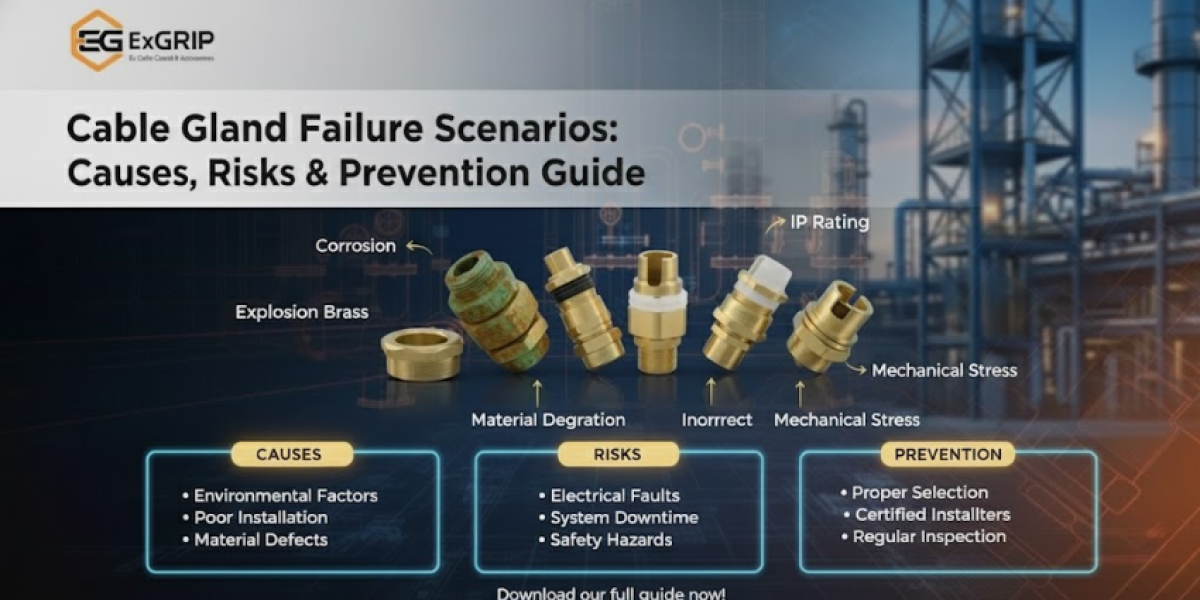
Cable glands are often treated as small components, but their failure can cause major industrial accidents, downtime, and safety risks. From water ingress and cable pull-out to loss of explosion protection, a failed cable gland compromises the entire electrical system.
In this blog, we explain what really happens when a cable gland fails, the most common industrial failure scenarios, and how correct cable gland sizing, compression cable gland selection, certified ATEX cable glands, Ex cable glands, and proper cable gland accessories help prevent such failures.
This guide is especially useful for electrical engineers, EPC contractors, plant managers, and safety officers working in industrial and hazardous areas.
Why Cable Gland Failure Is a Serious Industrial Risk?
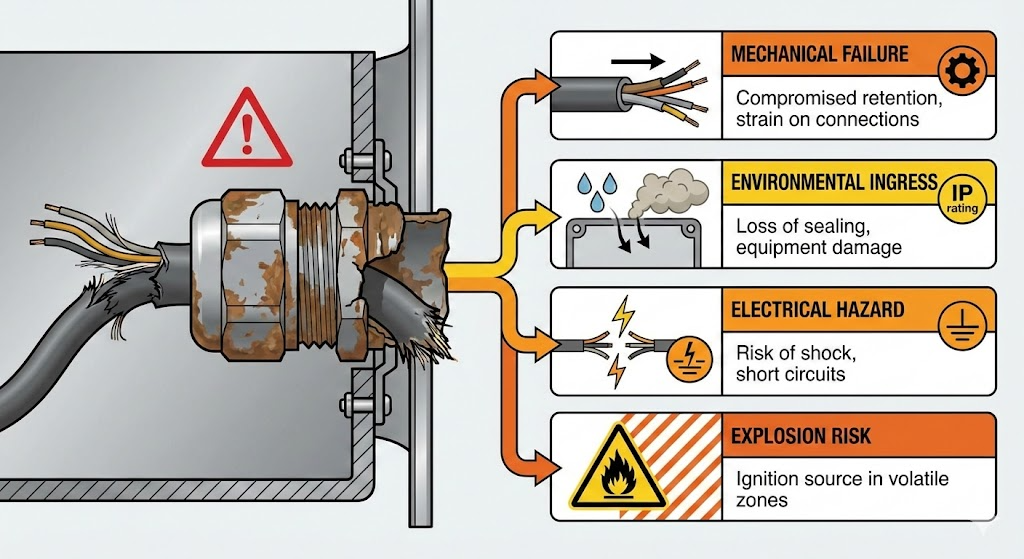
The image below shows how a failed cable gland can trigger multiple industrial risks, including mechanical failure, environmental ingress, electrical hazards, and explosion risk in hazardous zones.
Common Industrial Cable Gland Failure Scenarios
Cable gland failures rarely happen suddenly. In most industrial sites, they begin as small installation or selection mistakes that grow into serious operational and safety problems over time. Below are the most common real-world failure scenarios engineers encounter in the field.
Incorrect cable gland sizing is the most frequent and overlooked cause of gland failure in industrial installations.
-
The gland does not grip the cable firmly
-
Sealing rings fail to compress properly
-
Continuous vibration allows cable movement
-
The enclosure gradually loses its IP rating
-
Moisture and dust enter control panels
-
Cable insulation deteriorates faster
-
Short circuits and unexpected shutdowns occur
A compression cable gland depends on precise tightening to provide both sealing and mechanical retention. Too much or too little compression leads to failure.
-
Over-tightening damages sealing rings
-
Under-tightening allows cable pull-out
-
Using the wrong gland type for the cable construction
| Cable Type | Correct Gland Type | Risk If Wrong Gland Is Used |
|---|---|---|
| Unarmoured | Single compression | Poor sealing or cable movement |
| Armoured | Double compression | Loss of earthing and weak grip |
In many inspections, the gland itself is fine the problem lies with missing or incorrect cable gland accessories.
-
No sealing washer → water ingress
-
Wrong locknut → gland loosens over time
-
Missing earth tag → ineffective grounding
-
Sealing washers
-
Locknuts
-
Earth tags
-
Reducers and adapters
ATEX cable glands are specifically designed to prevent flame propagation and gas entry in explosive atmospheres. Failure here is critical.
-
Non-certified gland installed in ATEX zones
-
Incorrect cable outer diameter selection
-
Improper tightening torque during installation
-
Loss of explosion containment
-
ATEX certification becomes invalid
-
Serious safety, legal, and compliance issues
Even certified Ex cable glands cannot protect equipment if they are installed incorrectly.
-
Incorrect cable stripping length
-
Improper armour clamping
-
Wrong positioning of sealing components
-
Flame path integrity compromised
-
Gas ingress becomes possible
-
Equipment is no longer explosion-safe
Industries Where Cable Gland Failure Is Most Critical
Oil & Gas plants
Chemical & petrochemical industries
Power generation & substations
Pharmaceutical manufacturing
- Offshore and marine installations
Conclusion & Call-to-Action
Cable gland failure is not a minor issue it directly affects safety, compliance, and system reliability. Most failures are caused by incorrect cable gland sizing, wrong compression cable gland selection, missing cable gland accessories, or misuse of ATEX cable glands and Ex cable glands.
By using a proper cable and gland size chart, selecting the correct gland type, and following best installation practices, industrial failures can be completely avoided.
📩 Talk to our technical team today at Exgrip.com
📞 Or call us directly for quick assistance!
Contact Us:
📞 Phone: +91 9537118899
🌐 Website: www.exgrip.com
📩 Request a Quote: Contact Page
FAQs
What is the most common cause of cable gland failure?
Incorrect cable gland sizing is the most common cause, leading to poor sealing and mechanical instability.
Can wrong cable gland accessories cause failure?
Yes. Missing sealing washers, locknuts, or earth tags can cause leakage, loosening, and safety issues.
Why are ATEX cable glands important in hazardous areas?
ATEX cable glands prevent flame propagation and gas entry, ensuring explosion protection compliance.
Is a double compression cable gland better than single compression?
For armoured cables and outdoor or hazardous applications, double compression cable glands offer better sealing and mechanical strength.
How do I choose the correct gland size?
Always refer to a cable and gland size chart based on the actual cable outer diameter (OD).